. 2018 Jul 2;8(1):9961.
doi: 10.1038/s41598-018-28177-4.

Catalysis of amorpha-4,11-diene synthase unraveled and improved by mutability landscape guided engineering

Affiliations

Catalysis of amorpha-4,11-diene synthase unraveled and improved by mutability landscape guided engineering

Ingy I Abdallah et al. Sci Rep. .

Abstract

Amorpha-4,11-diene synthase (ADS) cyclizes the substrate farnesyl pyrophosphate to produce amorpha-4,11-diene as a major product. This is considered the first committed and rate-limiting step in the biosynthesis of the antimalarial artemisinin. Here, we utilize a reported 3D model of ADS to perform mutability landscape guided enzyme engineering. A mutant library of 258 variants along sixteen active site residues was created then screened for catalytic activity and product profile. This allowed for identification of the role of some of these residues in the mechanism. R262 constrains the released pyrophosphate group along with magnesium ions. The aromatic residues (W271, Y519 and F525) stabilize the intermediate carbocations while T296, G400, G439 and L515 help with the 1,6- and 1,10-ring closures. Finally, W271 is suggested to act as active site base along with T399, which ensures regioselective deprotonation. The mutability landscape also helped determine variants with improved catalytic activity. H448A showed ~4 fold increase in catalytic efficiency and the double mutation T399S/H448A improved kcat by 5 times. This variant can be used to enhance amorphadiene production and in turn artemisinin biosynthesis. Our findings provide the basis for the first step in improving industrial production of artemisinin and they open up possibilities for further engineering and understanding of ADS.


Conflict of interest statement

The authors declare no competing interests.

Figures
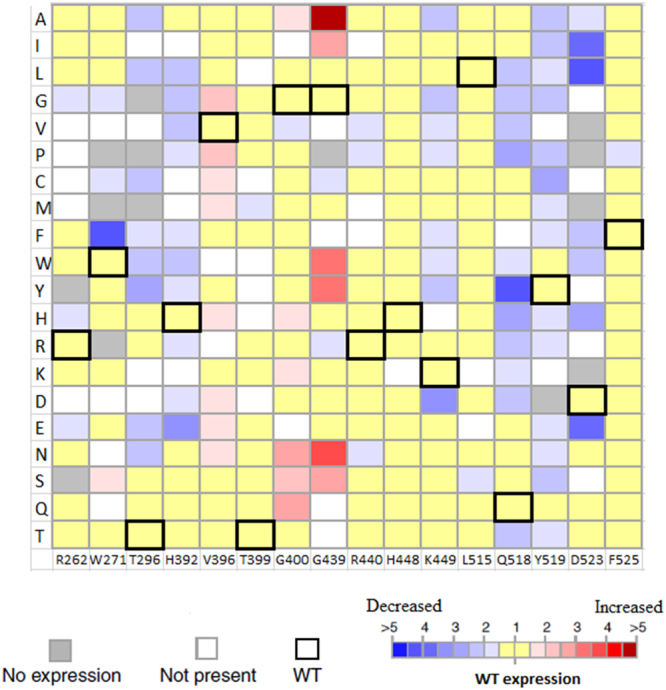
Figure 1
Figure 1
Mutability landscape of ADS for expression level using quantitative densitometric assay. For the mutability landscape, the vertical axis portrays the 20 possible amino acid residues. The wild-type amino acid residue at each position is indicated by bold squares, white squares represent variants that are not present in the library and grey squares represent variants that are not expressed. The color represents the concentration of expressed protein where blue range squares indicate decrease in expression while red range squares indicate increase in expression compared to the wild type.
Figure 2
Figure 2
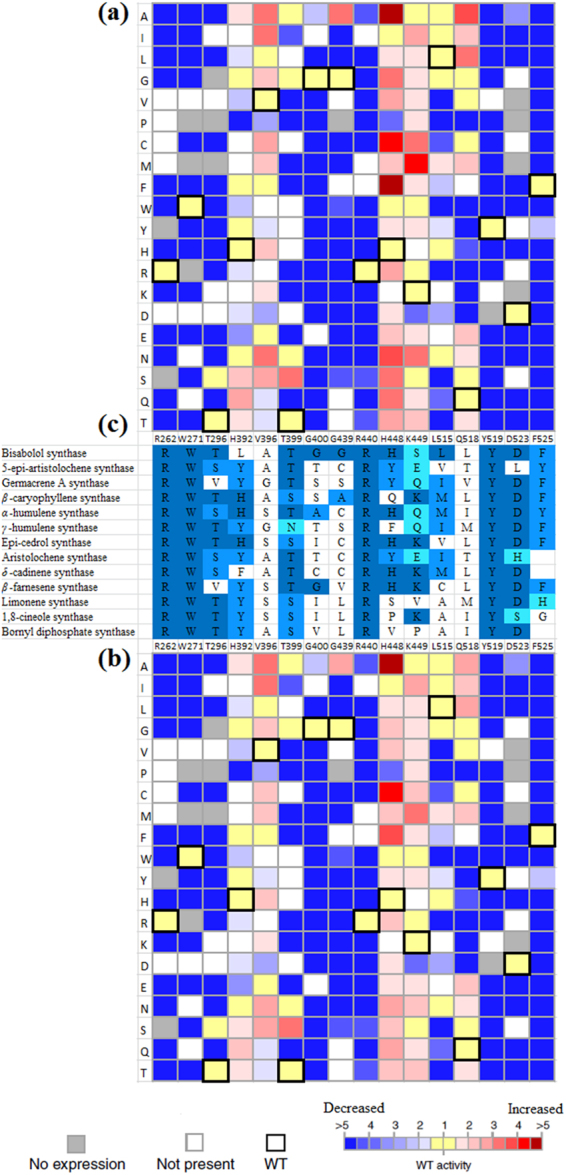
(a) Mutability landscape of ADS for catalytic activity using bioluminescent assay. (b) Mutability landscape of ADS for catalytic activity using GC-MS assay. For the mutability landscapes, the vertical axis portrays the 20 possible amino acid residues. The wild-type amino acid residue at each position is indicated by bold squares, white squares represent variants that are not present in the library and grey squares represent variants that are not expressed. The color represents the catalytic rate of reaction (V) where blue range squares indicate decrease in catalytic activity while red range squares indicate increase in catalytic activity compared to the wild type. The illustrated data are an average of two separate experiments (n = 2). (c) Multiple sequence alignment of the mutability landscape of ADS with ten sesquiterpene synthases and three monoterpene synthases. Residues that are identical, strongly similar, weakly similar and non-matching compared to ADS are colored dark blue, blue, cyan and white, respectively.
Figure 3
Figure 3
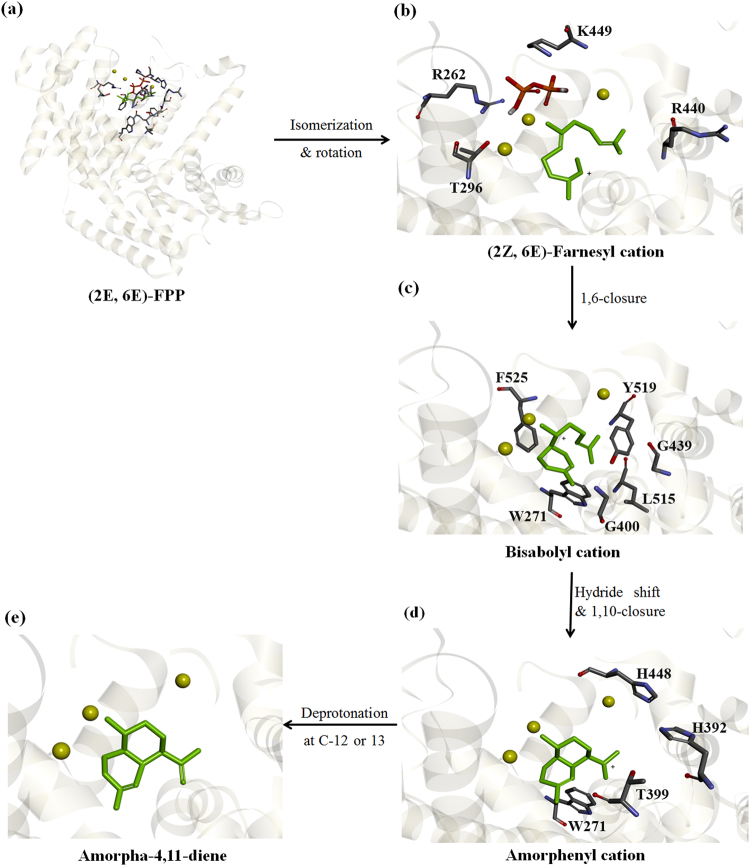
Proposed mechanism of ADS. (a) The substrate (2E, 6E)-FPP in the active site surrounded by the sixteen residues selected for mutation. (b) Following isomerization, the intermediate (2Z, 6E)-Farnesyl cation (green) and the released pyrophosphate (red) are in the active site. (c) 1,6-ring closure leads to the formation of the bisabolyl cation. (d) 1,10-ring closure produces the amorphenyl cation. (e) Deprotonation at C-12 or 13 creates the final product amorpha-4,11-diene.
Figure 4
Figure 4
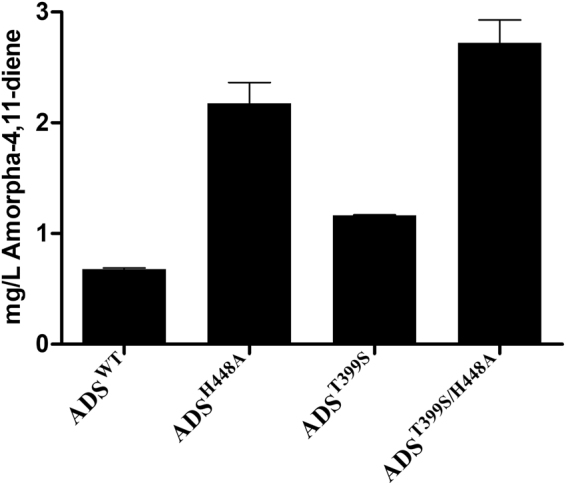
Comparison of in vivo production levels of amorpha-4,11-diene in E. coli due to expression of wild type ADS and variants H448A, T399S and T399S/H448A. The illustrated data are an average of two separate experiments (n = 2).

References

    1. White NJ, et al. Malaria. The Lancet. 2013;383:723–735. doi: 10.1016/S0140-6736(13)60024-0. - DOI - PubMed
    1. Martin VJ, Pitera DJ, Withers ST, Newman JD, Keasling JD. Engineering a mevalonate pathway in Escherichia coli for production of terpenoids. Nature Biotechnology. 2003;21:796–802. doi: 10.1038/nbt833. - DOI - PubMed
    1. Westfall PJ, et al. Production of amorphadiene in yeast, and its conversion to dihydroartemisinic acid, precursor to the antimalarial agent artemisinin. Proc Natl Acad Sci USA. 2012;109:E111–118. doi: 10.1073/pnas.1110740109. - DOI - PMC - PubMed
    1. Lindahl A-L, et al. Production of the Artemisinin Precursor Amorpha-4,11-diene by Engineered Saccharomyces cerevisiae. Biotechnology Letters. 2006;28:571–580. doi: 10.1007/s10529-006-0015-6. - DOI - PubMed
    1. Xie D-Y, Ma D-M, Judd R, Jones AL. Artemisinin biosynthesis in Artemisia annua and metabolic engineering: questions, challenges, and perspectives. Phytochemistry Reviews. 2016;15:1093–1114. doi: 10.1007/s11101-016-9480-2. - DOI

Publication types

MeSH terms