


His Bundle Pacing: A New Frontier in the Treatment of Heart Failure
- PMID: 29967682
- PMCID: PMC6020230
- DOI: 10.15420/aer.2018.6.2
His Bundle Pacing: A New Frontier in the Treatment of Heart Failure
Abstract
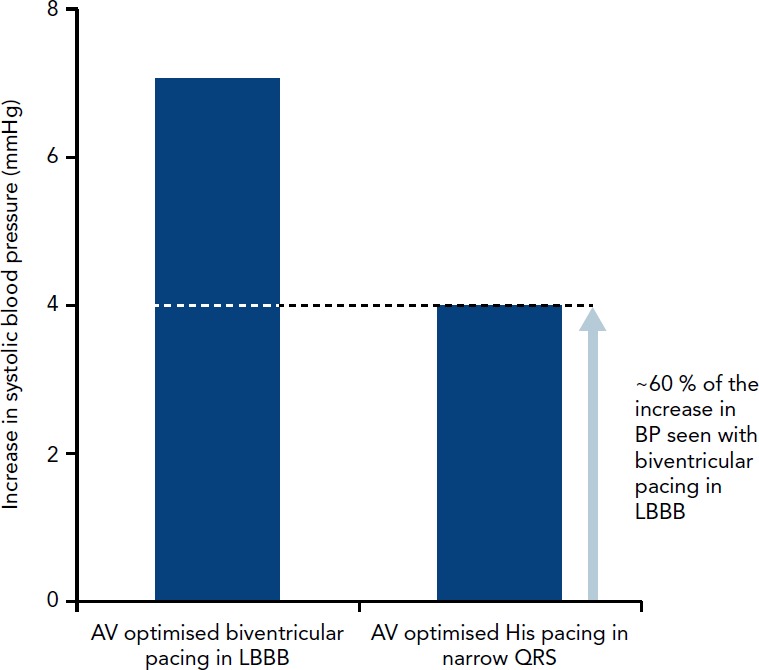
Biventricular pacing has revolutionised the treatment of heart failure in patients with sinus rhythm and left bundle branch block; however, left ventricular-lead placement is not always technically possible. Furthermore, biventricular pacing does not fully normalise ventricular activation and, therefore, the ventricular resynchronisation is imperfect. Right ventricular pacing for bradycardia may cause or worsen heart failure in some patients by causing dyssynchronous ventricular activation. His bundle pacing activates the ventricles via the native His-Purkinje system, resulting in true physiological pacing, and, therefore, is a promising alternate site for pacing in bradycardia and traditional CRT indications in cases where it can overcome left bundle branch block. Furthermore, it may open up new indications for pacing therapy in heart failure, such as targeting patients with PR prolongation, but a narrow QRS duration. In this article we explore the physiology, technology and potential roles of His bundle pacing in the prevention and treatment of heart failure.
Keywords: His bundle; atrial fibrillation; bradycardia pacing; heart failure; left bundle branch block reversal; pacing therapy.
Conflict of interest statement
Disclosure: The authors have no conflicts of interest to declare.
Figures
References
Publication types
Grants and funding
LinkOut - more resources
Full Text Sources
Other Literature Sources
Research Materials
