Review
. 2018 Jun 5:2018:6075403.
doi: 10.1155/2018/6075403. eCollection 2018.

Metabolic Reprogramming of Cancer Associated Fibroblasts: The Slavery of Stromal Fibroblasts

Affiliations
Review

Metabolic Reprogramming of Cancer Associated Fibroblasts: The Slavery of Stromal Fibroblasts

Angelica Avagliano et al. Biomed Res Int. .

Abstract

Cancer associated fibroblasts (CAFs) are the main stromal cell type of solid tumour microenvironment and undergo an activation process associated with secretion of growth factors, cytokines, and paracrine interactions. One of the important features of solid tumours is the metabolic reprogramming that leads to changes of bioenergetics and biosynthesis in both tumour cells and CAFs. In particular, CAFs follow the evolution of tumour disease and acquire a catabolic phenotype: in tumour tissues, cancer cells and tumour microenvironment form a network where the crosstalk between cancer cells and CAFs is associated with cell metabolic reprogramming that contributes to CAFs activation, cancer growth, and progression and evasion from cancer therapies. In this regard, the study of CAFs metabolic reprogramming could contribute to better understand their activation process, the interaction between stroma, and cancer cells and could offer innovative tools for the development of new therapeutic strategies able to eradicate the protumorigenic activity of CAFs. Therefore, this review focuses on CAFs metabolic reprogramming associated with both differentiation process and cancer and stromal cells crosstalk. Finally, therapeutic responses and potential anticancer strategies targeting CAFs metabolic reprogramming are reviewed.


Figures
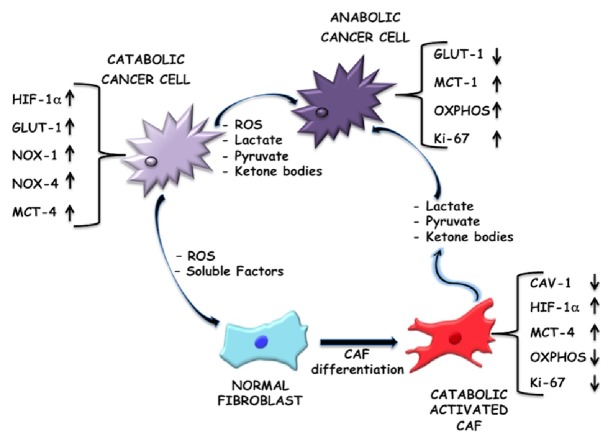
Figure 1
Figure 1
Metabolic reprogramming of tumour microenvironment, a three-compartment model. Tumour growth and progression are sustained by a metabolic interplay between catabolic tumour cells, normal fibroblasts, and catabolic activated CAFs that contribute to the anabolic reprogramming of cancer cells. This crosstalk is mediated by ROS, soluble factors, energy-rich fuels, and catabolite transporters, such as monocarboxylate transporter 1 (MCT-1), monocarboxylate transporter 4 (MCT-4), and glucose transporter protein (GLUT-1). In particular, mitochondrial dysfunction in catabolic cancer cells is associated with glycolysis switch (“Warburg effect”). These catabolic tumour cells show an increase of glucose uptake, upregulation of NOX-1 and NOX-4, and high level both of ROS and energy-rich fuels extrusion. The differentiation of normal fibroblasts into activated CAFs is ROS modulated. ROS, produced by catabolic cancer cells, upregulate HIF-1α whose levels are also increased by the loss of caveolin-1 (Cav-1). These events are involved in CAFs glycolytic switch. Hence, CAFs show a catabolic phenotype characterized by an inhibition of OXPHOS, a reduction of proliferation marker Ki-67, and release of energy-rich fuels. These molecules, represented by lactate, pyruvate, ketone bodies, etc., feed cancer cells that acquire an anabolic phenotype, where the high request of ATP is satisfied by an efficient mitochondrial OXPHOS.

References

    1. Warburg O., Wind F., Negelein E. The metabolism of tumors in the body. The Journal of General Physiology. 1927;8(6):519–530. doi: 10.1085/jgp.8.6.519. - DOI - PMC - PubMed
    1. Warburg O. On the origin of cancer cells. Science. 1956;123(3191):309–314. doi: 10.1126/science.123.3191.309. - DOI - PubMed
    1. Yoshida G. J. Metabolic reprogramming: the emerging concept and associated therapeutic strategies. Journal of Experimental & Clinical Cancer Research. 2015;34(111) - PMC - PubMed
    1. Gentric G., Mieulet V., Mechta-Grigoriou F. Heterogeneity in Cancer Metabolism: New Concepts in an Old Field. Antioxidants & Redox Signaling. 2017;26(9):462–485. doi: 10.1089/ars.2016.6750. - DOI - PMC - PubMed
    1. Xing Y., Zhao S., Zhou B. P., Mi J. Metabolic reprogramming of the tumour microenvironment. FEBS Journal. 2015;282(20):3892–3898. doi: 10.1111/febs.13402. - DOI - PubMed

LinkOut - more resources
