


A Comparison of Patient-Reported Outcomes After Nipple-Sparing Mastectomy and Conventional Mastectomy with Reconstruction
- PMID: 29968023
- PMCID: PMC6205203
- DOI: 10.1245/s10434-018-6585-4
A Comparison of Patient-Reported Outcomes After Nipple-Sparing Mastectomy and Conventional Mastectomy with Reconstruction
Abstract
Introduction: Nipple-sparing mastectomy (NSM) is increasingly used for breast cancer risk reduction and treatment. Prior small studies with variable control for baseline characteristics suggest superior satisfaction with NSM. The purpose of this study was to compare patient satisfaction following NSM and total mastectomy (TM) utilizing the BREAST-Q patient-reported outcome measure in a well-characterized patient population.
Methods: Patients at a single institution undergoing NSM or TM with immediate tissue expander/implant reconstruction who completed a follow-up BREAST-Q from 2007 to 2017 were identified by retrospective review of a prospective database. Baseline characteristics were compared, and linear mixed models were used to analyze associations with BREAST-Q scores over time.
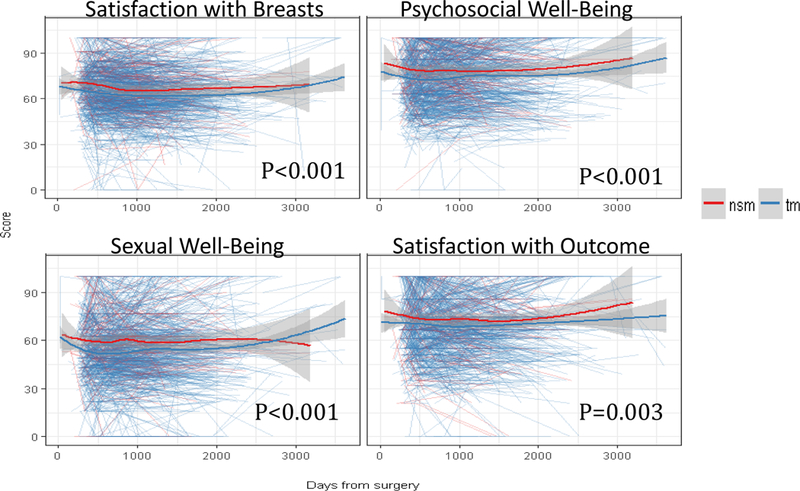
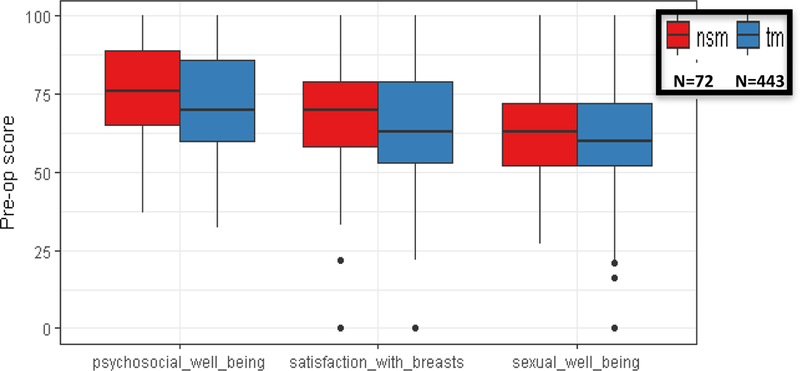
Results: Of 1866 eligible patients, 219 (12%) underwent NSM, and 1647 (88%) underwent TM. Median time from baseline to BREAST-Q was 658 days. Patients with NSM were younger, more likely to be white, and had lower BMI. They more often had prophylactic surgery, bilateral mastectomies, lower-stage disease, and less often received chemotherapy/radiation than patients with TM. On multivariable analysis, after controlling for relevant clinical variables, there was no difference in satisfaction with breasts or satisfaction with outcome overall between NSM and TM patients. Psychosocial well-being and sexual well-being were significantly higher in the NSM group. After additionally controlling for preoperative BREAST-Q score in a subset of patients (72 NSM; 443 TM), only psychosocial well-being remained significantly higher in NSM patients.
Conclusions: Patient-reported outcomes should be discussed with women weighing the risks and benefits of NSM to provide a better understanding of expected quality of life.
Conflict of interest statement
AUTHORS’ DISCLOSURE OF POTENTIAL CONFLICTS OF INTEREST
The preparation of this manuscript was funded in part by NIH/NCI Cancer Center Support Grant No. P30 CA 0087348 to Memorial Sloan Kettering Cancer Center, and this study has been accepted for presentation in podium format at the 19th Annual Meeting of the American Society of Breast Surgeons, May 2–6, 2018, Orlando, FL. Dr. Monica Morrow is a consultant for Genomic Health. Dr. Pusic is a co-developer of the BREAST-Q and receives royalties when the questionnaire is used in for-profit industry-sponsored clinical trials.
Figures
References
-
- Krajewski AC, Boughey JC, Degnim AC, Jakub JW, Jacobson SR, Hoskin TL, Hieken TJ. Expanded Indications and Improved Outcomes for Nipple-Sparing Mastectomy Over Time. Ann Surg Oncol 2015;22(10):3317–23. - PubMed
-
- Freeman BS. Complications of subcutaneous mastectomy with prosthetic replacement, immediate or delayed. South Med J 1967;60(12):1277–80. - PubMed
-
- Freeman BS. Subcutaneous mastectomy for benign breast lesions with immediate or delayed prosthetic replacement. Plast Reconstr Surg Transplant Bull 1962;30:676–82. - PubMed
-
- Freeman BS. Technique of subcutaneous mastectomy with replacement; immediate and delayed. Br J Plast Surg 1969;22(2):161–6. - PubMed
-
- Network NCC. NCCN Clinical Practice Guidelines in Oncology: Breast Cancer 2018.
Publication types
MeSH terms
Grants and funding
LinkOut - more resources
Full Text Sources
Other Literature Sources
Medical
