


Timing and Delays in Breast Cancer Evaluation and Treatment
- PMID: 29968031
- PMCID: PMC6123282
- DOI: 10.1245/s10434-018-6615-2
Timing and Delays in Breast Cancer Evaluation and Treatment
Abstract
Background: Even small delays in the treatment of breast cancer are a frequently expressed concern of patients. Knowledge about this subject is important for clinicians to counsel patients appropriately and realistically, while also optimizing care. Although data and quality measures regarding time to chemotherapy and radiotherapy have been present for some time, data regarding surgical care are more recent and no standard exists. This review was written to discuss our current knowledge about the relationship of treatment times to outcomes.
Methods: The published medical literature addressing delays and optimal times to treatment was reviewed in the context of our current time-dependent standards for chemotherapy and radiotherapy. The surgical literature and the lack of a time-dependent surgical standard also were discussed, suggesting a possible standard.
Results: Risk factors for delay are numerous, and tumor doubling times are both difficult to determine and unhelpful to assess the impact of longer treatment times on outcomes. Evaluation components also have a time cost and are inextricable from the patient's workup. Although the published literature has lack of uniformity, optimal times to each modality are strongly suggested by emerging data, supporting the current quality measures. Times to surgery, chemotherapy, and radiotherapy all have a measurable impact on outcomes, including disease-free survival, disease-specific survival, and overall survival.
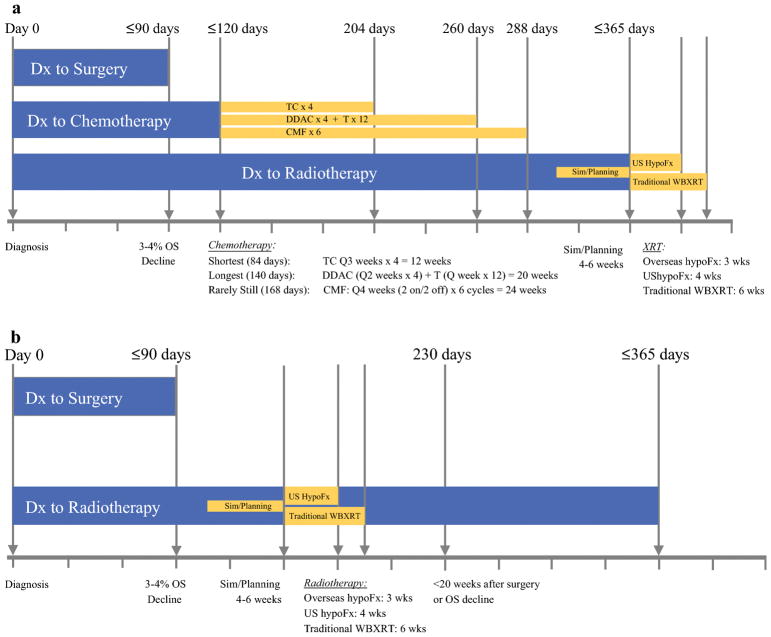
Conclusions: Delays have less of an impact than often thought but have a measurable impact on outcomes. Optimal times from diagnosis are < 90 days for surgery, < 120 days for chemotherapy, and, where chemotherapy is administered, < 365 days for radiotherapy.
Figures
References
-
- Jassem J, Ozmen V, Bacanu F, et al. Delays in diagnosis and treatment of breast cancer: a multinational analysis. Eur J Public Health. 2014 Oct;24(5):761–767. - PubMed
-
- Mitnick JS, Vazquez MF, Plesser KP, Roses DF. Breast cancer malpractice litigation in New York State. Radiology. 1993 Dec;189(3):673–676. - PubMed
-
- Zylstra S, D’Orsi CJ, Ricci BA, et al. Defense of breast cancer malpractice claims. The breast journal. 2001 Mar-Apr;7(2):76–90. - PubMed
Publication types
MeSH terms
Grants and funding
LinkOut - more resources
Full Text Sources
Other Literature Sources
Medical
