The Effects of Diet Alone or in Combination with Exercise in Patients with Prehypertension and Hypertension: a Randomized Controlled Trial
- PMID: 29968437
- PMCID: PMC6031728
- DOI: 10.4070/kcj.2017.0349
The Effects of Diet Alone or in Combination with Exercise in Patients with Prehypertension and Hypertension: a Randomized Controlled Trial
Abstract
Background and objectives: Supervised lifestyle interventions, including dietary and exercise programs, may be infeasible to implement in real-world settings. Therefore, this study aimed to evaluate the effectiveness of a home-based lifestyle modification intervention on blood pressure (BP) management.
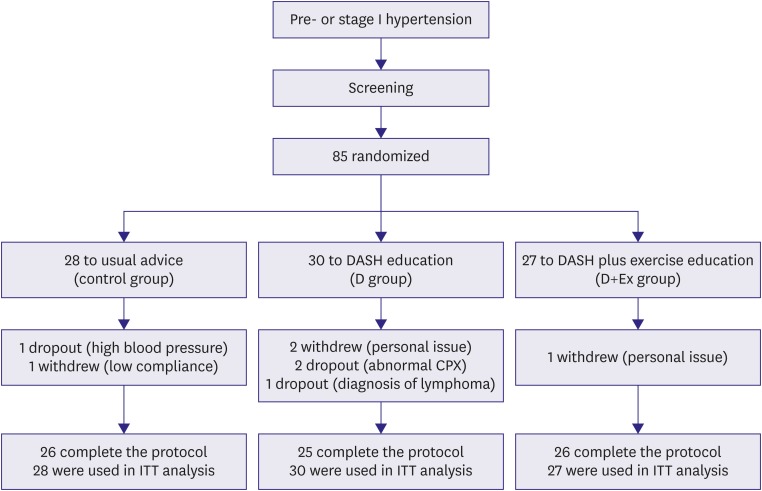
Methods: Eighty-five patients aged over 20 years and diagnosed with prehypertension or mild hypertension were randomly assigned to an advice-only comparison group (C group, n=28), a Dietary Approaches to Stop Hypertension (DASH) diet education group (D group, n=30), or a DASH and home-based exercise group (D+Ex group, n=27). The intervention lasted for 8 weeks. The primary outcome was the difference in office systolic blood pressure (SBP) before and after the study period (Trial registry at ClinicalTrials.gov, NCT01637909).
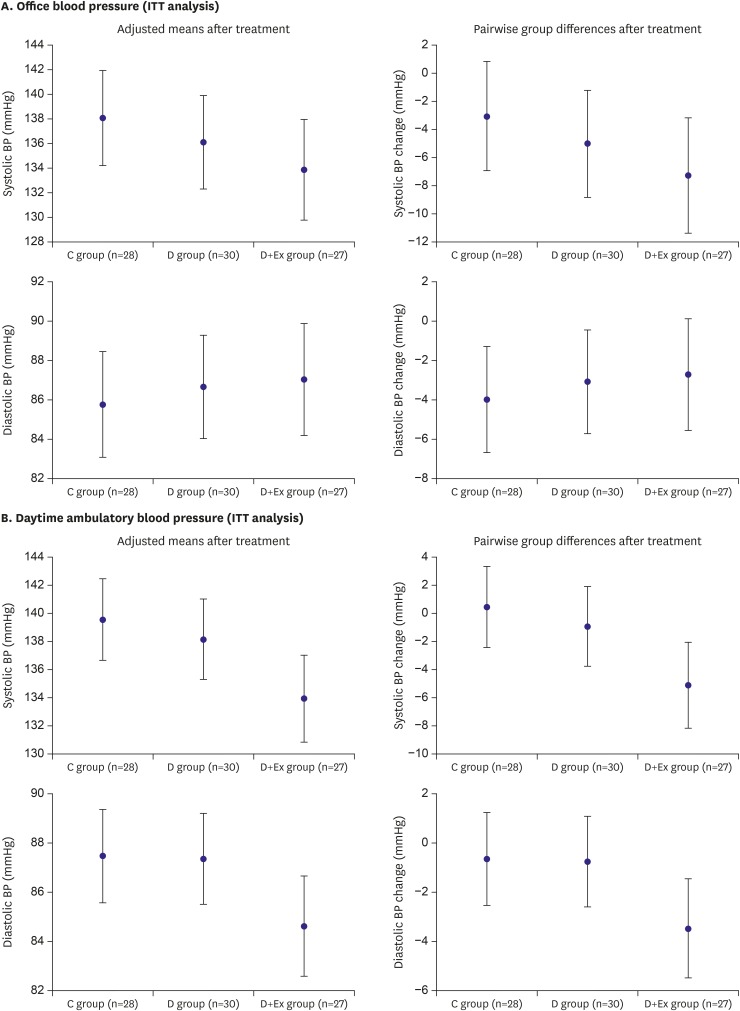
Results: Seventy-two participants (87.8%) completed the trial. The degree of change in office SBP did not significantly differ among the intervention groups; however, the D+Ex group demonstrated a tendency toward decreased SBP. Upon analysis of 24-hour ambulatory BP measurements, daytime ambulatory SBP was significantly lower in the D+Ex group (134 mmHg; 95% confidence interval [CI], 131 to 137; p=0.011) than in the C group (139.5 mmHg; 95% CI, 130.9 to 137), and daytime ambulatory SBP was significantly decreased in the D+Ex group (-5.2 mmHg; 95% CI, -8.3 to -2.1; p=0.011) compared to the C group (0.4 mmHg, 95% CI, -2.5 to 3.3).
Conclusions: In conclusion, lifestyle modification emphasizing both diet and exercise was effective for lowering BP and should be favored over diet-only modifications.
Keywords: Diet; Exercise; Hypertension; Lifestyle; Prehypertension.
Copyright © 2018. The Korean Society of Cardiology.
Conflict of interest statement
The authors have no financial conflicts of interest.
Figures
Comment in
-
Lifestyle Modification, the Effective but Neglected Strategy in Lowering Blood Pressure.Korean Circ J. 2018 Jul;48(7):652-654. doi: 10.4070/kcj.2018.0194. Korean Circ J. 2018. PMID: 29968438 Free PMC article. No abstract available.
References
-
- Weber MA, Schiffrin EL, White WB, et al. Clinical practice guidelines for the management of hypertension in the community a statement by the American Society of Hypertension and the International Society of Hypertension. J Hypertens. 2014;32:3–15. - PubMed
-
- Mancia G, Fagard R, Narkiewicz K, et al. 2013 ESH/ESC guidelines for the management of arterial hypertension: the Task Force for the Management of Arterial Hypertension of the European Society of Hypertension (ESH) and of the European Society of Cardiology (ESC) Eur Heart J. 2013;34:2159–2219. - PubMed
-
- Eckel RH, Jakicic JM, Ard JD, et al. 2013 AHA/ACC guideline on lifestyle management to reduce cardiovascular risk: a report of the American College of Cardiology/American Heart Association Task Force on Practice Guidelines. Circulation. 2014;129:S76–S99. - PubMed
-
- Whelton SP, Chin A, Xin X, He J. Effect of aerobic exercise on blood pressure: a meta-analysis of randomized, controlled trials. Ann Intern Med. 2002;136:493–503. - PubMed
-
- Friedberg JP, Rodriguez MA, Watsula ME, et al. Effectiveness of a tailored behavioral intervention to improve hypertension control: primary outcomes of a randomized controlled trial. Hypertension. 2015;65:440–446. - PubMed
Associated data
LinkOut - more resources
Full Text Sources
Other Literature Sources
Medical