


Group Cognitive Behavioral Therapy and Attention Bias Modification for Childhood Anxiety Disorders: A Factorial Randomized Trial of Efficacy
- PMID: 29969293
- PMCID: PMC6421990
- DOI: 10.1089/cap.2018.0022
Group Cognitive Behavioral Therapy and Attention Bias Modification for Childhood Anxiety Disorders: A Factorial Randomized Trial of Efficacy
Abstract
Background: The objective of this study is to assess group differences in symptom reduction between individuals receiving group cognitive behavioral therapy (G-CBT) and attention bias modification (ABM) compared to their respective control interventions, control therapy (CT), and attention control training (ACT), in a 2 × 2 factorial design.
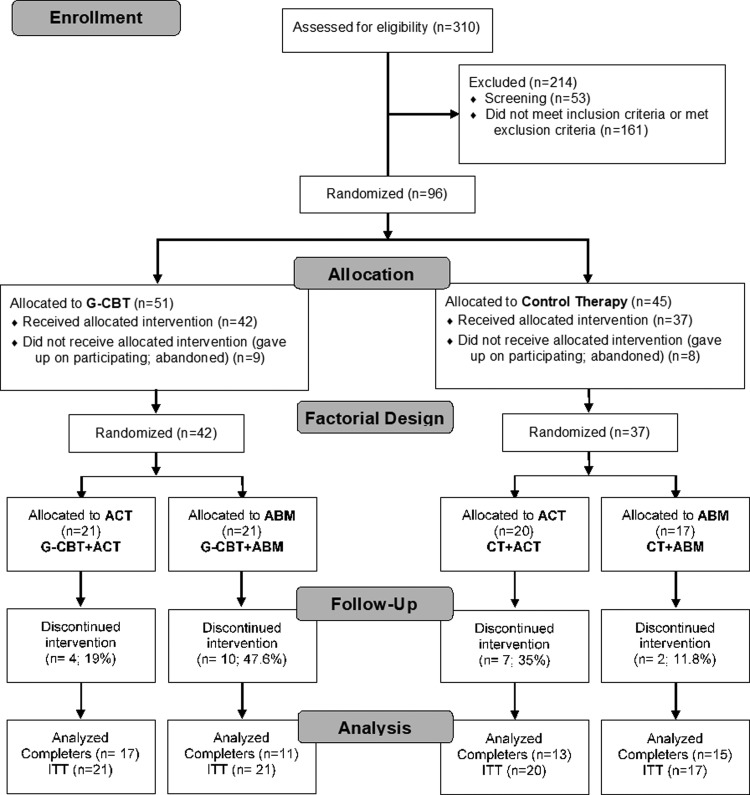
Methods: A total of 310 treatment-naive children (7-11 years of age) were assessed for eligibility and 79 children with generalized, separation or social anxiety disorder were randomized and received G-CBT (n = 42) or CT (n = 37). Within each psychotherapy group, participants were again randomized to ABM (n = 38) or ACT (n = 41) in a 2 × 2 factorial design resulting in four groups: G-CBT + ABM (n = 21), G-CBT + ACT (n = 21), CT + ABM (n = 17), and CT + ACT (n = 20). Primary outcomes were responder designation as defined by Clinical Global Impression-Improvement (CGI-I) scale (≤2) and change on the Pediatric Anxiety Rating Scale (PARS).
Results: There were significant improvements of symptoms in all groups. No differences in response rates or mean differences in PARS scores were found among groups: G-CBT + ABM group (23.8% response; 3.9 points, 95% confidence interval [CI] -0.3 to 8.1), G-CBT + ACT (42.9% response; 5.6 points, 95% CI 2.2-9.0), CT + ABM (47.1% response; 4.8 points 95% CI 1.08-8.57), and CT + ACT (30% response; 0.8 points, 95% CI -3.0 to 4.7). No evidence or synergic or antagonistic effects were found, but the combination of G-CBT and ABM was found to increase dropout rate.
Conclusions: We found no effect of G-CBT or ABM beyond the effects of comparison groups. Results reveal no benefit from combining G-CBT and ABM for anxiety disorders in children and suggest potential deleterious effects of the combination on treatment acceptability.
Keywords: attention bias modification treatment; attention retraining; attention training; cognitive behavioral therapy; factorial; phobias.
Conflict of interest statement
No competing financial interests exist.
Figures
References
-
- Abend R, Pine D, Fox NA, Bar-Haim Y: Learning and memory consolidation processes of attention-bias modification in anxious and nonanxious individuals. Clin Psychol Sci 2:620–627, 2014
-
- Bar-Haim Y: Research review: Attention bias modification (ABM): A novel treatment for anxiety disorders. J Child Psychol Psychiatry 51:859–870, 2010 - PubMed
-
- Bar-Haim Y, Abend R, Pine D: Tel-Aviv University/National Institute of Mental Health Attention Bias Modification Treatment. 2010. http://people.socsci.tau.ac.il/mu/anxietytrauma/files/2013/08/TAU-NIMH-A... (Accessed June26, 2018)
-
- Bar-Haim Y, Lamy D, Pergamin L, Bakermans-Kranenburg MJ, van IMH: Threat-related attentional bias in anxious and nonanxious individuals: A meta-analytic study. Psychol Bull 133:1–24, 2007 - PubMed
-
- Bar-Haim Y, Morag I, Glickman S: Training anxious children to disengage attention from threat: A randomized controlled trial. J Child Psychol Psychiatry 52:861–869, 2011 - PubMed
Publication types
MeSH terms
LinkOut - more resources
Full Text Sources
Other Literature Sources
Medical
Miscellaneous
