


Effectiveness of a comprehensive interactive eHealth intervention on patient-reported and clinical outcomes in patients with an implantable cardioverter defibrillator [ACQUIRE-ICD trial]: study protocol of a national Danish randomised controlled trial
- PMID: 29969990
- PMCID: PMC6029360
- DOI: 10.1186/s12872-018-0872-7
Effectiveness of a comprehensive interactive eHealth intervention on patient-reported and clinical outcomes in patients with an implantable cardioverter defibrillator [ACQUIRE-ICD trial]: study protocol of a national Danish randomised controlled trial
Abstract
Background: In Denmark and other countries, there has been a shift in the management of patients with an implantable cardioverter defibrillator (ICD) with remote device monitoring largely replacing in-hospital visits. Less patient-nurse and patient-physician interaction may lead to gaps in patients' quality of care and impede patients' adaptation to living successfully with the ICD. A comprehensive eHealth intervention that include goal-setting, monitoring of symptoms of depression, anxiety, and quality of life, psychological treatment, information provision, supportive tools, online dialogues with nursing staff and access to an online community network, may help fill these gaps and be particularly beneficial to patients who suffer from anxiety and depression. This study will evaluate the effectiveness of the ACQUIRE-ICD care innovation, a comprehensive and interactive eHealth intervention, on patient-reported and clinical outcomes.
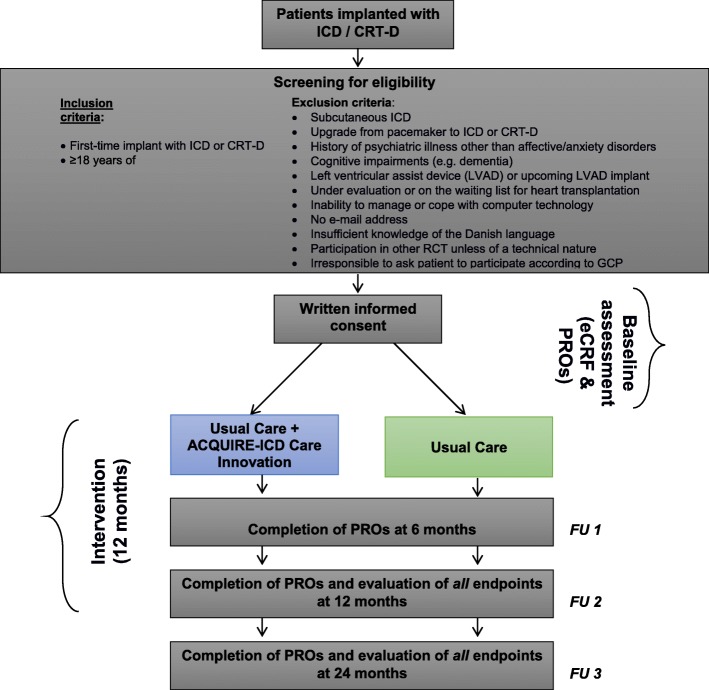
Methods: The ACQUIRE-ICD study is a multicenter, prospective, two-arm, unblinded randomised controlled superiority trial that will enroll 478 patients implanted with a first-time ICD or ICD with cardiac synchronisation therapy (CRT-D) from the six implanting centers in Denmark. The trial will evaluate the clinical effectiveness and cost-effectiveness of the ACQUIRE-ICD care innovation, as add-on to usual care compared with usual care alone. The primary endpoint, device acceptance, assessed with the Florida Patient Acceptance Survey, is evaluated at 12 months' post implant. Secondary endpoints, evaluated at 12 and 24 months' post implant, include patient-reported outcomes, return to work, time to first ICD therapy and first hospitalisation, mortality and cost-effectiveness.
Discussion: The effectiveness of a comprehensive and interactive eHealth intervention that relies on patient-centred and personalised tools offered via a web-based platform targeted to patients with an ICD has not been assessed so far. The ACQUIRE-ICD care innovation promotes and facilitates that patients become active participants in the management of their disease, and as such addresses the need for a more patient-centered disease-management approach. If the care innovation proves to be beneficial to patients, it may not only increase patient empowerment and quality of life but also free up time for clinicians to care for more patients.
Trial registration: The trial has been registered on https://clinicaltrials.gov/ct2/show/NCT02976961 on November 30, 2016 with registration number [ NCT02976961 ].
Keywords: Anxiety; Depression; Device acceptance; Heart disease; Implantable cardioverter defibrillator; Patient-centered tools; Quality of life; eHealth intervention.
Conflict of interest statement
Ethics approval and consent to participate
Every patient will receive written and oral information about the study and sign an informed consent form prior to enrollment. The study protocol was submitted to the Regional Committees on Health Research Ethics for Southern Denmark, who indicated that according to Danish law about ethics related to health research (§ 14, 1), ethical committee approval is not required (VEK #S-20160063, June 13, 2016).
Consent for publication
Not applicable.
Competing interests
The authors declare that they have no competing interests, except CJB who owns shares in Liva Healhcare AS, the company that has developed parts of the technical platform, LIVA, used in the study.
Publisher’s Note
Springer Nature remains neutral with regard to jurisdictional claims in published maps and institutional affiliations.
Figures
References
-
- Priori SG, Blomstrom-Lundqvist C, Mazzanti A, et al. 2015 ESC guidelines for the management of patients with ventricular arrhythmias and the prevention of sudden cardiac death: The Task Force for the Management of Patients with Ventricular Arrhythmias and the Prevention of Sudden Cardiac Death of the European Society of Cardiology (ESC) Endorsed by: Association for European Paediatric and Congenital Cardiology (AEPC) Eur Heart J. 2015;36:2793–2867. doi: 10.1093/eurheartj/ehv316. - DOI - PubMed
-
- Siddiqui WJ, Aggarwal S, Rafique M, Singh S, Kutalek S, Eisen HJ. Prophylactic use of the implantable cardioverter-defibrillator and its effect on the long-term survival, cardiovascular and sudden cardiac death in nonischemic cardiomyopathy patients-a systematic review and meta-analysis. Heart Fail Rev. 2018;23(2):181–190. doi: 10.1007/s10741-018-9671-6. - DOI - PubMed
-
- Raatikainen MJP, Arnar DO, Merkely B, et al. A decade of information on the use of cardiac implantable electronic devices and interventional electrophysiological procedures in the European Society of Cardiology Countries: 2017 report from the European heart rhythm association. Europace. 2017;19:ii1–ii90. doi: 10.1093/europace/eux258. - DOI - PubMed
Publication types
MeSH terms
Associated data
LinkOut - more resources
Full Text Sources
Other Literature Sources
Medical
Research Materials
