


Screening for vitamin D deficiency in a tropical area: results of a sun exposure questionnaire
- PMID: 29970080
- PMCID: PMC6029128
- DOI: 10.1186/s12902-018-0272-0
Screening for vitamin D deficiency in a tropical area: results of a sun exposure questionnaire
Abstract
Background: Vitamin D deficiency is pandemic while resources available to measure 25-hydroxyvitamin D (25OHD) are limited. The present study aimed to verify whether sun exposure measured by a structured questionnaire could predict serum 25OHD concentrations in healthy Caucasian individuals living in a tropical area.
Methods: A cross-sectional study was carried out in subjects living in the greater São Paulo area, Brazil. Two groups of 50 young (20 to 40 years old) and 50 older (60 to 80 years old) subjects (N = 200) answered a structured questionnaire on sun exposure and had blood samples drawn for serum 25OHD concentration measurement during both summer and winter. Anthropometric data were also recorded. Correlation between the questionnaire variables (duration of sun exposure, amount of exposed skin, total sun exposure score - TSES and other data) and serum 25OHD concentration was evaluated.
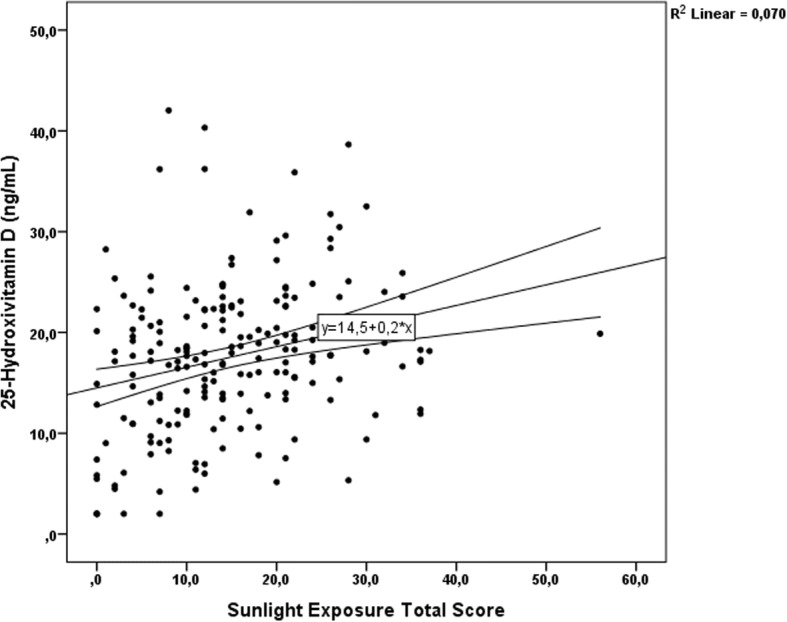
Results: Mean serum 25OHD concentration was 17.60 ± 7.3 ng/mL with no difference between age groups (p = 0.293). TSES weakly correlated with serum 25OHD levels (r = 0.264; p < 0.001). Separate analyzes by age groups demonstrated that TSES correlated significantly with serum 25OHD concentration only in the older subjects during summer (r = 0.322; p = 0.023). Using linear regression analyses, TSES and body mass index (BMI) were significantly associated with serum 25OHD levels. On the other hand, Receiver operating characteristic (ROC) analysis for TSES showed no significance as a screening tool for vitamin D deficiency (p = 0.172).
Conclusion: Sun exposure questionnaire associated with BMI correlates with serum 25OHD concentration with very low accuracy. The use of the questionnaire does not discriminate between vitamin D sufficient and deficient individuals.
Keywords: And elderly; Questionnaire; Summer; Sun exposure; Vitamin D; Winter; Young.
Conflict of interest statement
Ethics approval and consent to participate
Participants in this study were volunteers and gave written informed consent before entering the study. UNIFESP/EPM’s Ethics and Research Committee approved the present study (reference number 464.939).
Consent for publication
Not applicable.
Competing interests
The authors declare that they have no competing interests.
Publisher’s Note
Springer Nature remains neutral with regard to jurisdictional claims in published maps and institutional affiliations.
Figures
References
-
- Brouwer-Brolsma EM, Bischoff-Ferrari HA, Bouillon R, Feskens EJ, Gallagher CJ, Hypponen E, Llewellyn DJ, Stoecklin E, Dierkes J, Kies AK, et al. Vitamin D: do we get enough? A discussion between vitamin D experts in order to make a step towards the harmonisation of dietary reference intakes for vitamin D across Europe. Osteoporos Int. 2013;24(5):1567–1577. doi: 10.1007/s00198-012-2231-3. - DOI - PubMed
MeSH terms
Substances
LinkOut - more resources
Full Text Sources
Other Literature Sources
Medical
