


How can the risk of ovarian retorsion be reduced?
- PMID: 29970160
- PMCID: PMC6031141
- DOI: 10.1186/s13256-018-1677-0
How can the risk of ovarian retorsion be reduced?
Abstract
Background: In the current treatment of idiopathic ovarian torsion, the use of oophorectomy has declined in favor of preserving the ovary. This approach brings with it the question of how to reduce the possibility of retorsion of the detorsioned ovary. The aim of this study was to analyze how retorsion can be prevented.
Methods: Five patients (a 30-day-old Caucasian girl, a 55-day-old Caucasian girl, an 8-year-old Caucasian girl, a 10-year-old Caucasian girl, and a 16-year-old Caucasian girl) who underwent surgery due to non-neoplastic ovarian torsion were retrospectively analyzed for diagnosis and treatment in terms of reducing the possibility of retorsion.
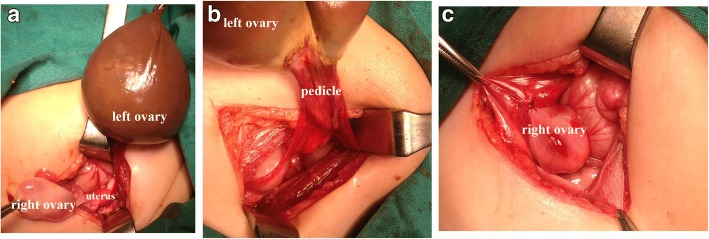
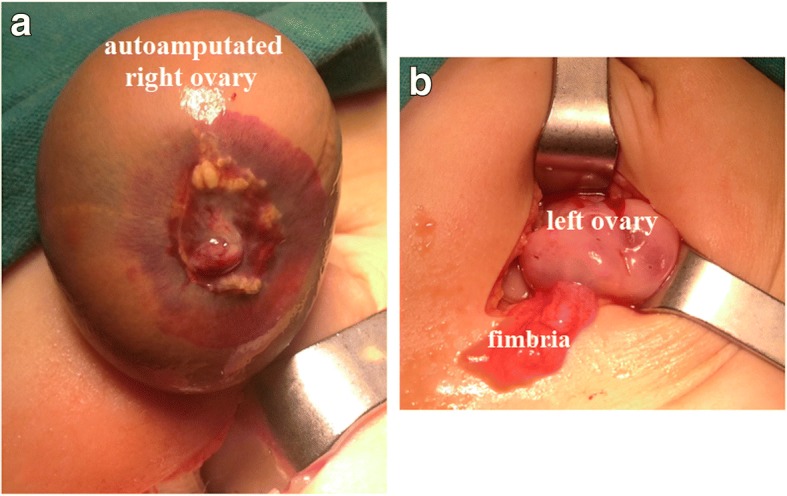
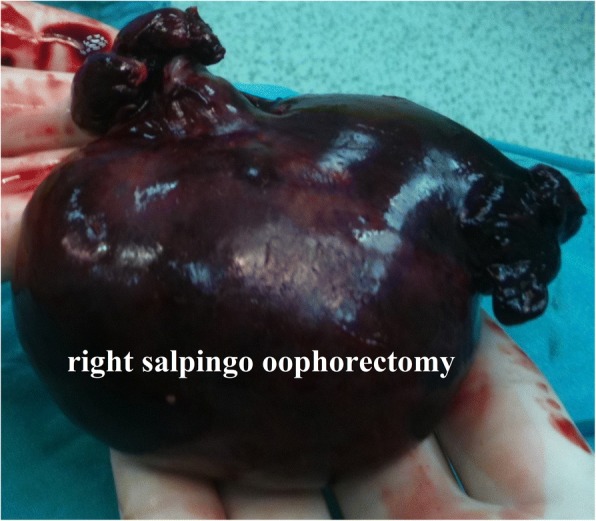
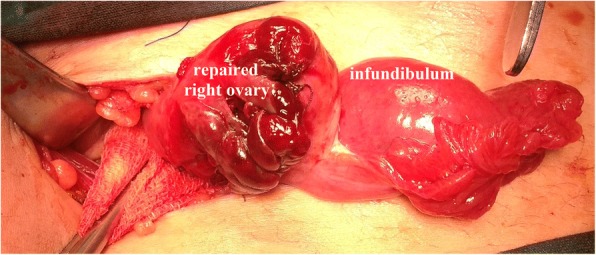
Results: In all patients, a precise diagnosis of idiopathic unilateral ovarian torsion was made during laparotomy, and the patients underwent different procedures. The ovary was found to be autoamputated in one patient, and two patients underwent salpingo-oophorectomies due to adnexal necrosis. The ovaries were detorsioned in the remaining two patients. During the operations, patients were evaluated regarding the prevention of retorsion of the ipsilateral and/or contralateral ovary; cyst drainage, cystectomy, ligament fixation, and/or oophoropexy were performed. The median follow-up period of the patients was 2 years (range 1.5-6 years), and they continue to be followed uneventfully.
Conclusions: To date, there is no standard approach to protect the ovary from retorsion in patients who undergo surgery due to torsion. The surgical procedure should be tailored on a case-by-case basis.
Keywords: Child; Detorsion; Oophorectomy; Oophoropexy; Ovarian torsion; Retorsion.
Conflict of interest statement
Ethics approval and consent to participate
This study is retrospective. Written and verbal informed consent was obtained from the patients’ legal guardians.
Consent for publication
Written informed consent was obtained from the patients’ legal guardians for the publication of these case reports and any accompanying images. A copy of this written consent is available for review by the Editor-in-Chief of this journal.
Competing interests
The author declares that she has no competing interests.
Publisher’s Note
Springer Nature remains neutral with regard to jurisdictional claims in published maps and institutional affiliations.
Figures

References
MeSH terms
LinkOut - more resources
Full Text Sources
Other Literature Sources
Medical
