


Internet-delivered cognitive behavioural therapy for young children with obsessive-compulsive disorder: development and initial evaluation of the BIP OCD Junior programme
- PMID: 29971153
- PMCID: PMC6020306
- DOI: 10.1192/bjo.2018.10
Internet-delivered cognitive behavioural therapy for young children with obsessive-compulsive disorder: development and initial evaluation of the BIP OCD Junior programme
Abstract
Background: Internet-delivered cognitive behavioural therapy (ICBT) is a promising approach for increasing access to evidence-based treatments.
Aims: To develop and evaluate the feasibility and preliminary efficacy of an ICBT programme for young children with obsessive-compulsive disorder (OCD), named BIP OCD Junior.
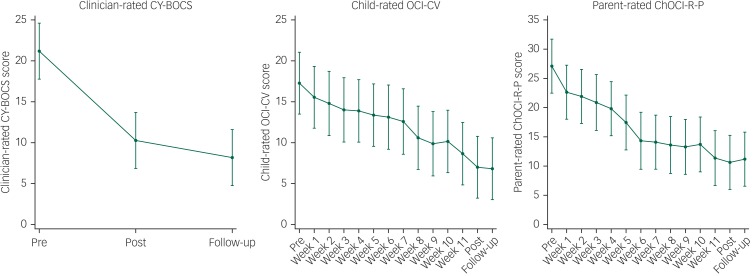
Method: Eleven children aged 7-11 years were enrolled in a 12-week open trial of parent- and therapist-guided ICBT for OCD. The primary outcome measure was the Children's Yale-Brown Obsessive-Compulsive Scale (CY-BOCS).
Results: There was a significant improvement in OCD symptoms post-treatment, with a large within-group effect size on the CY-BOCS (Cohen's d = 1.86, 95% CI 0.83 to 2.86). Results were maintained at 3-month follow-up. Both children and parents rated the treatment as credible and were highly satisfied with the intervention.
Conclusions: BIP OCD Junior is a feasible and credible treatment option for young children with OCD. Randomised controlled trials are needed to further establish its efficacy and cost-effectiveness relative to gold standard face-to-face CBT.
Declaration of interest: None.
Keywords: Cognitive behavioural therapy; child; early onset; internet-delivered therapy; obsessive-compulsive disorder.
Figures

References
-
- American Psychiatric Association. Diagnostic and Statistical Manual of Mental Disorders: DSM-5. APA, 2013.
-
- Piacentini J, Bergman RL, Keller M, McCracken J. Functional impairment in children and adolescents with obsessive-compulsive disorder. J Child Adolesc Psychopharmacol 2003; 13: 61–9. - PubMed
-
- Taylor S. Early versus late onset obsessive–compulsive disorder: evidence for distinct subtypes. Clin Psychol Rev 2011; 31: 1083–100. - PubMed
LinkOut - more resources
Full Text Sources
Other Literature Sources
