A Multicenter Study of Patient-Reported Infectious and Noninfectious Complications Associated With Indwelling Urethral Catheters
- PMID: 29971436
- PMCID: PMC6143107
- DOI: 10.1001/jamainternmed.2018.2417
A Multicenter Study of Patient-Reported Infectious and Noninfectious Complications Associated With Indwelling Urethral Catheters
Abstract
Importance: Indwelling urethral catheters (ie, Foley catheters) are important in caring for certain hospitalized patients but can also cause complications in patients.
Objective: To determine the incidence of infectious and noninfectious patient-reported complications associated with the indwelling urethral catheter.
Design, setting, and participants: A prospective cohort study of consecutive patients with placement of a new indwelling urethral catheter while hospitalized at 1 of 4 US hospitals in 2 states. The study was conducted from August 26, 2015, to August 18, 2017. Participants were evaluated at baseline and contacted at 14 days and 30 days after insertion of the catheter about complications associated with the indwelling urethral catheter and how catheterization affected their social activities or activities of daily living.
Exposures: Indwelling urethral catheter placement during hospitalization. Patients were enrolled within 3 days of catheter insertion and followed up for 30 days after catheter placement, whether the catheter remained in or was removed from the patient.
Main outcomes and measures: Infectious and noninfectious complications associated with an indwelling urethral catheter as well as how the catheter affected patient social activities or activities of daily living.
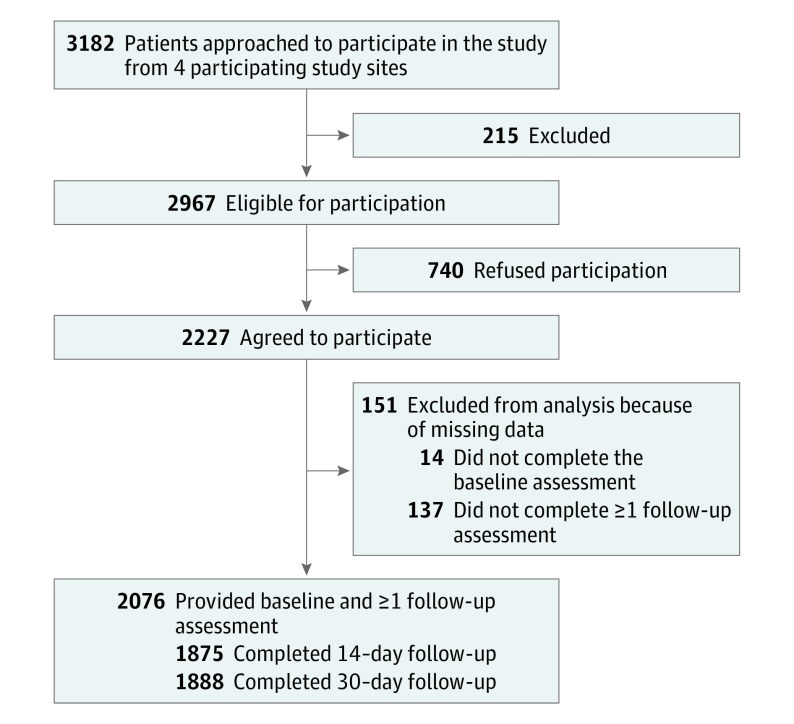
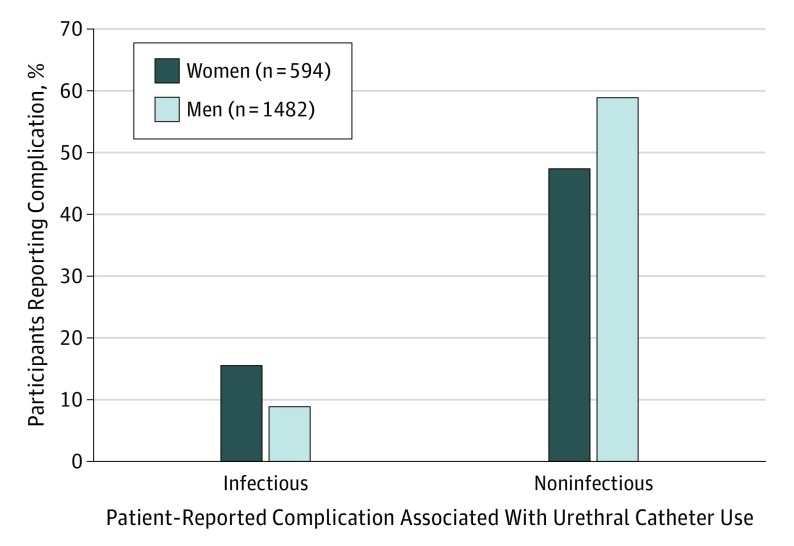
Results: Of 2967 eligible patients, 2227 (75.1%) agreed to participate at 1 of 4 study sites; 2076 total patients were evaluated. Of these, 71.4% were male; mean (SD) age was 60.8 (13.4) years. Most patients (1653 of 2076 [79.6%]) had short-term catheters placed for surgical procedures. During the 30 days after urethral catheter insertion, 1184 of 2076 patients (57.0%; 95% CI, 54.9%-59.2%) reported at least 1 complication due to the indwelling urethral catheter. Infectious complications were reported by 219 of 2076 patients (10.5%; 95% CI, 9.3%-12.0%), whereas noninfectious complications (eg, pain or discomfort, blood in the urine, or sense of urinary urgency) occurred in 1150 patients (55.4%; 95% CI, 53.2%-57.6%) (P < .001). Women were more likely to report an infectious complication (92 of 594 [15.5%] women vs 127 of 1482 [8.6%] men; P < .001), while men were more likely to report a noninfectious complication (869 of 1482 [58.6%] men vs 281 of 594 [47.3%] women; P < .001). Restrictions in activities of daily living (49 of 124 patients [39.5%]) or social activity (54 of 124 [43.9%]) were commonly reported by the patients who had catheters still in place; sexual problems were reported by 99 of 2034 patients (4.9%) after their catheter was removed.
Conclusions and relevance: Noninfectious complications of urethral catheters affect a substantial number of patients, underscoring the importance of avoiding urethral catheterization whenever possible. Given the high incidence of these patient-reported complications, urethral catheter-associated noninfectious complications should be a focus of surveillance and prevention efforts.
Conflict of interest statement
Figures
References
-
- Elder M. US catheter market In: Global Markets for Catheters. Wellesley, MA: BCC Research; 2016:91-96.
-
- Magill SS, Edwards JR, Bamberg W, et al. ; Emerging Infections Program Healthcare-Associated Infections and Antimicrobial Use Prevalence Survey Team . Multistate point-prevalence survey of health care–associated infections. N Engl J Med. 2014;370(13):1198-1208. doi: 10.1056/NEJMoa1306801 - DOI - PMC - PubMed
-
- World Health Organization Report on the Burden of Endemic Health Care–Associated Infection Worldwide: A Systematic Review of the Literature. Geneva, Switzerland: World Health Organization; 2011.
Publication types
MeSH terms
LinkOut - more resources
Full Text Sources
Other Literature Sources
Medical