


Validation of fitness tracker for sleep measures in women with asthma
- PMID: 29972657
- PMCID: PMC6522318
- DOI: 10.1080/02770903.2018.1490753
Validation of fitness tracker for sleep measures in women with asthma
Abstract
Objective: Nighttime wakening with asthma symptoms is a key to assessment and therapy decisions, with no gold standard objective measure. The study aims were to (1) determine the feasibility, (2) explore equivalence, and (3) test concordance of a consumer-based accelerometer with standard actigraphy for measurement of sleep patterns in women with asthma as an adjunct to self-report.
Methods: Panel study design of women with poorly controlled asthma from a university-affiliated primary care clinic system was used. We assessed sensitivity and specificity, equivalence and concordance of sleep time, sleep efficiency, and wake counts between the consumer-based accelerometer Fitbit Charge™ and Actigraph wGT3X+. We linked data between devices for comparison both automatically by 24-hour period and manually by sleep segment.
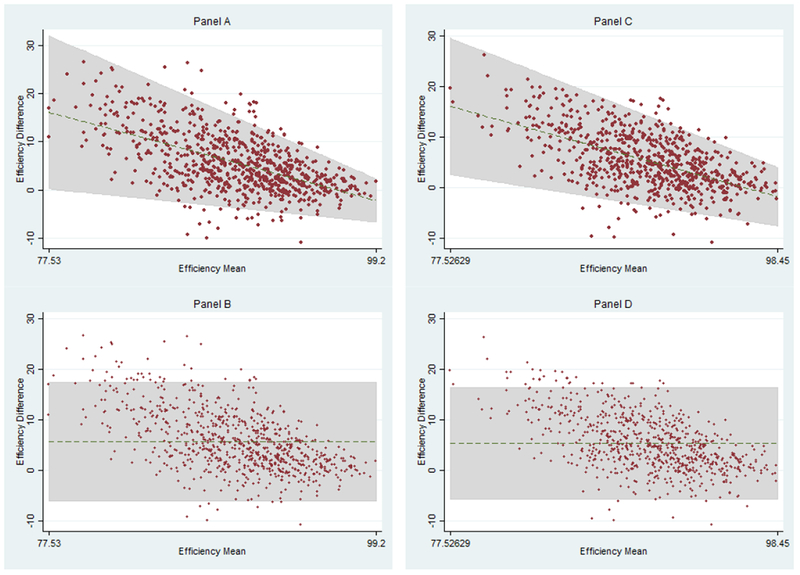
Results: Analysis included 424 938 minutes, 738 nights, and 833 unique sleep segments from 47 women. The fitness tracker demonstrated 97% sensitivity and 40% specificity to identify sleep. Between device equivalence for total sleep time (15 and 42-minute threshold) was demonstrated by sleep segment. Concordance improved for wake counts and sleep efficiency when adjusting for a linear trend.
Conclusions: There were important differences in total sleep time, efficiency, and wake count measures when comparing individual sleep segments versus 24-hour measures of sleep. Fitbit overestimates sleep efficiency and underestimates wake counts in this population compared to actigraphy. Low levels of systematic bias indicate the potential for raw measurements from the devices to achieve equivalence and concordance with additional processing, algorithm modification, and modeling. Fitness trackers offer an accessible and inexpensive method to quantify sleep patterns in the home environment as an adjunct to subjective reports, and require further informatics development.
Keywords: actigraphy; asthma; fitness tracker; sleep disruption; women.
Conflict of interest statement
Declaration of Interest: Authors CJ, MJM, JP, OL, GW, & SS declared that no competing interests exist. JC’s research has been funded by grants from NSF (#1737617, #1645090), The Ohio State University, and had been committed support from the Environmental Health Study for Western New York (also documented as The Tonawanda Health Study: An Epidemiologic Study of Health Effects and Coke Oven Emissions from Tonawanda Coke). Dr. Castner has received support from the Emergency Nursing Association/Journal of Emergency Nursing for teaching, speaking honoraria, and editor/editorial board travel. Dr. Castner has had a research/data analysis consulting relationship with the Harvard T. H. Chan School of Public Health, American Lung Association, and hospitals in the region of study, with additional funding/consulting disclosures which are unlikely to be perceived as a conflict of interest available on request. The authors alone are responsible for the content and writing of the paper.
Figures



References
-
- Nurmagambetov T, Kuwahara R, Garbe P. The Economic Burden of Asthma in the United States, 2008-2013. Annals of the American Thoracic Society. 2018;15(3):348–56. - PubMed
-
- Global Initiative for Asthma. Global Strategy for Asthma Management and Prevention 2017 [Available from: Available from: www.ginasthma.orghttp://ginasthma.org/2017-gina-report-global-strategy-for-asthma-managem....
-
- Centers for Disease Control and Prevention. Asthma Call-Back Survey United States Codebook Report, 2012 2012 [Available from: http://www.cdc.gov/brfss/acbs/2012/pdf/ACBS_2012_ADULT_LLCP_CODEBOOK.pdf.
-
- Khan WH, Mohsenin V, D’Ambrosio CM. Sleep in Asthma. Clin Chest Med. 2014;35(3):483–93. - PubMed
-
- Moorman JE. National surveillance for asthma--United States, 1980–2004: Department of Health and Human Services, Centers for Disease Control and Prevention Atlanta, GA; 2007.
Publication types
MeSH terms
Grants and funding
LinkOut - more resources
Full Text Sources
Other Literature Sources
Medical
