Platelet Counts during Pregnancy
- PMID: 29972751
- PMCID: PMC6049077
- DOI: 10.1056/NEJMoa1802897
Platelet Counts during Pregnancy
Abstract
Background: Platelet counts of less than 150,000 per cubic millimeter during uncomplicated pregnancies are described as gestational thrombocytopenia if no alternative cause is identified. Platelet counts may be even lower in women with pregnancy-related complications. However, the occurrence and severity of thrombocytopenia throughout pregnancy are not defined.
Methods: We evaluated platelet counts throughout pregnancy in women who delivered at Oklahoma University Medical Center between 2011 and 2014. These platelet counts were compared with those of nonpregnant women who were included in the National Health and Nutrition Examination Survey from 1999 through 2012.
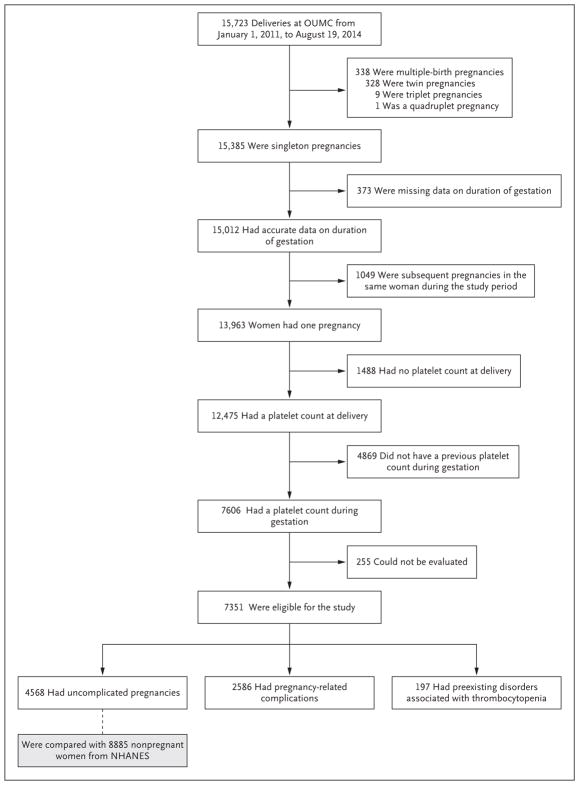
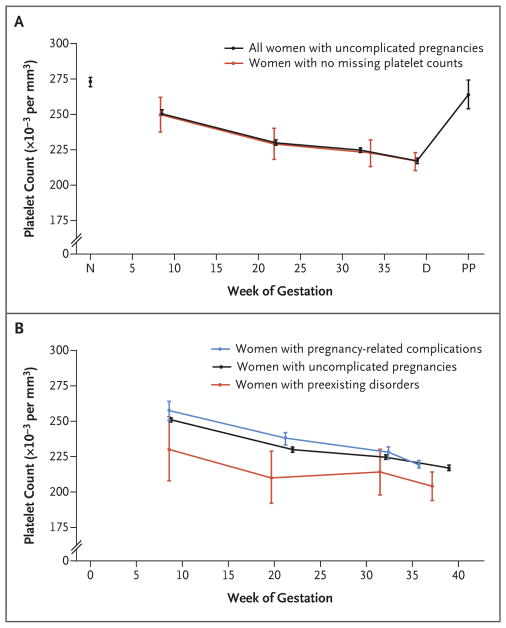
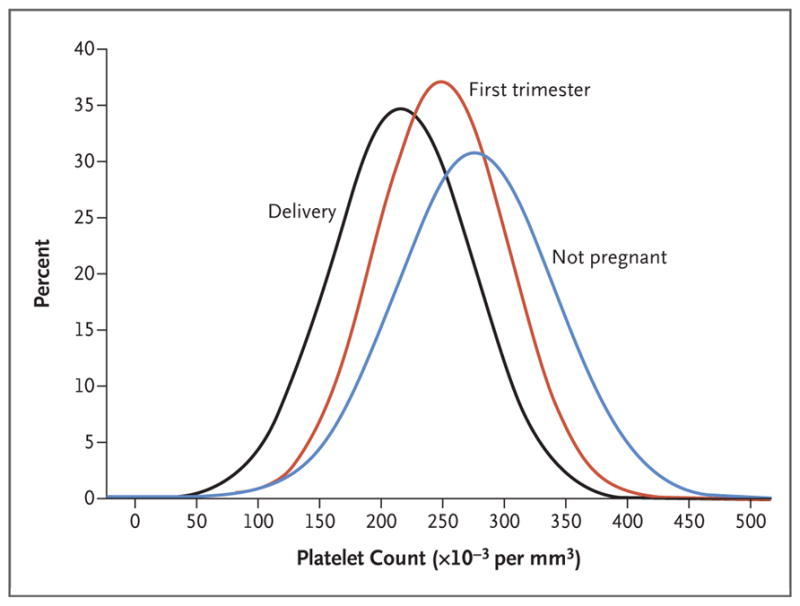
Results: Among the 15,723 deliveries that occurred during the study period, 7351 women had sufficient data for our analyses. Of these women, 4568 had uncomplicated pregnancies, 2586 had pregnancy-related complications, and 197 had preexisting disorders associated with thrombocytopenia. Among the women who had uncomplicated pregnancies, the mean platelet count in the first trimester (mean gestation, 8.7 weeks) was 251,000 per cubic millimeter, which was lower than the mean platelet count in the 8885 nonpregnant women (273,000 per cubic millimeter) (P<0.001). At the time of delivery, 9.9% of the women with uncomplicated pregnancies had a platelet count below 150,000 per cubic millimeter. During the course of the uncomplicated pregnancies and deliveries, only 45 women (1.0%) had a platelet count below 100,000 per cubic millimeter. Among the 12 women with uncomplicated pregnancies who had a platelet count below 80,000 per cubic millimeter, only 5 (0.1%, among whom the range of platelet counts was 62,000 to 78,000 per cubic millimeter; median, 65,000) were identified by medical record review as having no alternative cause for the thrombocytopenia. Platelet counts of less than 150,000 per cubic millimeter at the time of delivery were more common among women who had pregnancy-related complications than among women who had uncomplicated pregnancies (11.9% vs. 9.9%, P=0.01). Throughout their pregnancies and deliveries, 59 women (2.3%) with pregnancy-related complications had a platelet count below 100,000 per cubic millimeter, and 31 (1.2%) had a platelet count below 80,000 per cubic millimeter.
Conclusions: Mean platelet counts decreased during pregnancy in all the women, beginning in the first trimester. In women who have a platelet count of less than 100,000 per cubic millimeter, a cause other than pregnancy or its complications should be considered. (Funded by the National Heart, Lung, and Blood Institute.).
Figures
Comment in
-
Platelet Counts during Pregnancy.N Engl J Med. 2018 Oct 18;379(16):1581. doi: 10.1056/NEJMc1810467. N Engl J Med. 2018. PMID: 30338964 No abstract available.
References
-
- Burrows RF, Kelton JG. Fetal thrombocytopenia and its relation to maternal thrombocytopenia. N Engl J Med. 1993;329:1463–6. - PubMed
-
- Boehlen F, Hohlfeld P, Extermann P, Perneger TV, de Moerloose P. Platelet count at term pregnancy: a reappraisal of the threshold. Obstet Gynecol. 2000;95:29–33. - PubMed
-
- Sainio S, Kekomäki R, Riikonen S, Teramo K. Maternal thrombocytopenia at term: a population-based study. Acta Obstet Gynecol Scand. 2000;79:744–9. - PubMed
-
- Practice bulletin no. 166: thrombocytopenia in pregnancy. Obstet Gynecol. 2016;128(3):e43–e53. - PubMed
-
- Burrows RF, Kelton JG. Incidentally detected thrombocytopenia in healthy mothers and their infants. N Engl J Med. 1988;319:142–5. - PubMed
Publication types
MeSH terms
Grants and funding
LinkOut - more resources
Full Text Sources
Other Literature Sources
Medical