Review
. 2018 Sep;592(17):3007-3023.
doi: 10.1002/1873-3468.13183. Epub 2018 Jul 12.

The translational regulation of maternal mRNAs in time and space

Affiliations
Review

The translational regulation of maternal mRNAs in time and space

Cecilia Lanny Winata et al. FEBS Lett. 2018 Sep.

Abstract

Since their discovery, the study of maternal mRNAs has led to the identification of mechanisms underlying their spatiotemporal regulation within the context of oogenesis and early embryogenesis. Following synthesis in the oocyte, maternal mRNAs are translationally silenced and sequestered into storage in cytoplasmic granules. At the same time, their unique distribution patterns throughout the oocyte and embryo are tightly controlled and connected to their functions in downstream embryonic processes. At certain points in oogenesis and early embryogenesis, maternal mRNAs are translationally activated to perform their functions in a timely manner. The cytoplasmic polyadenylation machinery is responsible for the translational activation of maternal mRNAs, and its role in initiating the maternal to zygotic transition events has recently come to light. Here, we summarize the current knowledge on maternal mRNA regulation, with particular focus on cytoplasmic polyadenylation as a mechanism for translational regulation.

Keywords: cytoplasmic polyadenylation; maternal mRNA; maternal to zygotic transition; translational regulation.


Figures

Figure 1
Figure 1
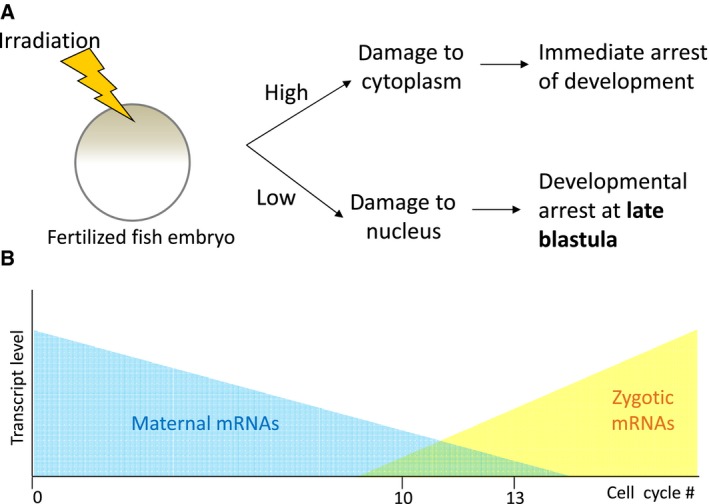
Maternal mRNAs control development up to the point when zygotic genome is activated during the MZT occurring at late blastula in fishes and amphibians. (A) Neyfakh's experiment with irradiated loach embryos show different phenotypes depending on the doses of radiation which affects either cytoplasm or nucleus. The delayed developmental arrest resulting upon nuclear damage gave rise to the understanding of the morphogenetic function of the nuclei, which is responsible for development from late blastula onward. (B) Current understanding at the molecular level established that maternal mRNAs present at high levels prior to MZT drives development up to this point, before it is taken over by zygotic genes expressed from here onward.
Figure 2
Figure 2
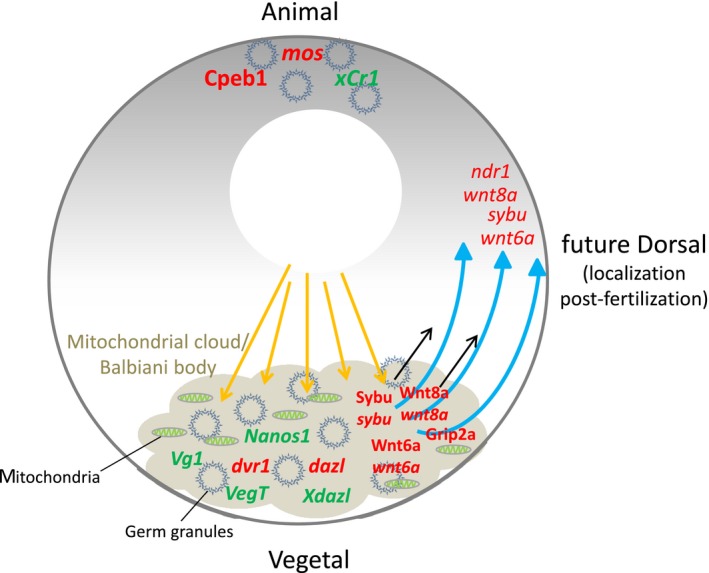
Distribution of key maternal factors in the oocyte. Studies in different organisms have shown that maternal mRNAs are organized in cytoplasmic granules together with several regulatory proteins responsible for their post‐transcriptional processing and thus translational regulation. In fish and amphibians, a large structure known as mitochondrial cloud or Balbiani body is present at the vegetal pole of the oocyte. This structure consists of a large accumulation of mitochondria and cytoplasmic granules (specifically termed germ granules) containing silenced mRNAs. The mitochondrial cloud serves as a vehicle for transporting and localizing maternal factors to the vegetal cortex during oogenesis by means of microtubule network and motor proteins (yellow arrows). At egg activation and fertilization, Sybu and Wnt8 are translocated to the future dorsal axis through microtubule‐mediated transport (blue arrows).
Figure 3
Figure 3
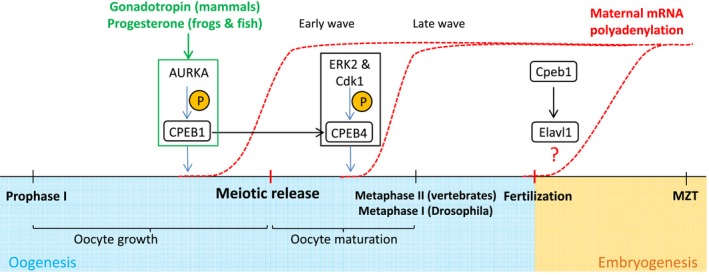
Different waves of maternal mRNA activation throughout oogenesis and early embryogenesis mediated by cytoplasmic polyadenylation. Maternal mRNAs are synthesized throughout the period of oocyte growth and stored in a dormant state. The first wave of activation is stimulated by GH or progesterone, resulting in phosphorylation of CPEB1 by Aurora kinase and the cytoplasmic polyadenylation of several maternal factors required for oocyte maturation. Another late wave is in turn mediated by CPEB4 whose translation was activated during the early wave and is phosphorylated by ERK2 and Cdk1 kinases. Following fertilization, another wave of cytoplasmic polyadenylation occurs on thousands of maternal transcripts. This later wave is required for the embryo to undergo a proper process of MZT. However, the exact molecular mechanism regulating this third wave of cytoplasmic polyadenylation has not yet been worked out.

References

    1. Neyfakh AA (1964) Radiation investigation of nucleo‐cytoplasmic interrelations in morphogenesis and biochemical differentiation. Nature 201, 880–884. - PubMed
    1. Neyfakh AA (1961) Comparative study of the morphogenetic function of Nuclei in Animal. Zh Obshch Biol 22, 42–57. - PubMed
    1. Moore JA (1946) Studies in the development of frog hybrids; embryonic development in the cross Rana pipiens female x Rana sylvatica male. J Exp Zool 101, 173–219. - PubMed
    1. Moore JA (1955) Abnormal combinations of nuclear and cytoplasmic systems in frogs and toads. Adv Genet 7, 139–182. - PubMed
    1. Harvey SA, Sealy I, Kettleborough R, Fenyes F, White R, Stemple D and Smith JC (2013) Identification of the zebrafish maternal and paternal transcriptomes. Development 140, 2703–2710. - PMC - PubMed

Publication types

LinkOut - more resources