


Yield of household contact tracing for tuberculosis in rural South Africa
- PMID: 29973140
- PMCID: PMC6030742
- DOI: 10.1186/s12879-018-3193-7
Yield of household contact tracing for tuberculosis in rural South Africa
Abstract
Background: Efficient and effective strategies for identifying cases of active tuberculosis (TB) in rural sub-Saharan Africa are lacking. Household contact tracing offers a potential approach to diagnose more TB cases, and to do so earlier in the disease course.
Methods: Adults newly diagnosed with active TB were recruited from public clinics in Vhembe District, South Africa. Study staff visited index case households and collected sputum specimens for TB testing via smear microscopy and culture. We calculated the yield and the number of households needed to screen (NHNS) to find one additional case. Predictors of new TB among household contacts were evaluated using multilevel logistic regression.
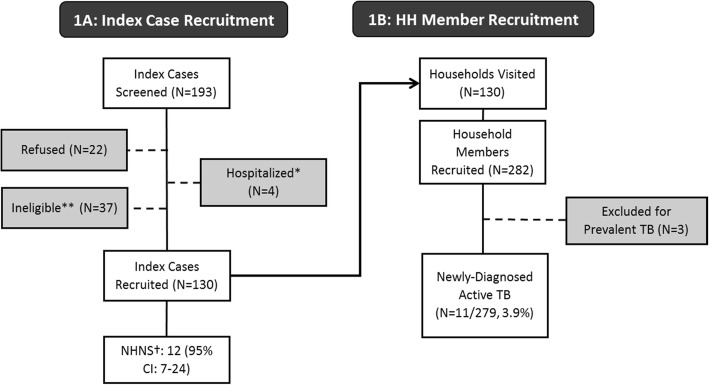
Results: We recruited 130 index cases and 282 household contacts. We identified 11 previously undiagnosed cases of bacteriologically-confirmed TB, giving a prevalence of 3.9% (95% CI: 2.0-6.9%) among contacts, a yield of 8.5 per 100 (95% CI: 4.2-15.1) index cases traced, and NHNS of 12 (95% CI: 7-24). The majority of new TB cases (10/11, 90.9%) were smear negative, culture positive. The presence of TB symptoms was not associated with an increased odds of active TB (aOR: 0.3, 95% CI: 0.1-1.4).
Conclusions: Household contacts of recently diagnosed TB patients in rural South Africa have high prevalence of TB and can be feasibly detected through contact tracing, but more sensitive tests than sputum smear are required. Symptom screening among household contacts had low sensitivity and specificity for active TB in this study.
Keywords: Active case finding; Rural; Tuberculosis.
Conflict of interest statement
Ethics approval and consent to participate
The research on human subjects was approved by the University of the Witwatersrand’s Human Research Ethics Committee, the Johns Hopkins Bloomberg School of Public Health Internal Review Board, and the Limpopo Provincial Government Department of Health. Study participants provided individual, written informed consent for inclusion in the study. Parental consent was obtained for participants less than 18 years of age; children ages 7–17 also provided assent.
Consent for publication
Not applicable.
Competing interests
JG is an editor at
Publisher’s Note
Springer Nature remains neutral with regard to jurisdictional claims in published maps and institutional affiliations.
Figures
References
-
- World Health Organization . Global tuberculosis report 2014. Geneva: WHO; 2014.
-
- Storla D, Yimer S, Bjune G. A systematic review of delay in the diagnosis and treatment of tuberculosis. BMC Public Health. 2008;8 http://www.biomedcentral.com/1471-2458/8/15. - PMC - PubMed
MeSH terms
Grants and funding
LinkOut - more resources
Full Text Sources
Other Literature Sources
