


Potential gains in life expectancy by reducing inequality of lifespans in Denmark: an international comparison and cause-of-death analysis
- PMID: 29973183
- PMCID: PMC6033219
- DOI: 10.1186/s12889-018-5730-0
Potential gains in life expectancy by reducing inequality of lifespans in Denmark: an international comparison and cause-of-death analysis
Abstract
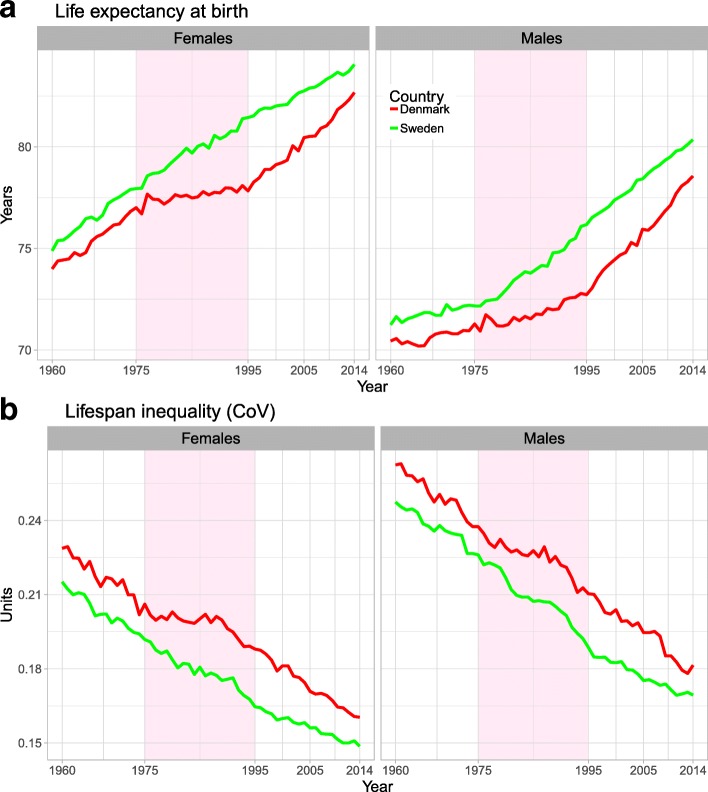
Background: Reducing lifespan inequality is increasingly recognized as a health policy objective. Whereas lifespan inequality declined with rising longevity in most developed countries, Danish life expectancy stagnated between 1975 and 1995 for females and progressed slowly for males. It is unknown how Danish lifespan inequality changed, which causes of death drove these developments, and where the opportunities for further improvements lie now.
Methods: We present an analytical strategy based on cause-by-age decompositions to simultaneously analyze changes in Danish life expectancy and lifespan inequality from 1960 to 2014, as well as current Swedish-Danish differences.
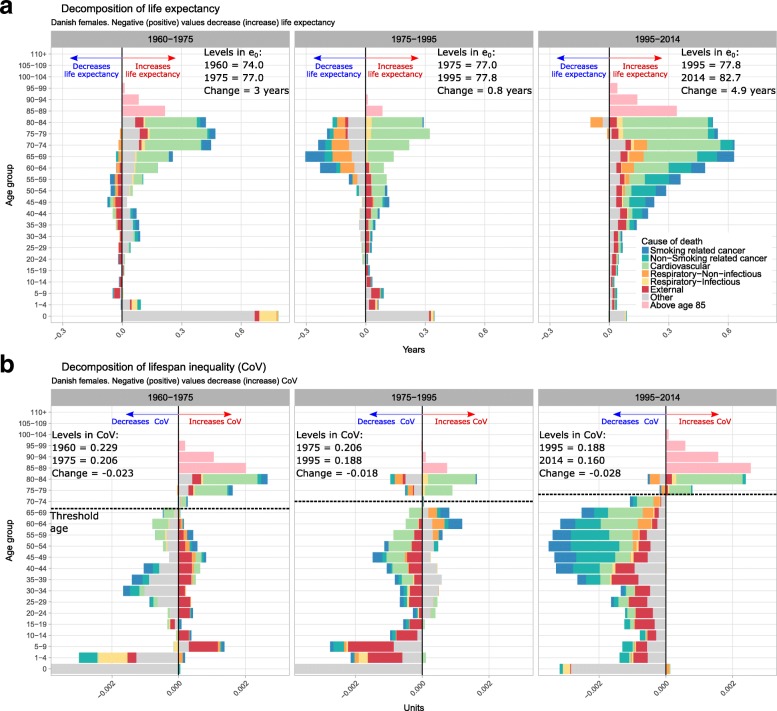
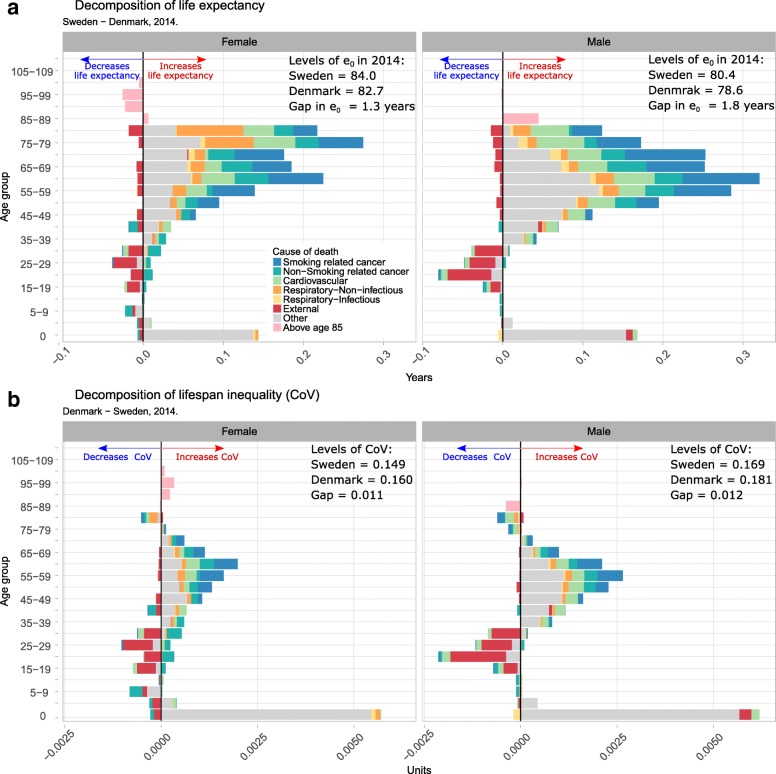
Results: Stagnation in Danish life expectancy coincided with a shorter period of stagnation in lifespan inequality (1975-1990). The stagnation in life expectancy was mainly driven by increases in cancer and non-infectious respiratory mortality at higher ages (-.63 years) offsetting a reduction in cardiovascular and infant mortality (+ 1.52 years). Lifespan inequality stagnated because most causes of death did not show compression over the time period. Both these observations were consistent with higher smoking-related mortality in Danes born in 1919-1939. After 1995, life expectancy and lifespan equality increased in lockstep, but still lag behind Sweden, mainly due to infant mortality and cancer.
Conclusions: Since 1960, Danish improvements in life expectancy and lifespan equality were halted by smoking-related mortality in those born 1919-1939, while also reductions in old-age cardiovascular mortality held back lifespan equality. The comparison with Sweden suggests that Denmark can reduce inequality in lifespans and increase life expectancy through a consistent policy target: reducing cancer and infant mortality.
Keywords: Cancer; Demography; Lifespan variability; Mortality; Public health.
Conflict of interest statement
Ethics approval and consent to participate
We use secondary, grouped, publicly available data. Therefore, no ethics approval from our institutions was needed. The consent to participate is not applicable for the same reasons.
Consent for publication
Not applicable.
Competing interests
The authors declare that they have no competing interests.
Publisher’s Note
Springer Nature remains neutral with regard to jurisdictional claims in published maps and institutional affiliations.
Figures
References
-
- Organization WH World Health Statistics 2016: Monitoring Health for the SDGs Sustainable Development Goals: World Health Organization; 2016.
-
- Tuljapurkar S. The final inequality: variance in age at death. In Demography and the Economy, pp. 209-221. University of Chicago Press, 2010.
Publication types
MeSH terms
Grants and funding
LinkOut - more resources
Full Text Sources
Other Literature Sources
Medical
