Association between maternal adherence to healthy lifestyle practices and risk of obesity in offspring: results from two prospective cohort studies of mother-child pairs in the United States
- PMID: 29973352
- PMCID: PMC6031199
- DOI: 10.1136/bmj.k2486
Association between maternal adherence to healthy lifestyle practices and risk of obesity in offspring: results from two prospective cohort studies of mother-child pairs in the United States
Abstract
Objective: To examine the association between an overall maternal healthy lifestyle (characterized by a healthy body mass index, high quality diet, regular exercise, no smoking, and light to moderate alcohol intake) and the risk of developing obesity in offspring.
Design: Prospective cohort studies of mother-child pairs.
Setting: Nurses' Health Study II (NHSII) and Growing Up Today Study (GUTS) in the United States.
Participants: 24 289 GUTS participants aged 9-14 years at baseline who were free of obesity and born to 16 945 NHSII women.
Main outcome measure: Obesity in childhood and adolescence, defined by age and sex specific cutoff points from the International Obesity Task Force. Risk of offspring obesity was evaluated by multivariable log-binomial regression models with generalized estimating equations and an exchangeable correlation structure.
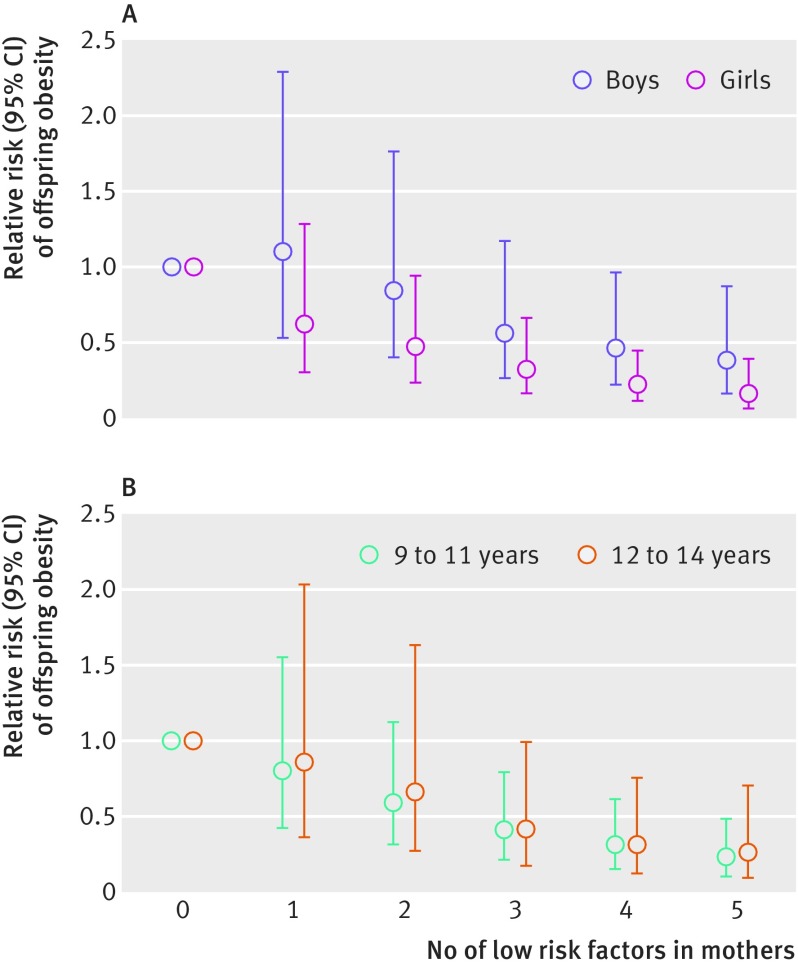
Results: 1282 (5.3%) offspring became obese during a median of five years of follow-up. Risk of incident obesity was lower among offspring whose mothers maintained a healthy body mass index of 18.5-24.9 (relative risk 0.44, 95% confidence interval 0.39 to 0.50), engaged in at least 150 min/week of moderate/vigorous physical activities (0.79, 0.69 to 0.91), did not smoke (0.69, 0.56 to 0.86), and consumed alcohol in moderation (1.0-14.9 g/day; 0.88, 0.79 to 0.99), compared with the rest. Maternal high quality diet (top 40% of the Alternate Healthy Eating Index 2010 diet score) was not significantly associated with the risk of obesity in offspring (0.97, 0.83 to 1.12). When all healthy lifestyle factors were considered simultaneously, offspring of women who adhered to all five low risk lifestyle factors had a 75% lower risk of obesity than offspring of mothers who did not adhere to any low risk factor (0.25, 0.14 to 0.47). This association was similar across sex and age groups and persisted in subgroups of children with various risk profiles defined by factors such as pregnancy complications, birth weight, gestational age, and gestational weight gain. Children's lifestyle did not significantly account for the association between maternal lifestyle and offspring obesity risk, but when both mothers and offspring adhered to a healthy lifestyle, the risk of developing obesity fell further (0.18, 0.09 to 0.37).
Conclusion: Our study indicates that adherence to a healthy lifestyle in mothers during their offspring's childhood and adolescence is associated with a substantially reduced risk of obesity in the children. These findings highlight the potential benefits of implementing family or parental based multifactorial interventions to curb the risk of childhood obesity.
Published by the BMJ Publishing Group Limited. For permission to use (where not already granted under a licence) please go to http://group.bmj.com/group/rights-licensing/permissions.
Conflict of interest statement
Competing interests: All authors have completed the ICMJE uniform disclosure form at www.icmje.org/coi_disclosure.pdf and declare: support from the National Institutes of Health for the submitted work; no financial relationships with any organizations that might have an interest in the submitted work in the previous three years; no other relationships or activities that could appear to have influenced the submitted work.
Figures
References
Publication types
MeSH terms
Grants and funding
- R01 HL096905/NHLBI NIH HHS/National Heart, Lung, and Blood Institute/United States
- R01 MH087786/NIMH NIH HHS/National Institute of Mental Health/United States
- P30 DK046200/NIDDK NIH HHS/National Institute of Diabetes and Digestive and Kidney Diseases/United States
- R01 DK084001/NIDDK NIH HHS/National Institute of Diabetes and Digestive and Kidney Diseases/United States
- R01 ES021372/NIEHS NIH HHS/National Institute of Environmental Health Sciences/United States
- R01 OH009803/NIOSH CDC HHS/National Institute for Occupational Safety and Health/United States
- U54 CA155626/NCI NIH HHS/National Cancer Institute/United States
- UM1 CA176726/NCI NIH HHS/National Cancer Institute/United States
- T32 DK007703/NIDDK NIH HHS/National Institute of Diabetes and Digestive and Kidney Diseases/United States
- R01 ES022981/ES/NIEHS NIH HHS/United States
- R01 HL034594/NHLBI NIH HHS/National Heart, Lung, and Blood Institute/United States
- R01 HD066963/NICHD NIH HHS/National Institute of Child Health & Human Development/United States
LinkOut - more resources
Full Text Sources
Other Literature Sources
Medical