


Serum Uric Acid in Roma and Non-Roma-Its Correlation with Metabolic Syndrome and Other Variables
- PMID: 29973567
- PMCID: PMC6069053
- DOI: 10.3390/ijerph15071412
Serum Uric Acid in Roma and Non-Roma-Its Correlation with Metabolic Syndrome and Other Variables
Abstract
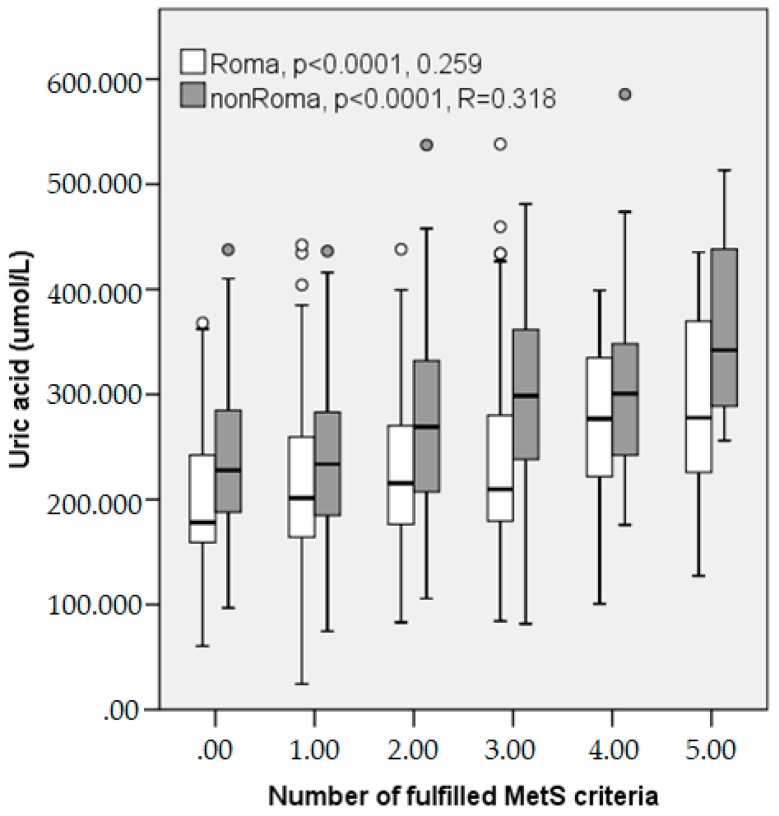
Background: The Roma population is one of the major marginalized groups in Europe, having higher incidence of all spectrums of disease and a shorter life expectancy. Yet, the reasons for higher morbidity and its exact prevalence were not properly studied. Objectives: The objective of our study was to compare the frequency of metabolic syndrome (MetS) in Roma people to the non-Roma population in Slovakia, and to compare levels of uric acid and its correlation with components of metabolic syndrome. Methods: A group of 452 Roma people aged 18⁻55 years, was compared to a control group of 403 non-Roma people. The data were obtained by questionnaire, anthropometric measures, and analyzed blood and urine samples Results: The prevalence of MetS was significantly higher among Roma participants (131; 29.6%) compared with non-Roma participants (80; 20.1%), p = 0.001. Roma people significantly more often fulfilled obesity and low high-density lipoprotein (HDL) criteria of MetS (257, 58.9% vs. 180, 45.8%, p < 0.0001, and 312, 70.0% vs. 140, 34.9%, p < 0.0001). There was no difference in the triacylglycerols (TG), glycemia or blood pressure (BP) criteria of MetS. The Roma also presented with greater levels of high sensitivity C-reactive protein (hs-CRP). Baseline levels of uric acid (UA) among the Roma population were significantly lower compared with the majority population (226.54 ± 79.8 vs. 259.11 ± 84.53) (p < 0.001). The levels of UA significantly correlated with fulfilled criteria of MetS. Univariate regression showed that UA is a significant predictor of MetS in the whole cohort (unadjusted odds ratio (OR) 1.005; 95% CI 1.004⁻1.007; p < 0.0001) also after the adjustment for age, sex, and ethnicity (adjusted OR 1.008; 95% CI 1.005⁻1.010; p < 0.0001). Conclusions: We were able to show that prevalence of MetS among the Roma is higher than in the majority population. Moreover, the uric acid levels are significantly lower in the Roma group as well as when it comes to a cohort with MetS. Levels of UA, besides others, depend on ethnicity, age, and sex.
Keywords: Roma population; metabolic syndrome; uric acid.
Conflict of interest statement
The authors declare no conflict of interest.
Figures
References
Publication types
MeSH terms
Substances
LinkOut - more resources
Full Text Sources
Other Literature Sources
Medical
Research Materials
Miscellaneous
