Review
. 2018 Jun 20:9:855.
doi: 10.3389/fpls.2018.00855. eCollection 2018.

FtsH Protease in the Thylakoid Membrane: Physiological Functions and the Regulation of Protease Activity

Affiliations
Review

FtsH Protease in the Thylakoid Membrane: Physiological Functions and the Regulation of Protease Activity

Yusuke Kato et al. Front Plant Sci. .

Abstract

Protein homeostasis in the thylakoid membranes is dependent on protein quality control mechanisms, which are necessary to remove photodamaged and misfolded proteins. An ATP-dependent zinc metalloprotease, FtsH, is the major thylakoid membrane protease. FtsH proteases in the thylakoid membranes of Arabidopsis thaliana form a hetero-hexameric complex consisting of four FtsH subunits, which are divided into two types: type A (FtsH1 and FtsH5) and type B (FtsH2 and FtsH8). An increasing number of studies have identified the critical roles of FtsH in the biogenesis of thylakoid membranes and quality control in the photosystem II repair cycle. Furthermore, the involvement of FtsH proteolysis in a singlet oxygen- and EXECUTER1-dependent retrograde signaling mechanism has been suggested recently. FtsH is also involved in the degradation and assembly of several protein complexes in the photosynthetic electron-transport pathways. In this minireview, we provide an update on the functions of FtsH in thylakoid biogenesis and describe our current understanding of the D1 degradation processes in the photosystem II repair cycle. We also discuss the regulation mechanisms of FtsH protease activity, which suggest the flexible oligomerization capability of FtsH in the chloroplasts of seed plants.

Keywords: FtsH protease; chloroplast development; photosynthesis; photosystem II repair; post-translational modification (PTM); reactive oxygen species (ROS).


Figures
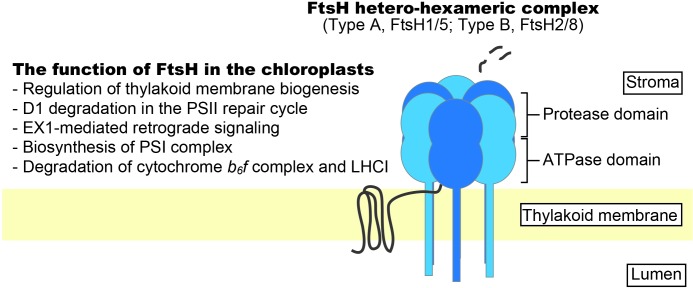
FIGURE 1
FIGURE 1
Schematic representation of FtsH protease complex in chloroplasts. Thylakoid FtsH forms a hetero-hexameric structure integrated into the thylakoid membrane. Increasing evidence shows the importance of FtsH in protein quality control in the thylakoid membrane.
FIGURE 2
FIGURE 2
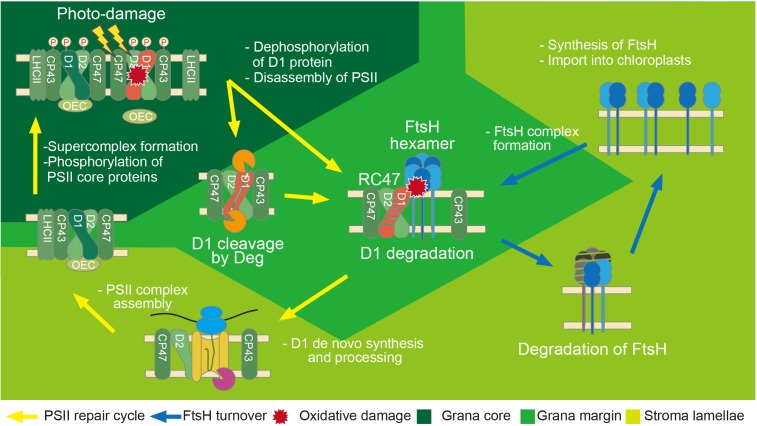
Model of PSII repair and regulation of FtsH activity in chloroplasts. In chloroplasts, photodamaged D1 migrates from the grana stacks to the grana margins, which is the location of D1 degradation in the PSII repair cycle. Dephosphorylation of PSII core proteins by chloroplast PP2C phosphatase and partial disassembly of the PSII complex occur prior to the degradation process. D1 degradation is mainly conducted by FtsH (fundamental degradation), and endopeptidic cleavages by Deg proteases facilitate the effective degradation by FtsH in photoinhibitory conditions. Newly synthesized D1 is processed at its C-terminus by CtpA peptidase. Repaired PSII migrates to the grana core to form functional PSII. Phosphorylation of PSII core proteins is carried out by STN8 kinase. On the other hand, the PSII repair cycle might require proper FtsH turnover in chloroplasts. When FtsH has access to damaged PSII, FtsH concomitantly suffers from oxidative damage induced by ROS. The damaged FtsH should be repaired by proper turnover. Newly synthesized FtsH proteins are imported into chloroplasts and subsequently integrated into the thylakoid membrane. FtsH forms functional complexes in the grana margin. The post-translational modification in FtsH might regulate protease activity and/or complex formation.

References

    1. Adam Z., Frottin F., Espagne C., Meinnel T., Giglione C. (2011). Interplay between N-terminal methionine excision and FtsH protease is essential for normal chloroplast development and function in Arabidopsis. Plant Cell 23 3745–3760. 10.1105/tpc.111.087239 - DOI - PMC - PubMed
    1. Aro E. M., Kettunen R., Tyystjärvi E. (1992). ATP and light regulate D1 protein modification and degradation Role of D1 in photoinhibition. FEBS Lett. 297 29–33. 10.1016/0014-5793(92)80320-G - DOI - PubMed
    1. Bailey S., Thompson E., Nixon P. J., Horton P., Mullineaux C. W., Robinson C., et al. (2002). A critical role for the Var2 FtsH homologue of Arabidopsis thaliana in the photosystem II repair cycle in vivo. J. Biol. Chem. 277 2006–2011. 10.1074/jbc.M105878200 - DOI - PubMed
    1. Barker M., De Vries R., Nield J., Komenda J., Nixon P. J. (2006). The Deg proteases protect Synechocystis sp. PCC 6803 during heat and light stresses but are not essential for removal of damaged D1 protein during the photosystem two repair cycle. J. Biol. Chem. 281 30347–30355. 10.1074/jbc.M601064200 - DOI - PubMed
    1. Bečková M., Yu J., Krynická V., Kozlo A., Shao S., Koník P., et al. (2017). Structure of Psb29/Thf1 and its association with the FtsH protease complex involved in photosystem II repair in cyanobacteria. Philos. Trans. R. Soc. B Biol. Sci. 372:20160394. 10.1098/rstb.2016.0394 - DOI - PMC - PubMed

LinkOut - more resources