


Learning Style Preferences of Practicing Nurses
- PMID: 29975315
- PMCID: PMC6088726
- DOI: 10.1097/NND.0000000000000462
Learning Style Preferences of Practicing Nurses
Abstract
Nursing professional development practitioners are encouraged to consider incorporating preferred learning styles into professional development programs. However, conclusive evidence about preferred learning styles does not exist. This study describes the preferred learning styles of nursing staff. Results showed that learning style preferences existed and were correlated with satisfaction, years of experience, and gender. The results can be used to plan and deliver professional development opportunities that are engaging and promote retention of learning.
Conflict of interest statement
Conflicts of Interest and Source of Funding: None declared. This project was supported by Grant Number UL1 TR002377 from the National Center for Advancing Translational Sciences (NCATS). Its contents are solely the responsibility of the authors and do not necessarily represent the official views of the NIH. Support for this research study was also provided by the Anne L. Bronfman Mayo Clinic in Arizona Nursing Excellence Fund.
Figures
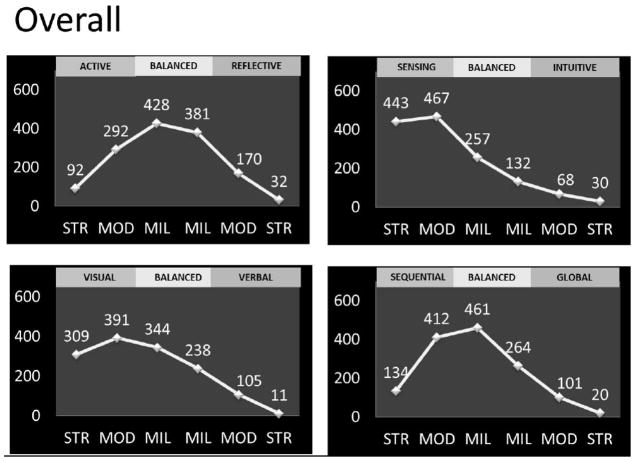
Upper Left: Active-Reflective Scale
Upper Right: Sensing-Intuitive Scale
Lower Left: Visual-Verbal Scale
Lower Right: Sequential-Global Scale
Comment in
-
Demonstrating Nursing Content by Applying Household Items to Case Studies.Nurse Educ. 2023 Nov-Dec 01;48(6):E202-E203. doi: 10.1097/NNE.0000000000001431. Epub 2023 Apr 28. Nurse Educ. 2023. PMID: 37130360 No abstract available.
References
-
- An D, Carr M. Learning styles theory fails to explain learning and achievement: Recommendations for alternative approaches. Personality and Individual Differences. 2017;116:410–416. doi: 10.1016/j.paid.2017.04.050. - DOI
-
- Budden JS, Moulton P, Harper KJ, Brunell M, Smiley RS. The 2015 National Nursing Workforce Survey. Journal of Nursing Regulation. 2016;7(1):S1–S90. doi: 10.1016/S2155-8256(16)31055-9. - DOI
-
- Dickerson P. Core curriculum for nursing professional development. 5. Chicago, IL: Association for Nursing Professional Development; 2017.
MeSH terms
Grants and funding
LinkOut - more resources
Full Text Sources
Other Literature Sources
