


Statistical justification of expansion cohorts in phase 1 cancer trials
- PMID: 29975406
- PMCID: PMC6108930
- DOI: 10.1002/cncr.31577
Statistical justification of expansion cohorts in phase 1 cancer trials
Abstract
Background: Phase I cancer trials increasingly incorporate dose-expansion cohorts (DECs), reflecting a growing demand to acquire more information about investigational drugs. Protocols commonly fail to provide a sample-size justification or analysis plan for the DEC. In this study, we develop a statistical framework for the design of DECs.
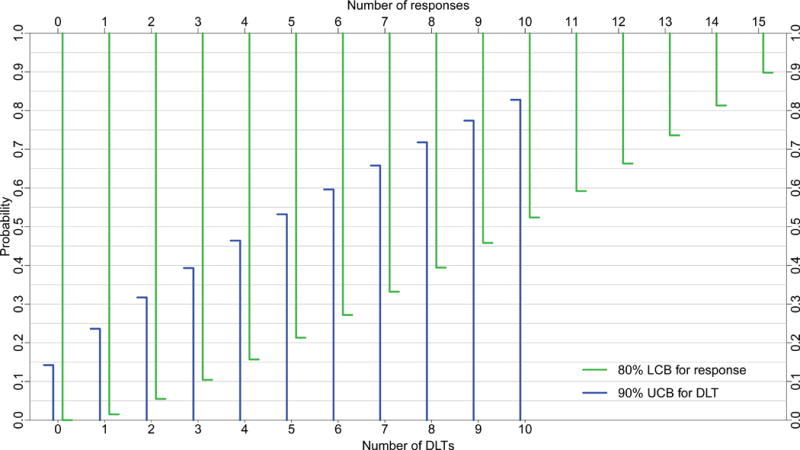
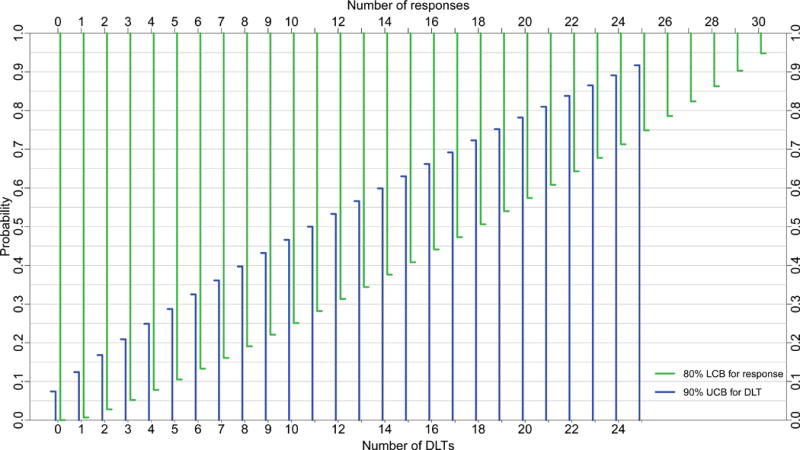
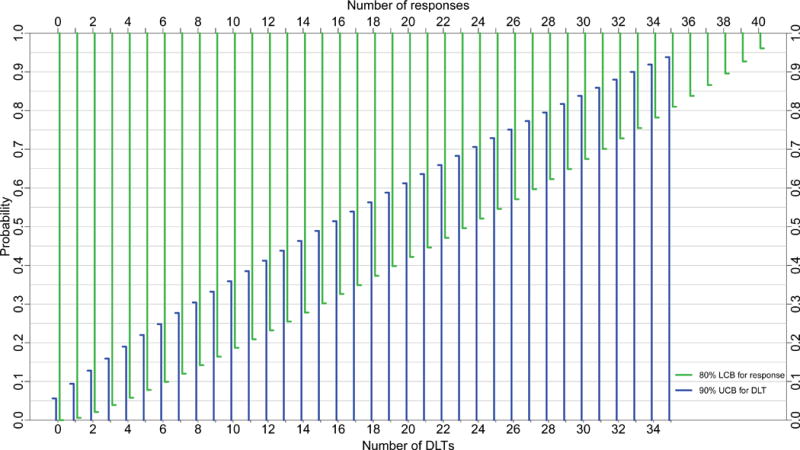
Methods: We assume the maximum tolerated dose (MTD) for the investigational drug has been identified in the dose-escalation stage of the trial. We use the 80% lower confidence bound and the 90% upper confidence bound for the response and toxicity rates, respectively, as decision thresholds for the dose-expansion stage. We calculate the operating characteristics with reference to prespecified minimum effective response rates and maximum safe DLT rates.
Results: We apply our framework to specify a system of DEC plans. The design comprises three components: 1) the number of subjects enrolled at the MTD, 2) the minimum number of responses necessary to indicate provisional drug efficacy, and 3) the maximum number of dose-limiting toxicities (DLTs) permitted to indicate drug safety. We demonstrate our method in an application to a cancer immunotherapy trial.
Conclusions: Our simple and practical tool enables creation of DEC designs that appropriately address the safety and efficacy objectives of the trial.
Keywords: design; dose expansion; dose-finding; efficacy; safety.
© 2018 American Cancer Society.
Figures

Comment in
-
Pragmatic approaches to address expansion cohort design.Cancer. 2018 Aug;124(16):3290-3292. doi: 10.1002/cncr.31574. Epub 2018 Jul 5. Cancer. 2018. PMID: 29975413 Free PMC article. No abstract available.
References
-
- Ivy SP, Siu LL, Garrett-Mayer E, Rubinstein L. Approaches to phase 1 clinical trial design focused on safety, efficiency, and selected patient populations: A report from the Clinical Trial Design Task Force of the National Cancer Institute Investigational Drug Steering Committee. Clin Cancer Res. 2010;16(6):1726–1736. doi: 10.1158/1078-0432.CCR-09-1961. - DOI - PMC - PubMed
-
- Korn EL, Midthune D, Chen TT, Rubinstein LV, Christian MC, Simon RM. A comparison of two phase I trial designs. Stat Med. 1994;13(18):1799–1806. - PubMed
Publication types
MeSH terms
Grants and funding
LinkOut - more resources
Full Text Sources
Other Literature Sources
Medical
Research Materials
