


Understanding plastome evolution in Hemiparasitic Santalales: Complete chloroplast genomes of three species, Dendrotrophe varians, Helixanthera parasitica, and Macrosolen cochinchinensis
- PMID: 29975758
- PMCID: PMC6033455
- DOI: 10.1371/journal.pone.0200293
Understanding plastome evolution in Hemiparasitic Santalales: Complete chloroplast genomes of three species, Dendrotrophe varians, Helixanthera parasitica, and Macrosolen cochinchinensis
Erratum in
-
Correction: Understanding plastome evolution in Hemiparasitic Santalales: Complete chloroplast genomes of three species, Dendrotrophe varians, Helixanthera parasitica, and Macrosolen cochinchinensis.PLoS One. 2018 Oct 5;13(10):e0205616. doi: 10.1371/journal.pone.0205616. eCollection 2018. PLoS One. 2018. PMID: 30289906 Free PMC article.
Abstract
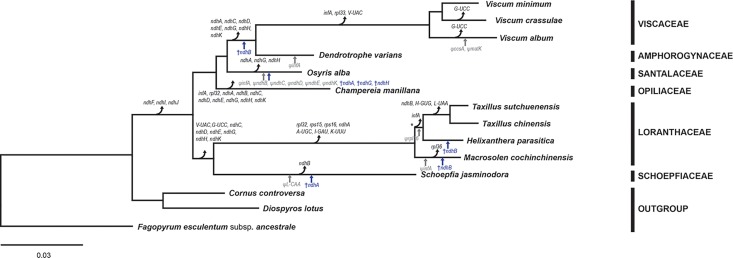
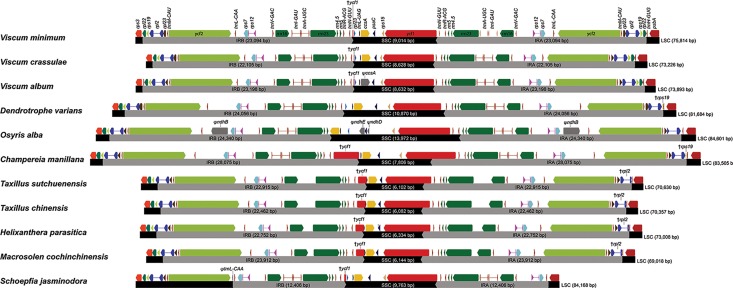
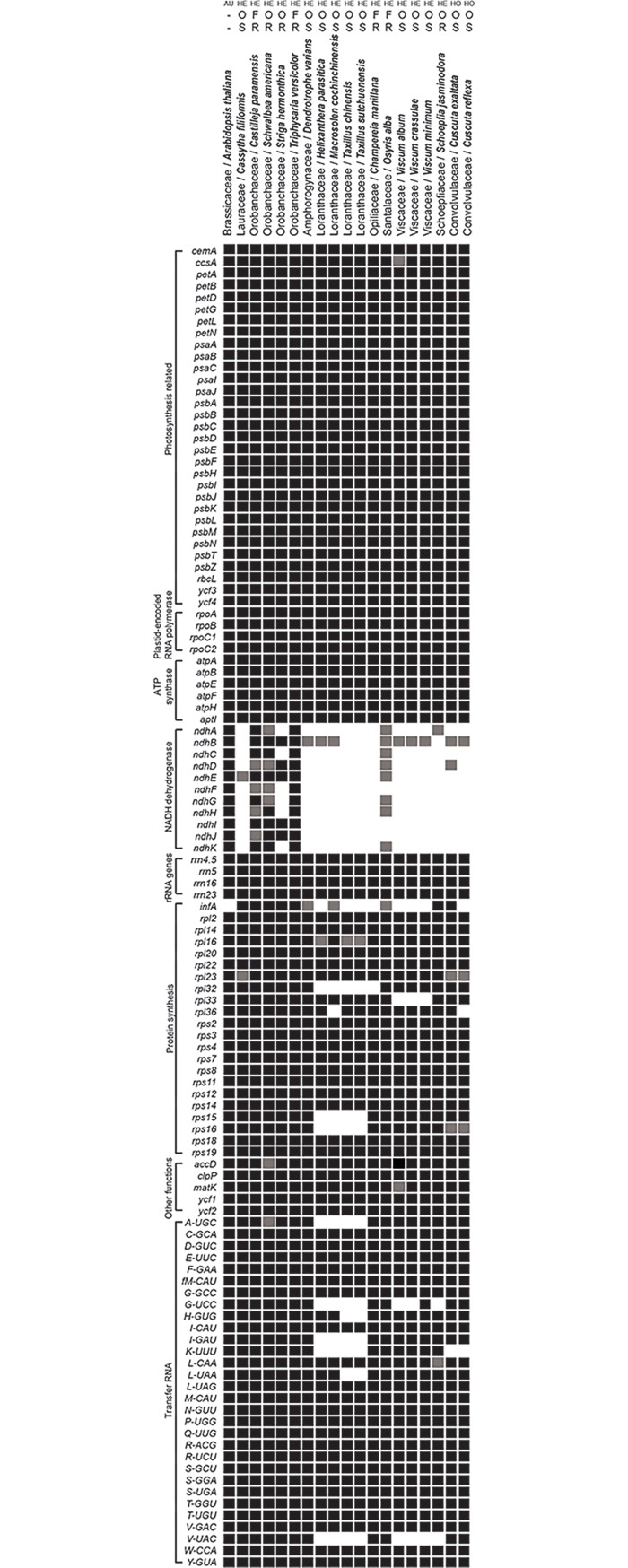
Santalales is a large order, with over 2200 species, most of which are root or aerial (stem) hemiparasites. In this study, we report the newly assembled chloroplast genome of Dendrotrophe varians (140,666 bp) in the family Amphorogynaceae and the cp genomes of Helixanthera parasitica (124,881 bp) and Macrosolen cochinchinensis (122,986 bp), both in the family Loranthaceae. We compared the cp genomes of 11 Santalales including eight currently available cp genomes. Santalales cp genomes are slightly or not reduced in size (119-147 kb), similar to other hemiparasitic species, when compared with typical angiosperm cp genomes (120-170 kb). In a phylogeny examining gene content, the NADH dehydrogenase gene group is the only one among eight functional gene groups that lost complete functionally in all examined Santalales. This supports the idea that the functional loss of ndh genes is the initial stage in the evolution of the plastome of parasitic plants, but the loss has occurred independently multiple times in angiosperms, while they are not found in some parasites. This suggests that the functional loss of ndh genes is not essential for the transition from autotroph to parasite. We additionally examined the correlation between gene content and type of parasitism (obligate/facultative and stem/root parasites) of all hemiparasitic species in which cp genomes have been reported to date. Correlation was not found in any types of parasitism.
Conflict of interest statement
The authors have declared that no competing interests exist.
Figures
References
-
- Kuijt J. Biology of parasitic flowering plants University of California Press: Berkeley and Los Angeles; 1969.
-
- Westwood JH, Yoder JI, Timko MP, dePamphilis CW. The evolution of parasitism in plants. Trends in Plant Sci. 2010;15(4): 227–235. doi: 10.1016/j.tplants.2010.01.004 - DOI - PubMed
-
- Nickrent DL. The parasitic plant connection 1997. [cited 09 Nobemver 2015]. Southern Illinois University; Available from: http://parasiticplants.siu.edu/
-
- Su H-J, Hu J-M, Anderson FE, Der JP, Nickrent DL. Phylogenetic relationships of Santalales with insights into the origins of holoparasitic Balanophoraceae. Taxon. 2015;64(3): 491–506.
-
- Irving LJ, Cameron DD. Chapter 3 You are what you eat: interactions between root parasitic plants and their hosts. Adv Bot Res. Volume 50: Academic Press. 2009. pp 87–138.
Publication types
MeSH terms
LinkOut - more resources
Full Text Sources
Other Literature Sources
Molecular Biology Databases
Miscellaneous
