. 2018 Jul 5;17(1):249.
doi: 10.1186/s12936-018-2382-6.

Assessing Plasmodium falciparum transmission in mosquito-feeding assays using quantitative PCR

Affiliations

Assessing Plasmodium falciparum transmission in mosquito-feeding assays using quantitative PCR

Claire Y T Wang et al. Malar J. .

Abstract

Background: Evaluating the efficacy of transmission-blocking interventions relies on mosquito-feeding assays, with transmission typically assessed by microscopic identification of oocysts in mosquito midguts; however, microscopy has limited throughput, sensitivity and specificity. Where low prevalence and intensity mosquito infections occur, as observed during controlled human malaria infection studies or natural transmission, a reliable method for detection and quantification of low-level midgut infection is required. Here, a semi-automated, Taqman quantitative PCR (qPCR) assay sufficiently sensitive to detect a single-oocyst midgut infection is described.

Results: Extraction of genomic DNA from Anopheles stephensi midguts using a semi-automated extraction process was shown to have equivalent extraction efficiency to manual DNA extraction. An 18S Plasmodium falciparum qPCR assay was adapted for quantitative detection of P. falciparum midgut oocyst infection using synthetic DNA standards. The assay was validated for sensitivity and specificity, and the limit of detection was 0.7 genomes/µL (95% CI 0.4-1.6 genomes/µL). All microscopy-confirmed oocyst infected midgut samples were detected by qPCR, including all single-oocyst positive midguts. The genome number per oocyst was assessed 8-9 days after feeding assay using both qPCR and droplet digital PCR and was 3722 (IQR: 2951-5453) and 3490 (IQR: 2720-4182), respectively.

Conclusions: This semi-automated qPCR method enables accurate detection of low-level P. falciparum oocyst infections in mosquito midguts, and may improve the sensitivity, specificity and throughput of assays used to evaluate candidate transmission-blocking interventions.

Keywords: Droplet digital PCR; Malaria; Oocyst; PCR; Plasmodium falciparum; Taqman; Transmission; Transmission-blocking; qPCR.


Figures
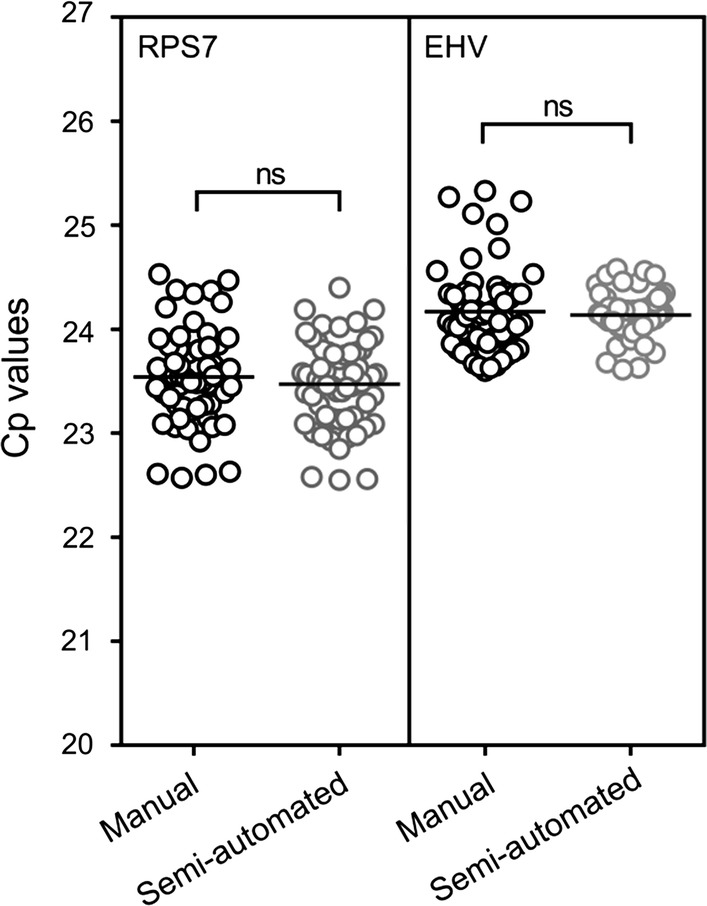
Fig. 1
Fig. 1
Comparison of DNA extraction efficiency using manual and semi-automated processes. DNA was extracted from two batches of 62 midguts using either the manual or semi-automated methods with efficiency compared by measuring the RPS7 and EHV DNA. The lines indicate the group mean and the groups were compared by Student’s t test (p = 0.38 and p = 0.56 for RPS7 and EHV, respectively)
Fig. 2
Fig. 2
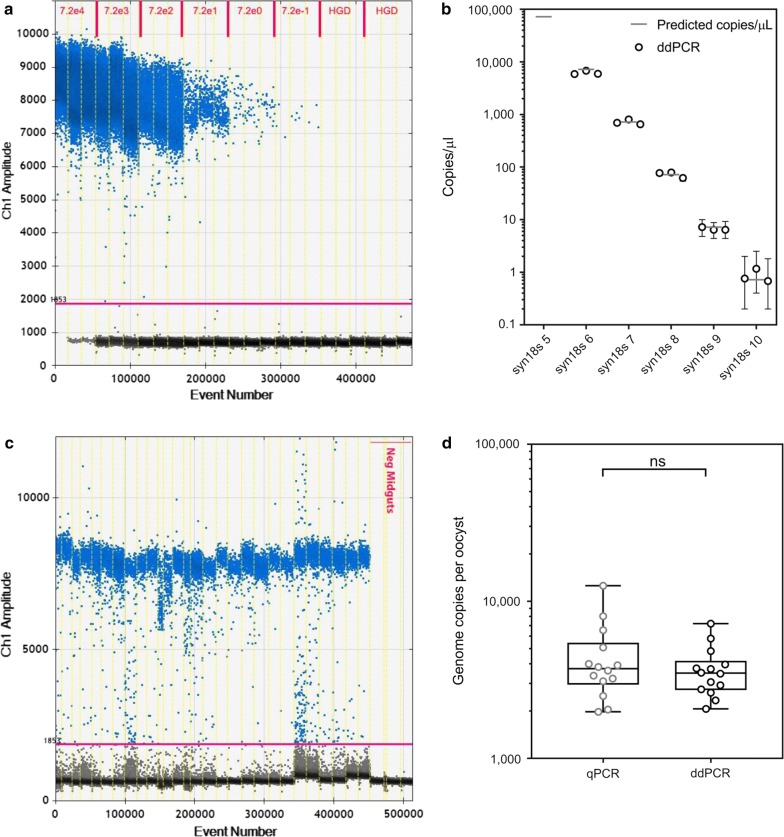
Droplet digital PCR for oocyst genome quantification. a One-dimensional scatter plots showing 18S ddPCR assay on positive (syn18s standards from 7.2 × 104 to 0.72 copies/µL) and negative human blood (“HGD”) extracts. Clear demarcation between positive and negative partitions is shown. Uninfected human blood extract reaction was used to determine a universal positive/negative threshold set at 1853. b Quantification of syn18s standards using ddPCR in triplicate (black circles indicate the median of each run with error bars showing 95% CI) compared to the predicted qPCR value (grey line). c One-dimensional scatter plots showing 18S ddPCR assay on 14 oocyst-positive midguts, with positive and negative partitions. Uninfected mosquito midguts (“Neg”) were used to determine a universal positive/negative threshold set at 1853. d Quantification of genomes per oocyst for the14 microscopy-confirmed oocyst-positive midguts using 18S qPCR and 18S ddPCR. Box plots indicate the median and whiskers show the minimum and maximum responses. Groups compared using Wilcoxon matched-pairs signed rank test (p = 0.43)

References

    1. WHO . World malaria report. Geneva: World Health Organization; 2016.
    1. Cibulskis RE, Alonso P, Aponte J, Aregawi M, Barrette A, Bergeron L, et al. Malaria: global progress 2000–2015 and future challenges. Infect Dis Poverty. 2016;5:61. doi: 10.1186/s40249-016-0151-8. - DOI - PMC - PubMed
    1. Price RN, Uhlemann AC, Brockman A, McGready R, Ashley E, Phaipun L, et al. Mefloquine resistance in Plasmodium falciparum and increased pfmdr1 gene copy number. Lancet. 2004;364:438–447. doi: 10.1016/S0140-6736(04)16767-6. - DOI - PMC - PubMed
    1. White NJ. Malaria: a molecular marker of artemisinin resistance. Lancet. 2014;383:1439–1440. doi: 10.1016/S0140-6736(14)60656-5. - DOI - PubMed
    1. Noedl H, Se Y, Schaecher K, Smith BL, Socheat D, Fukuda MM, et al. Evidence of artemisinin-resistant malaria in western Cambodia. N Engl J Med. 2008;359:2619–2620. doi: 10.1056/NEJMc0805011. - DOI - PubMed

MeSH terms

LinkOut - more resources