


Prognostic factors in patients with metastatic spine tumors derived from lung cancer-a novel scoring system for predicting life expectancy
- PMID: 29976208
- PMCID: PMC6034326
- DOI: 10.1186/s12957-018-1439-x
Prognostic factors in patients with metastatic spine tumors derived from lung cancer-a novel scoring system for predicting life expectancy
Abstract
Background: Recently, molecule-targeting and bone-modifying agents have improved the treatment outcomes of lung cancer-derived metastatic spine tumors. Therefore, the prognostic factors for such tumors were examined, and novel scoring systems for predicting the life expectancy of patients with such tumors were proposed.
Methods: In 207 patients with lung cancer-derived metastatic spine tumors (surgery 49; conservative therapy 158), we retrospectively examined the factors that influenced the post-treatment survival time (age, sex, the affected site, pathology, general condition, the number of extraspinal bone metastases, the number of spinal metastases, the presence/absence of major internal organ metastasis, paralysis state, the total Tokuhashi score, the serum alkaline phosphatase level, the serum carcinoembryonic antigen level, molecule-targeting drug treatment, and bone-modifying agent treatment). Based on the results, we devised novel scoring systems for predicting the prognosis of such patients.
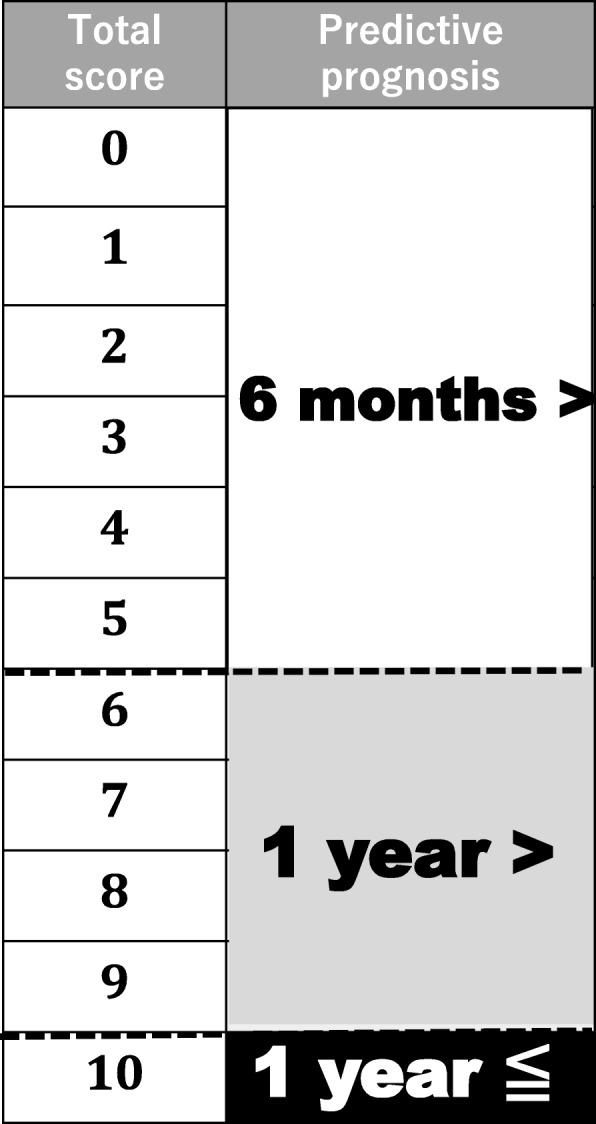
Results: Univariate analyses showed that the pathology of the primary lung tumor, the patient's general condition and paralysis state, and the presence/absence of molecule-targeting drug treatment significantly influenced survival. We performed a Cox regression analysis of these four factors and developed criteria for a novel scoring system based on the patient's general condition and paralysis state, which exhibited significance in the regression analysis. A retrospective review indicated that the consistency rate between predicted life expectancy and actual survival was 67.3%. When criteria based on the four factors that exhibited significance in the univariate analyses were adopted, the consistency rate was 76.2%.
Conclusion: The patient's general condition and paralysis state, the pathology of the primary lung tumor, and molecule-targeting drug treatment influenced survival among patients with lung cancer-derived metastatic spine tumors. Novel scoring systems based on these four factors were proposed.
Keywords: Lung cancer; Metastatic spine tumor; Molecule-targeting drug; Prognostic evaluation system; Scoring system; Treatment modality.
Conflict of interest statement
Ethics approval and consent to participate
All procedures performed in studies involving human participants were conducted in accordance with the ethical standards of the institutional and/or national research committee and with the 1964 Helsinki declaration and its later amendments or comparable ethical standards. Institutional review board approval was obtained from Nihon University Itabashi Hospital (approval number RK-11209-8).
Consent for publication
Not applicable
Competing interests
The authors declare that they have no competing interests.
Publisher’s Note
Springer Nature remains neutral with regard to jurisdictional claims in published maps and institutional affiliations.
Figures

References
-
- Ryo H, Sakai H, Yoneda S, Noguchi Y. Bone metastasis of primary lung cancer. Nihon Kokyuki Gakkai Zasshi. 1998;36:317–322. - PubMed
-
- Aydinli U, Ozturk C, Bayram S, Sarihan S, Evrensel T, Yilmaz HS. Evaluation of lung cancer metastases to the spine. Acta Orthop Belg. 2006;72:592–597. - PubMed
-
- Aydin AL, Emel E, Sasani M, Gomleksiz C, Oktenoglu T, Ozer AF. Lung cancer metastasis to the spine. Turk Neurosurg. 2016;26:635–42. - PubMed
MeSH terms
LinkOut - more resources
Full Text Sources
Other Literature Sources
Medical
