


Acceptability and stakeholders perspectives on feasibility of using trained psychologists and health workers to deliver school-based sexual and reproductive health services to adolescents in urban Accra, Ghana
- PMID: 29976216
- PMCID: PMC6034281
- DOI: 10.1186/s12978-018-0564-x
Acceptability and stakeholders perspectives on feasibility of using trained psychologists and health workers to deliver school-based sexual and reproductive health services to adolescents in urban Accra, Ghana
Abstract
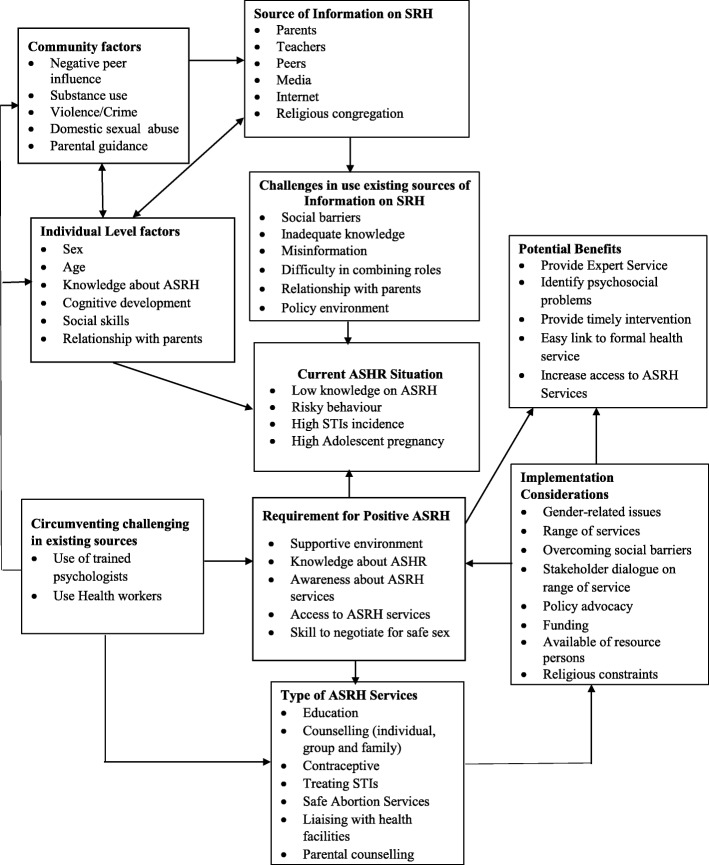
Background: Adolescent sexual and reproductive health is recognized as a key developmental issue of international concern. However, adolescents' access to sexual and reproductive health (SRH) information and services is largely inadequate in sub-Saharan Africa. With increasing enrollment in schools, this could be an avenue to reach adolescents with SRH information and services. This study was therefore conducted to assess the acceptability and stakeholders' perspectives on the feasibility of using health workers and trained psychologists to provide school-based SRH services in Ghana.
Methods: Fourteen (14) focus group discussions (N = 136) were conducted; 8 among adolescents aged 12-17 years (4 boys, 4 girls groups), 4 among parents (2 males, 2 females groups) and two among mixed teacher groups. We also conducted 18 in-depth interviews with teachers, managers of schools, health workers, clinical psychologists, as well as adolescent SRH program managers in the Ghana Health Service, Ghana Education Service, UNICEF, UNESCO and National Population Council, Ghana. We audio-recorded all interviews and took field notes. Interviews were transcribed and transcripts imported into NVivo 11 for analysis using grounded theory approach to qualitative data analysis.
Results: Many respondents reported that it was challenging for parents and/or teachers to provide adolescents with SRH information. For this reason, they agreed that it was a good idea to have health workers and psychologists provide SRH information and services to adolescents in school. Although, there was general agreement about providing SRH services in school, many of the respondents disagreed with distribution of condoms in schools as they believed that availing condoms would encourage adolescents to experiment with sex. While majority of respondents thought it was acceptable to use psychologists and health workers to provide school-based sexual and reproductive health to adolescents, some teachers and education managers thought the implementation of such a program would oppose practical challenges. Key among the challenges were how to pay for the services that health workers and trained psychologists will render, and the availability of psychologists to cater for all schools.
Conclusion: Stakeholders believe it is feasible and acceptable to use trained psychologists and health workers to deliver school-based SRH information and services in the Ghanaian school context. However, provisions must be made to cater for financial and other logistical considerations in the implementation of school-based SRH programs.
Keywords: Acceptability; Adolescents; Feasibility; Ghana; Health workers; Psychologists; School-based adolescents health services; Sexual and reproductive health.
Conflict of interest statement
Ethics approval and consent to participate
The study protocol for this study was reviewed and approved by the Population Council, Ghana with an additional approval from the ethic review committee of the Ghana Health Services. The Ghana Educational Service also provided institutional approval for the study to be conducted in their schools. We solicited and obtained informed consent from adult participants, ≥18 years as required in Ghana [66]. Parents provided signed informed consent form for their children to participate. Pupils and students < 18 years assented to participate in the study. Data from the respondents was anonymized.
Consent for publication
Not applicable.
Competing interests
The authors declare that they have no competing interests.
Publisher’s Note
Springer Nature remains neutral with regard to jurisdictional claims in published maps and institutional affiliations.
Figures
References
-
- UNFPA . International conference on population development: investing in people: National Progress in implementing the ICPD Programmme of action 1994-2004. A Summ. Rep. New York: UNFP; 2004.
-
- World health organization. Making health services adolescent friendly -developing national quality standards for adolescent friendly health services. Geneva: World Health Organization; 2012.
-
- Chandra-Mouli V, Svanemyr J, Amin A, Fogstad H, Say L, Girard F, et al. Twenty years after international conference on population and development: where are we with adolescent sexual and reproductive health and rights? J Adolesc Health. 2015;56:S1–S6. doi: 10.1016/j.jadohealth.2014.09.015. - DOI - PubMed
-
- Gruskin S, Ravindran TKS. Realising the ICPD 20 years later: shifting the paradigms for research and education. Glob Public Health. 2014;1692:1–6. - PubMed
MeSH terms
LinkOut - more resources
Full Text Sources
Other Literature Sources
Medical
