


T1-REDEEM: A Randomized Controlled Trial to Reduce Diabetes Distress Among Adults With Type 1 Diabetes
- PMID: 29976567
- PMCID: PMC6105321
- DOI: 10.2337/dc18-0391
T1-REDEEM: A Randomized Controlled Trial to Reduce Diabetes Distress Among Adults With Type 1 Diabetes
Abstract
Objective: To compare the effectiveness of two interventions to reduce diabetes distress (DD) and improve glycemic control among adults with type 1 diabetes (T1D).
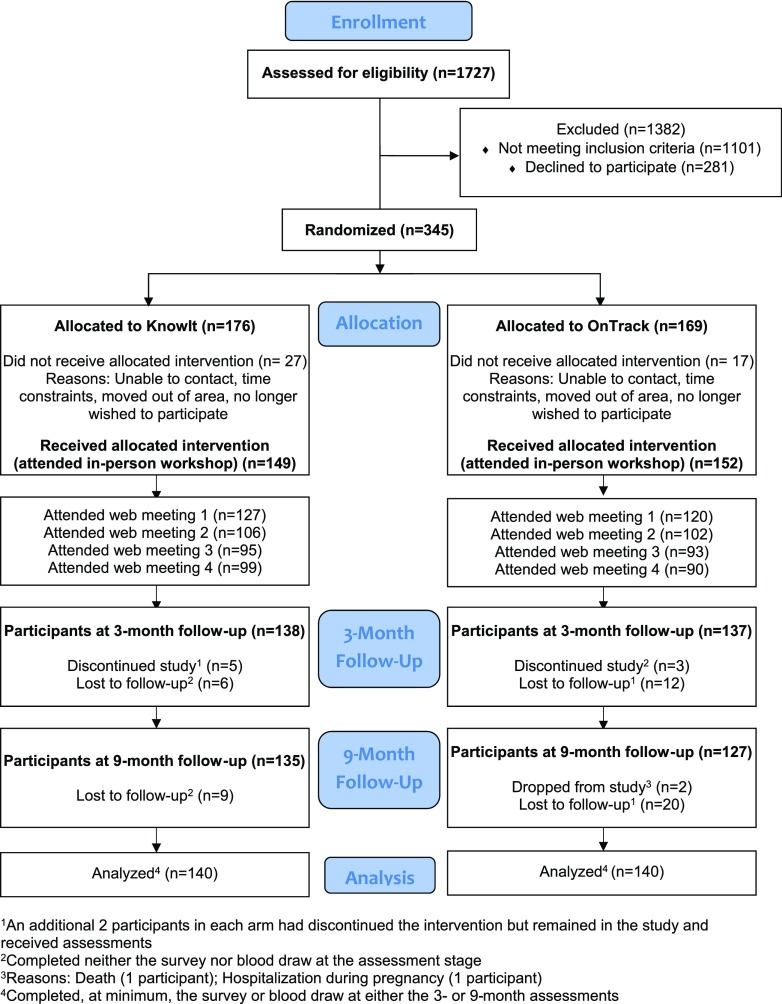
Research design and methods: Individuals with T1D (n = 301) with elevated DD and HbA1c were recruited from multiple settings and randomly assigned to OnTrack, an emotion-focused intervention, or to KnowIt, an educational/behavioral intervention. Each group attended a full-day workshop plus four online meetings over 3 months. Assessments occurred at baseline and 3 and 9 months. Primary and secondary outcomes were change in DD and change in HbA1c, respectively.
Results: With 12% attrition, both groups demonstrated dramatic reductions in DD (effect size d = 1.06; 78.4% demonstrated a reduction of at least one minimal clinically important difference). There were, however, no significant differences in DD reduction between OnTrack and KnowIt. Moderator analyses indicated that OnTrack provided greater DD reduction to those with initially poorer cognitive or emotion regulation skills, higher baseline DD, or greater initial diabetes knowledge than those in KnowIt. Significant but modest reductions in HbA1c occurred with no between-group differences. Change in DD was modestly associated with change in HbA1c (r = 0.14, P = 0.01), with no significant between-group differences.
Conclusions: DD can be successfully reduced among distressed individuals with T1D with elevated HbA1c using both education/behavioral and emotion-focused approaches. Reductions in DD are only modestly associated with reductions in HbA1c. These findings point to the importance of tailoring interventions to address affective, knowledge, and cognitive skills when intervening to reduce DD and improve glycemic control.
Trial registration: ClinicalTrials.gov NCT02175732.
© 2018 by the American Diabetes Association.
References
-
- Delahanty LM, Grant RW, Wittenberg E, et al. Association of diabetes-related emotional distress with diabetes treatment in primary care patients with type 2 diabetes. Diabet Med 2007;24:48–54 - PubMed
Publication types
MeSH terms
Substances
Associated data
Grants and funding
LinkOut - more resources
Full Text Sources
Other Literature Sources
Medical
Miscellaneous
