. 2018 Aug 29;92(18):e00649-18.
doi: 10.1128/JVI.00649-18. Print 2018 Sep 15.

Feline Leukemia Virus (FeLV) Disease Outcomes in a Domestic Cat Breeding Colony: Relationship to Endogenous FeLV and Other Chronic Viral Infections

Affiliations

Feline Leukemia Virus (FeLV) Disease Outcomes in a Domestic Cat Breeding Colony: Relationship to Endogenous FeLV and Other Chronic Viral Infections

Jordan A Powers et al. J Virol. .

Abstract

Exogenous feline leukemia virus (FeLV) is a feline gammaretrovirus that results in a variety of disease outcomes. Endogenous FeLV (enFeLV) is a replication-defective provirus found in species belonging to the Felis genus, which includes the domestic cat (Felis catus). There have been few studies examining interaction between enFeLV genotype and FeLV progression. We examined point-in-time enFeLV and FeLV viral loads, as well as occurrence of FeLV/enFeLV recombinants (FeLV-B), to determine factors relating to clinical disease in a closed breeding colony of cats during a natural infection of FeLV. Coinfections with feline foamy virus (FFV), feline gammaherpesvirus 1 (FcaGHV-1), and feline coronavirus (FCoV) were also documented and analyzed for impact on cat health and FeLV disease. Correlation analysis and structural equation modeling techniques were used to measure interactions among disease parameters. Progressive FeLV disease and FeLV-B presence were associated with higher FeLV proviral and plasma viral loads. Female cats were more likely to have progressive disease and FeLV-B. Conversely, enFeLV copy number was higher in male cats and negatively associated with progressive FeLV disease. Males were more likely to have abortive FeLV disease. FFV proviral load was found to correlate positively with higher FeLV proviral and plasma viral load, detection of FeLV-B, and FCoV status. Male cats were much more likely to be infected with FcaGHV-1 than female cats. This analysis provides insights into the interplay between endogenous and exogenous FeLV during naturally occurring disease and reveals striking variation in the infection patterns among four chronic viral infections of domestic cats.IMPORTANCE Endogenous retroviruses are harbored by many animals, and their interactions with exogenous retroviral infections have not been widely studied. Feline leukemia virus (FeLV) is a relevant model system to examine this question, as endogenous and exogenous forms of the virus exist. In this analysis of a large domestic cat breeding colony naturally infected with FeLV, we documented that enFeLV copy number was higher in males and inversely related to FeLV viral load and associated with better FeLV disease outcomes. Females had lower enFeLV copy numbers and were more likely to have progressive FeLV disease and FeLV-B subtypes. FFV viral load was correlated with FeLV progression. FFV, FcaGHV-1, and FeLV displayed markedly different patterns of infection with respect to host demographics. This investigation revealed complex coinfection outcomes and viral ecology of chronic infections in a closed population.

Keywords: endogenous; feline foamy virus; feline leukemia virus.


Figures

FIG 1
FIG 1
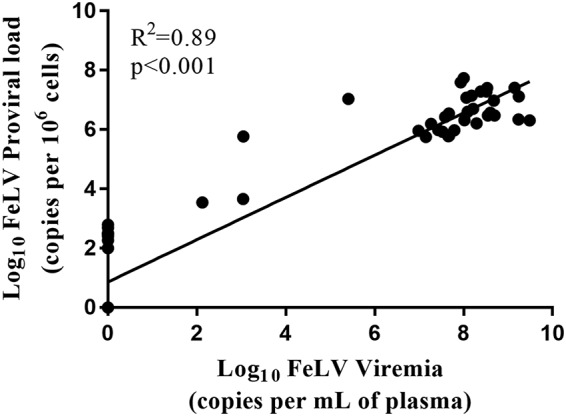
FeLV proviral load strongly correlated with plasma viremia as determined by Spearman correlation.
FIG 2
FIG 2
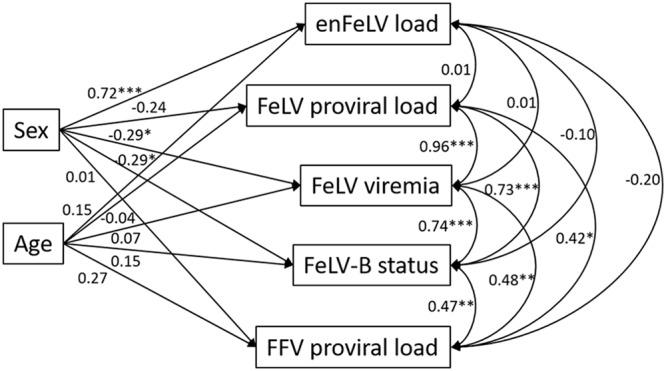
Structural equation model reveals FeLV associations with demographic factors and coinfection. FeLV variables covary with one another (curved double-headed arrows) and FFV proviral load (FFV is the only pathogen to covary with FeLV variables; see Table 3) and are predicted (single-headed arrows) by cat sex and age. Values represent standardized coefficients and are thus comparable in their relative-effect sizes (importance). Positive values associated with sex indicate higher response variable values for males, and negative coefficients indicate higher response variable values for females. *, P < 0.05; **, P < 0.01; ***, P < 0.001. All FeLV and FFV variables are log10 transformed, except FeLV-B status. Values for variation (r2) are as follows: enFeLV load, 0.55; FeLV proviral load, 0.06; FeLV viremia, 0.09; FeLV status, 0.10; FFV proviral load, 0.07.
FIG 3
FIG 3
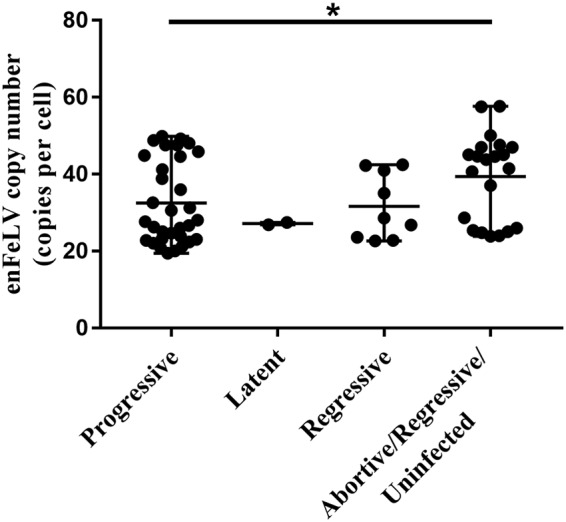
EnFeLV loads were significantly lower in cats with progressive disease than in those with regressive/abortive/uninfected disease (P = 0.02, Spearman correlation). There were 32 cats in the progressive group, the latent group had 2 cats, the regressive group had 9 cats, and the regressive/abortive/uninfected group had 22 cats. ns, not significant (a P value of <0.05 was considered statistically significant). *, P ≤ 0.05.
FIG 4
FIG 4
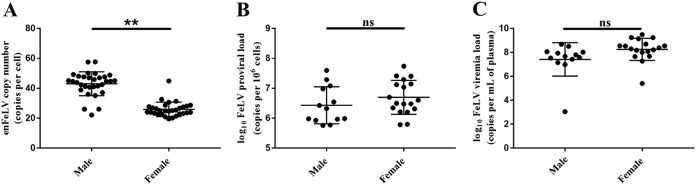
EnFeLV and FeLV are correlated to sex. Male cats had significantly higher enFeLV proviral loads than female cats (P < 0.005) (A), while female cats had higher mean FeLV proviral loads than male cats (P = 0.116) (B) and higher FeLV plasma viremia loads than male cats (P = 0.09) (C) that approached statistical significance, respectively. P values were determined by using ANOVA. ns, not significant (a P value of <0.05 was considered statistically significant). **, P ≤ 0.005.
FIG 5
FIG 5
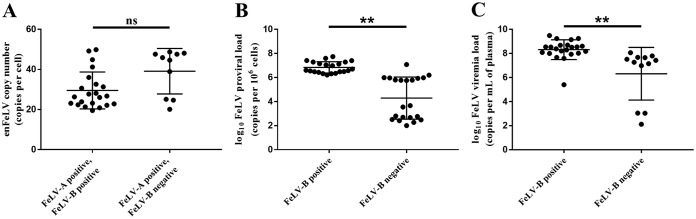
FeLV-B status is associated with higher levels of exFeLV viremia and tends to be associated with higher enFeLV copy number. (A) Cats with exFeLV infection that were PCR positive for FeLV-B tended to have lower enFeLV copy numbers (P = 0.06). (B) Cats with higher FeLV proviral loads (P < 0.001) (B) and higher FeLV plasma viremia loads (P < 0.001) (C) were more likely to develop FeLV-B. P values were determined by using Spearman correlation. ns, not significant (a P value of <0.05 was considered statistically significant). **, P ≤ 0.005.
FIG 6
FIG 6
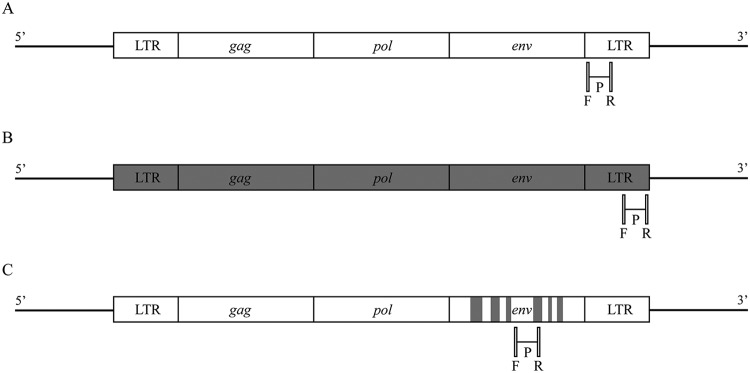
Schematic of FeLV genome (A), enFeLV genome (B), and FeLV-B genome (C) with associated primers (forward and reverse [R]) and probes (P) for specific amplification of these viruses. Recombination of FeLV subtype A with enFeLV in the env gene, resulting in FeLV subtype B, is depicted.

References

    1. Hoover EA, Mullins JI. 1991. Feline leukemia virus infection and diseases. J Am Vet Med Assoc 199:1287–1297. - PubMed
    1. Miyazawa T. 2002. Infections of feline leukemia virus and feline immunodeficiency virus. Front Biosci 7:d504–d518. - PubMed
    1. Benveniste RE, Todaro GJ. 1975. Segregation of RD-114 and FeLV-related sequences in crosses between domestic cat and leopard cat. Nature 257:506–508. doi: 10.1038/257506a0. - DOI - PMC - PubMed
    1. Driscoll CA, Menotti-Raymond M, Roca AL, Hupe K, Johnson WE, Geffen E, Harley EH, Delibes M, Pontier D, Kitchener AC, Yamaguchi N, O'Brien SJ, Macdonald DW. 2007. The Near Eastern origin of cat domestication. Science 317:519–523. doi: 10.1126/science.1139518. - DOI - PMC - PubMed
    1. Johnson WE, Eizirik E, Pecon-Slattery J, Murphy WJ, Antunes A, Teeling E, O'Brien SJ. 2006. The late Miocene radiation of modern Felidae: a genetic assessment. Science 311:73–77. doi: 10.1126/science.1122277. - DOI - PubMed

Publication types