Observational Study
. 2018 Jul 5;8(1):10186.
doi: 10.1038/s41598-018-28409-7.

Innate and adaptive immune dysregulation in critically ill ICU patients

Affiliations
Observational Study

Innate and adaptive immune dysregulation in critically ill ICU patients

Niharika Arora Duggal et al. Sci Rep. .

Abstract

This study aimed to evaluate whether ICU patients who developed persistent critical illness displayed an immune profile similar to an aged immune phenotype and any associations with patient outcomes. Twenty two critically ill ICU patients (27-76 years, 15 males), at day 5 of mechanical ventilation, and 22 healthy age-matched controls (27-77 years, 13 males) were recruited. Frequency and phenotype of innate and adaptive immune cells and telomere length in peripheral blood mononuclear cells (PBMCs) were measured. An elevated granulocyte count (p < 0.0001), increased numbers of immature granulocytes (p < 0.0001), increased CD16++ve monocytes (p = 0.003) and CD14+ve HLADRdim/low monocytes (p = 0.004) and lower NK cell numbers (p = 0.007) were observed in ICU patients compared to controls. Critically ill patients also had lower numbers of total T lymphocytes (p = 0.03), naïve CD4 T cells (p = 0.003) and PTK7+ve recent thymic emigrants (p = 0.002), and increased senescent CD28-ve CD57+ve CD4 T cells (p = 0.02), but there was no difference in PBMC telomere length. Regulatory immune cell frequency was affected with reduced circulating CD19+veCD24hiCD38hi regulatory B cells (p = 0.02). However, only a raised neutrophil:lymphocyte ratio and reduced frequency of CD14+ve HLADRdim/low monocytes were associated with poor outcomes. We conclude that persistent critical illness results in changes to immune cell phenotype only some of which are similar to that seen in physiological ageing of the immune system.


Conflict of interest statement

The authors declare no competing interests.

Figures

Figure 1
Figure 1
Neutrophil count and neutrophil:lymphocyte ratio. (a) Blood neutrophil count in critically ill patients (n = 22) and healthy controls (n = 22). (b) Correlation between neutrophil count and SOFA score in critically ill patients (n = 20). (c) Neutrophil:lymphocyte ratio in critically ill patients (n = 22) and healthy controls (n = 22). (d) Correlation between neutrophil:lymphocyte ratio and ICU length of stay (days) in critically ill patients (n = 19). Data are expressed as mean ± SEM.
Figure 2
Figure 2
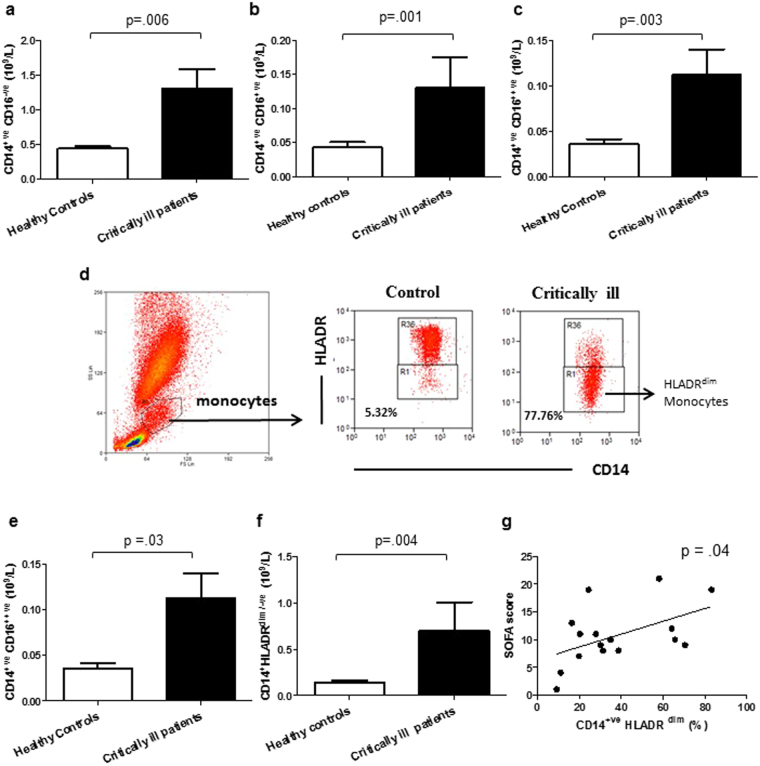
Monocyte subset distribution in critically ill patients (a) Blood CD14+ve CD16−ve; (b) CD14+ve CD16+ve; (c) CD14+ve CD16++ve monocyte counts in critically ill patients at recruitment (n = 20) and healthy controls (n = 19). (d) Whole blood was stained with anti-CD14 and HLADR antibodies and monocytes (CD14+) gated to identify HLADRdim monocytes. (e) Blood frequency and (f) numbers of CD14+ve HLADRdim monocytes in critically ill patients (n = 20) and healthy controls (n = 19). The mean value is indicated by the bar. (g) Correlation between frequency of CD14+ve HLADRdim monocyte and SOFA score in critically ill patients (n = 17). Data are expressed as mean ± SEM.
Figure 3
Figure 3
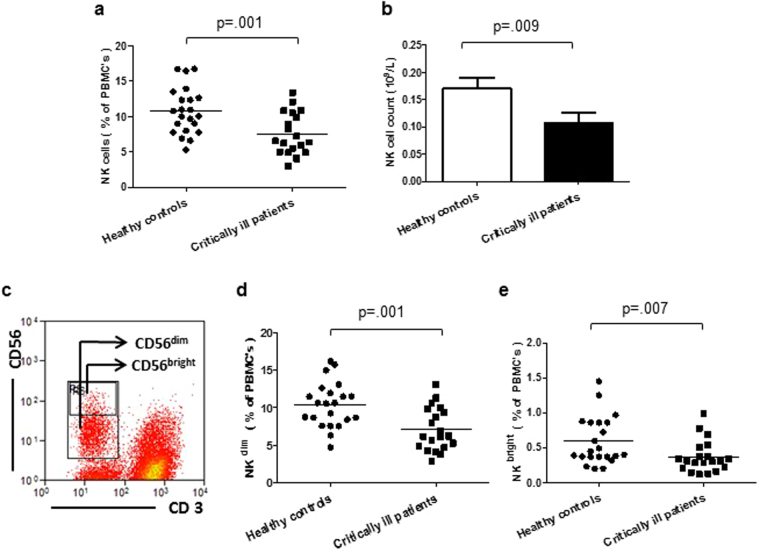
NK cell subsets in critically ill patients (a) Blood frequency and (b) numbers of NK cells in critically ill patients (n = 22) and healthy controls (n = 22). Data are expressed as mean ± SEM. (c) PBMCs were stained with anti-CD3 and anti-CD56 antibodies to identify CD56dim and CD56bright NK cells. (d) Frequency of CD56dim NK cells and (e) CD56bright NK cells in critically ill patients (n = 22) and healthy controls (n = 22).
Figure 4
Figure 4
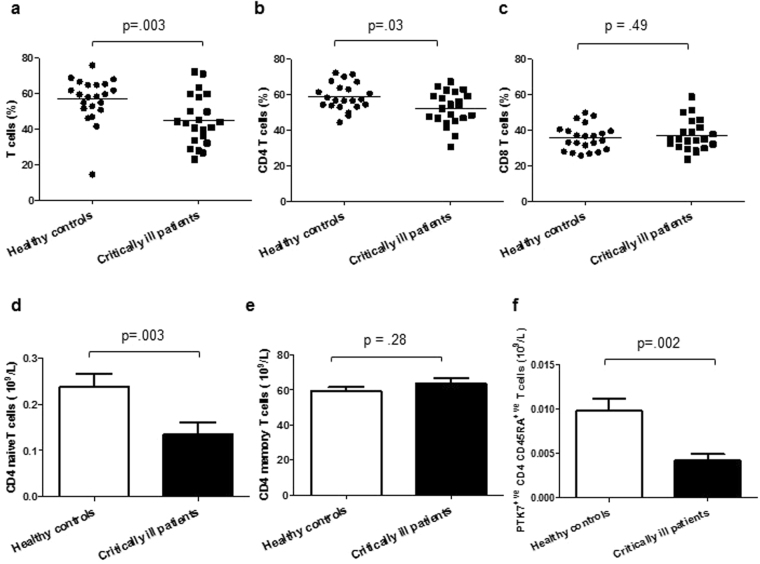
T cell subset distribution in critically ill patients (a) Frequency of total CD3+ve T cells, (b) CD4 T cells, (c) CD8 T cells in critically ill patients (n = 22) and healthy controls (n = 22). Numbers of (d) Naïve CD4 T cells, (e) memory CD4 T cells, (f) PTK7+ve CD45RA CD4 T cells in critically ill patients (n = 22) and healthy controls (n = 22). Data are expressed as mean ± SEM.
Figure 5
Figure 5
Accumulation of senescent T cells in critically ill patients (a) Frequency of CD28−ve CD57+ve CD4 T cells, (b) CD28−ve CD57+ve CD8 T cells, (c) KLRG1+ve CD4 T cells, (d) KLRG1+ve CD8 T cells in critically ill patients (n = 22) and healthy controls (n = 22). (e) Relative telomere length (RTL) in PBMCs for ICU patients (n = 22) compared to age-matched healthy controls (n = 22). (f) Frequency of CD25+ve Foxp3+ve CD4 Regulatory T cells in critically ill patients (n = 22) and healthy controls (n = 22). The mean value is indicated by the bar.
Figure 6
Figure 6
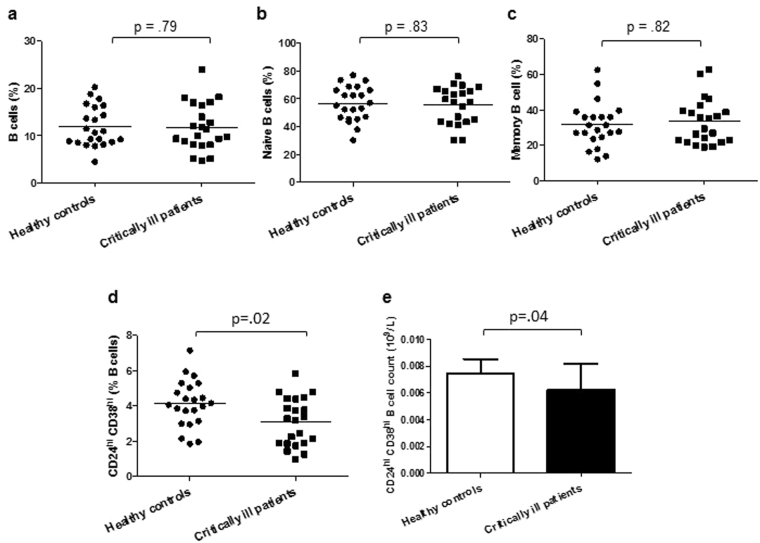
B cell subset distribution in critically ill patients Frequency of (a) CD19+ve B cells, (b) naïve IgD+ve CD27−ve CD19+ve B cells, (c) total memory B cells, (d) CD19+veCD24hiCD38hi B cells in critically ill patients (n = 22) and healthy controls (n = 22). The mean value is indicated by the bar. The absolute number of (e) CD19+veCD24hiCD38hi B cells in peripheral blood of healthy young (n = 22) and old donors (n = 22). Data are expressed as mean ± SEM.

References

    1. Hospital Episode Statistics Analysis H. Adult Critical Care in England - April 2013 to March 2014. Health and Social Care Information Centre. (2015).
    1. Xiao W, et al. A genomic storm in critically injured humans. J Exp Med. 2011;208:2581–90. doi: 10.1084/jem.20111354. - DOI - PMC - PubMed
    1. Brun-Buisson C. The epidemiology of the systemic inflammatory response. Intensive Care Med. 2000;26:64–74. doi: 10.1007/s001340051121. - DOI - PMC - PubMed
    1. Adib-Conquy M, Cavaillon JM. Compensatory anti-inflammatory response syndrome. Thromb Haemost. 2009;101:36–47. doi: 10.1160/TH08-07-0421. - DOI - PubMed
    1. Boomer JS, et al. Immunosuppression in patients who die of sepsis and multiple organ failure. JAMA. 2011;306:2594–605. doi: 10.1001/jama.2011.1829. - DOI - PMC - PubMed

Publication types