


Defence signalling marker gene responses to hormonal elicitation differ between roots and shoots
- PMID: 29977487
- PMCID: PMC6007416
- DOI: 10.1093/aobpla/ply031
Defence signalling marker gene responses to hormonal elicitation differ between roots and shoots
Abstract
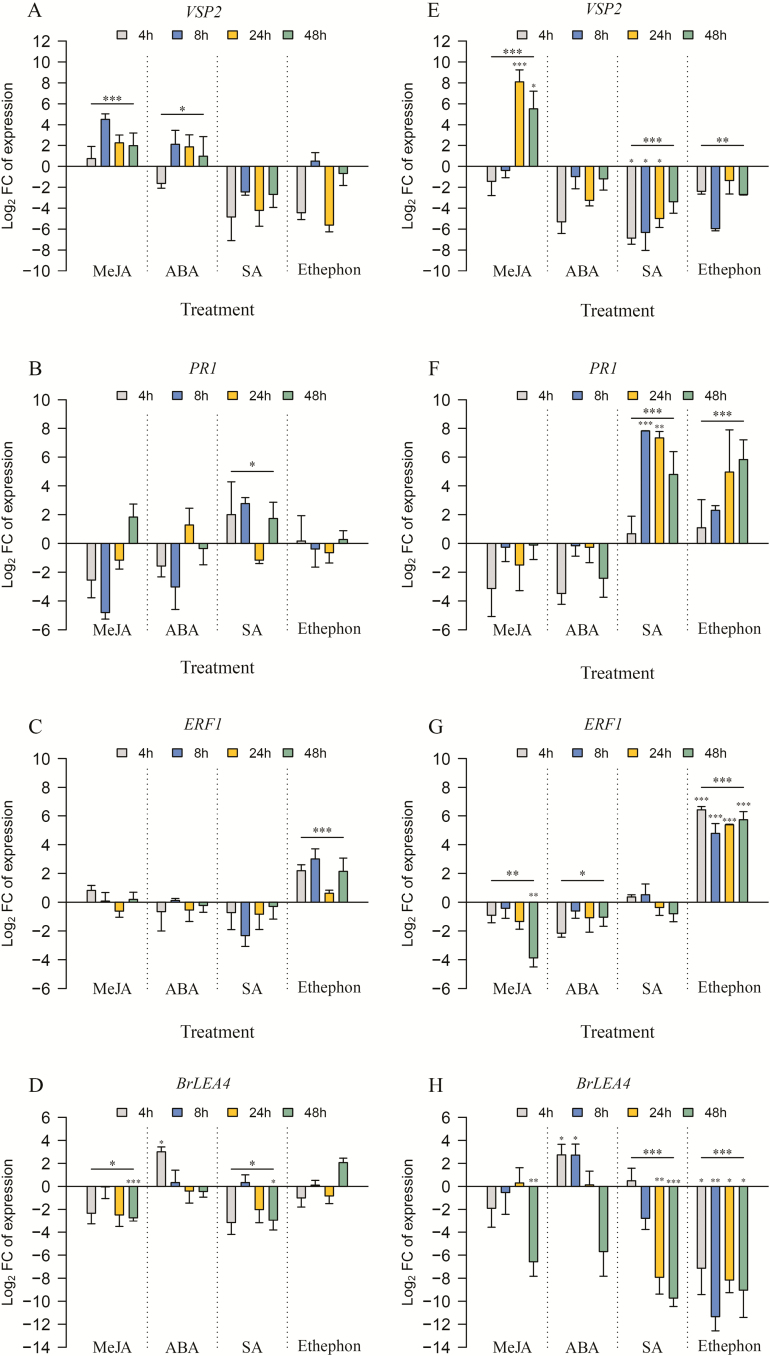
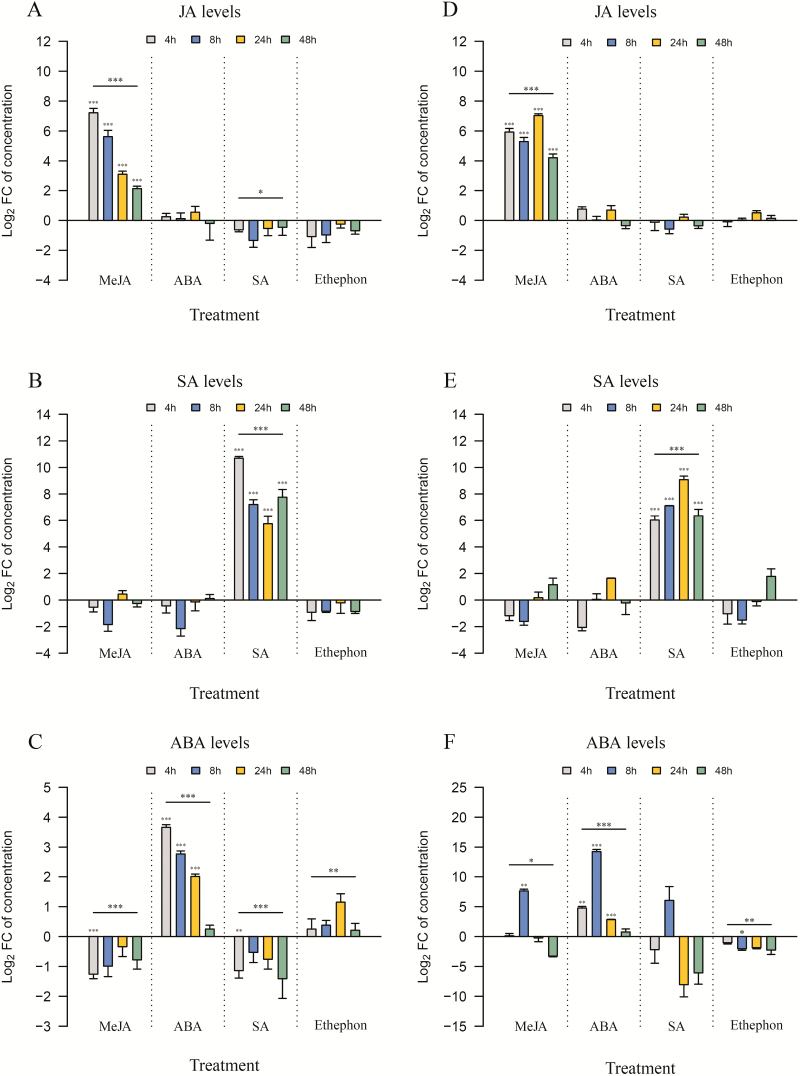
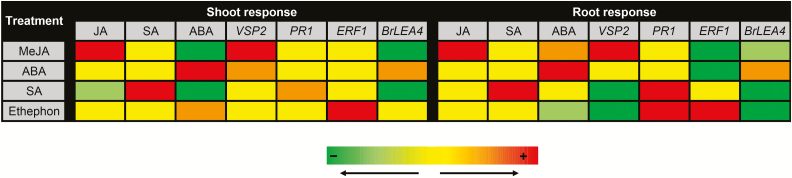
Phytohormones such as jasmonic acid (JA), salicylic acid (SA), ethylene (ET) and abscisic acid (ABA) play a key role in regulation of plant immune responses to different attackers. Extensive research over recent years has led to the identification of molecular markers for specific hormonal-regulated defence pathways. However, most of our current knowledge on the regulation of plant immunity derives from studies focused on above-ground organs, mainly on the model plant Arabidopsis thaliana. Therefore, it is unclear whether the paradigms based on experiments on above-ground organs are entirely transferable to roots. Here, we used the non-model plant Brassica rapa to study the regulation dynamics of hormonal-related marker genes in both roots and shoots. These markers were identified in Arabidopsis shoots after elicitation of the JA-, SA-, ET- or ABA-signalling pathways, and are commonly used to study induced responses. We assessed whether the regulation of those genes by hormonal elicitation differs between roots and shoots. To discern whether the differences in marker gene expression between roots and shoots are related to differences in hormone production or to differential responsiveness, we also measured actual hormone content in the treated tissue after elicitation. Our results show that some of the widely used markers did not show specific responsiveness to single hormone applications in B. rapa. We further found that hormonal elicitation led to different response patterns of the molecular markers in shoots and roots. Our results suggest that the regulation of some hormonal-related marker genes in B. rapa is organ specific and differs from the Arabidopsis-derived paradigms.
Keywords: Brassica; hormonal signalling; marker genes; phytohormones; plant defences.
Figures
References
-
- Abe H, Narusaka Y, Sasaki I, Hatakeyama K, Shin-I S, Narusaka M, Fukami-Kobayashi K, Matsumoto S, Kobayashi M. 2011. Development of full-length cDNAs from Chinese cabbage (Brassica rapa subsp. pekinensis) and identification of marker genes for defence response. DNA Research 18:277–289. - PMC - PubMed
-
- Anderson JP, Badruzsaufari E, Schenk PM, Manners JM, Desmond OJ, Ehlert C, Maclean DJ, Ebert PR, Kazan K. 2004. Antagonistic interaction between abscisic acid and jasmonate-ethylene signaling pathways modulates defense gene expression and disease resistance in Arabidopsis. The Plant Cell 16:3460–3479. - PMC - PubMed
-
- Berrocal‐Lobo M, Molina A, Solano R. 2002. Constitutive expression of ETHYLENE‐RESPONSE‐FACTOR1 in Arabidopsis confers resistance to several necrotrophic fungi. The Plant Journal 29:23–32. - PubMed
LinkOut - more resources
Full Text Sources
Other Literature Sources
