


Comparison of Lumbar Total Disc Replacement With Surgical Spinal Fusion for the Treatment of Single-Level Degenerative Disc Disease: A Meta-Analysis of 5-Year Outcomes From Randomized Controlled Trials
- PMID: 29977727
- PMCID: PMC6022955
- DOI: 10.1177/2192568217737317
Comparison of Lumbar Total Disc Replacement With Surgical Spinal Fusion for the Treatment of Single-Level Degenerative Disc Disease: A Meta-Analysis of 5-Year Outcomes From Randomized Controlled Trials
Abstract
Study design: Meta-analysis.
Objectives: To evaluate the long-term efficacy and safety of total disc replacement (TDR) compared with fusion in patients with functionally disabling chronic low back pain due to single-level lumbar degenerative disc disease (DDD) at 5 years.
Methods: PubMed and Cochrane Central Register of Controlled Trials databases were searched for randomized controlled trials reporting outcomes at 5 years for TDR compared with fusion in patients with single-level lumbar DDD. Outcomes included Oswestry Disability Index (ODI) success, back pain scores, reoperations, and patient satisfaction. All analyses were conducted using a random-effects model; analyses were reported as relative risk (RR) ratios and mean differences (MDs). Sensitivity analyses were conducted for different outcome definitions, high loss to follow-up, and high heterogeneity.
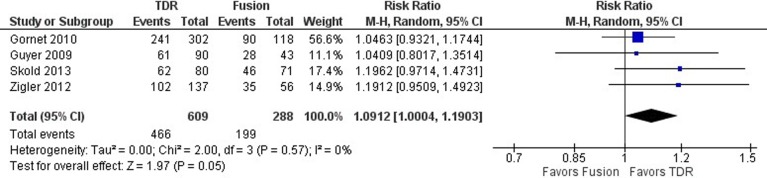
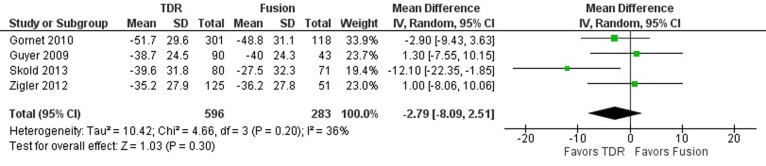
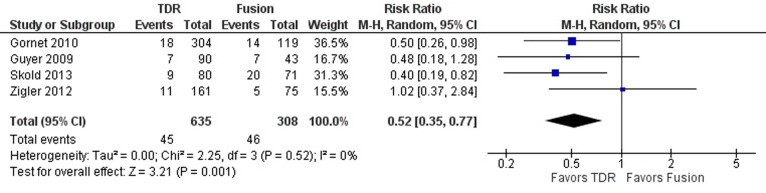
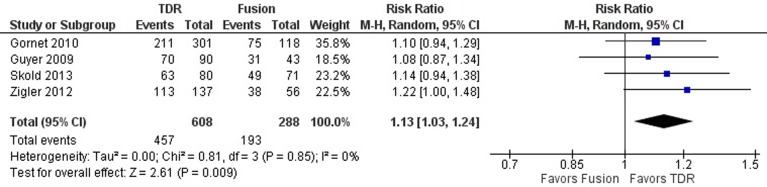
Results: The meta-analysis included 4 studies. TDR patients had a significantly greater likelihood of ODI success (RR 1.0912; 95% CI 1.0004, 1.1903) and patient satisfaction (RR 1.13; 95% CI 1.03, 1.24) and a significantly lower risk of reoperation (RR 0.52; 95% CI 0.35, 0.77) than fusion patients. There was no association with improvement in back pain scores whether patients received TDR or fusion (MD -2.79; 95% CI -8.09, 2.51). Most results were robust to sensitivity analyses. Results for ODI success and patient satisfaction were sensitive to different outcome definitions but remained in favor of TDR.
Conclusions: TDR is an effective alternative to fusion for lumbar DDD. It offers several clinical advantages over the longer term that can benefit the patient and reduce health care burden, without additional safety consequences.
Keywords: degenerative disc disease; long-term outcomes; lumbar arthrodesis; lumbar arthroplasty; lumbar fusion; meta-analysis; total disc replacement.
Conflict of interest statement
Declaration of Conflicting Interests: The author(s) declared the following potential conflicts of interest with respect to the research, authorship, and/or publication of this article: LP, NF, and CC are employees of Cornerstone Research Group Inc, a consultancy that received fees from Aesculap during the conduct of the study. JZ reports personal fees from Aesculap and DePuy Synthes outside the submitted work. MFG reports other funding from Medtronic, K2M, Bonovo, International Spine & Orthopedic Institute, LLC, Nocimed, OuroBoros, and Viscogliosi Bros Venture Partners, LLC outside the submitted work. FWS reports personal fees from Aesculap during the conduct of the study; personal fees from Medtronic, Zimmer/Biomet, and Nocimed and other from Nocimed outside the submitted work.
Figures

References
-
- Walker BF, Muller R, Grant WD. Low back pain in Australian adults: prevalence and associated disability. J Manipulative Physiol Ther. 2004;27:238–244. doi:10.1016/j.jmpt.2004.02.002. - PubMed
-
- Capkin E, Karkucak M, Cakirbay H, et al. The prevalence and risk factors of low back pain in the eastern Black Sea region of Turkey. J Back Musculoskelet Rehabil. 2015;28:783–787. doi:10.3233/bmr-150584. - PubMed
-
- Cassidy JD, Carroll LJ, Côté P. The Saskatchewan health and back pain survey. The prevalence of low back pain and related disability in Saskatchewan adults. Spine (Phila Pa 1976). 1998;23:1860–1866. - PubMed
Publication types
LinkOut - more resources
Full Text Sources
Other Literature Sources
Medical
Research Materials
Miscellaneous
