. 2018 Jun 27;4(2):00017-2018.
doi: 10.1183/23120541.00017-2018. eCollection 2018 Apr.

Analysis of pulmonary features and treatment approaches in the COPA syndrome

Affiliations

Analysis of pulmonary features and treatment approaches in the COPA syndrome

Jessica L Tsui et al. ERJ Open Res. .

Abstract

The COPA syndrome is a monogenic, autoimmune lung and joint disorder first identified in 2015. This study sought to define the main pulmonary features of the COPA syndrome in an international cohort of patients, analyse patient responses to treatment and highlight when genetic testing should be considered. We established a cohort of subjects (N=14) with COPA syndrome seen at multiple centres including the University of California, San Francisco, CA, USA. All subjects had one of the previously established mutations in the COPA gene, and had clinically apparent lung disease and arthritis. We analysed cohort characteristics using descriptive statistics. All subjects manifested symptoms before the age of 12 years, had a family history of disease, and developed diffuse parenchymal lung disease and arthritis. 50% had diffuse alveolar haemorrhage. The most common pulmonary findings included cysts on chest computed tomography and evidence of follicular bronchiolitis on lung biopsy. All subjects were positive for anti-neutrophil cytoplasmic antibody, anti-nuclear antibody or both and 71% of subjects had rheumatoid factor positivity. All subjects received immunosuppressive therapy. COPA syndrome is an autoimmune disorder defined by diffuse parenchymal lung disease and arthritis. We analysed an international cohort of subjects with genetically confirmed COPA syndrome and found that common pulmonary features included cysts, follicular bronchiolitis and diffuse alveolar haemorrhage. Common extrapulmonary features included early age of onset, family history of disease, autoantibody positivity and arthritis. Longitudinal data demonstrated improvement on chest radiology but an overall decline in pulmonary function despite chronic treatment.


Conflict of interest statement

Conflict of interest: None declared

Figures
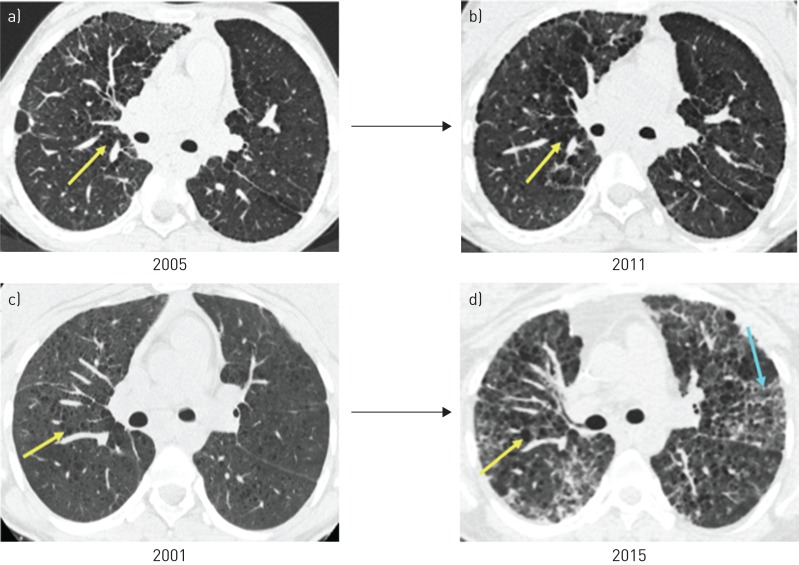
FIGURE 1
FIGURE 1
Serial imaging while on immunosuppressive therapy (two subjects). Axial computed tomography images from subject 5 demonstrate radiographic stability (a) baseline and b) 6 years later) in contrast to subject 4, who developed more cysts and ground-glass opacities over time (c) baseline and d) 14 years later). Yellow arrows indicate cysts and blue arrows indicate ground-glass opacity.
FIGURE 2
FIGURE 2
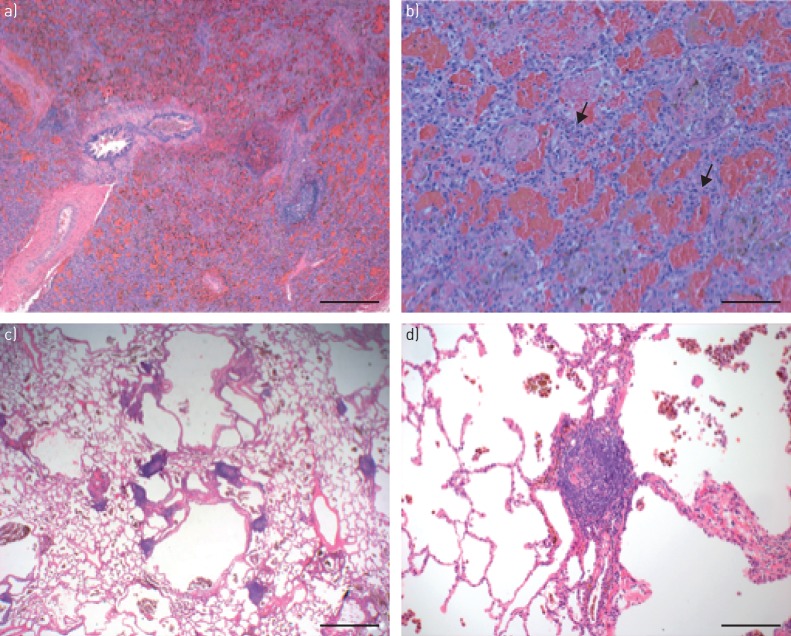
Lung histopathology from two subjects demonstrating either capillaritis or prior alveolar haemorrhage. Subject 2: a) low-power view shows diffuse alveolar haemorrhage with filling of alveolar spaces by red blood cells. Focal lymphoid hyperplasia is present. Scale bar=500 µm. b) High-power view shows alveolar haemorrhage and prominent septal neutrophils (arrows) consistent with alveolar capillaritis. Scale bar=100 µm. Subject 4: c) low-power view shows bronchiolocentric airspace enlargement/cystic change, prominent lymphoid hyperplasia and increased haemosiderin-filled intra-alveolar macrophages. Scale bar=1 mm. d) High-power view shows lymphoid hyperplasia and haemosiderin-filled macrophages, indicative of prior alveolar haemorrhage. Scale bar=200 µm.
FIGURE 3
FIGURE 3
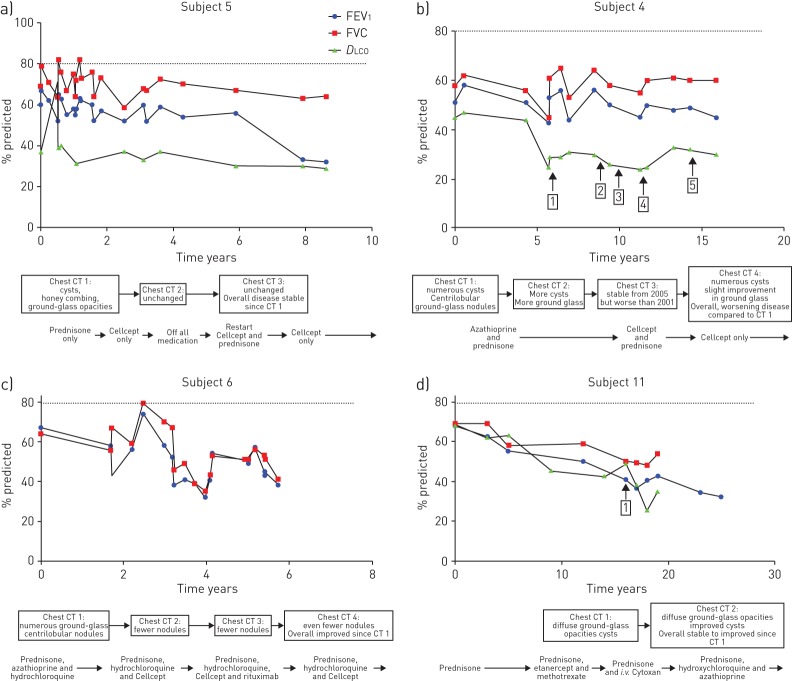
Impact of immunosuppressive therapy on pulmonary function, recurrence of diffuse alveolar haemorrhage (DAH) and chest computed tomography (CT) findings over time (four subjects). a) Subject 5 demonstrated decline in pulmonary function as indicated by % predicted forced expiratory volume in 1 s (FEV1), forced vital capacity (FVC) and diffusing capacity of the lung for carbon monoxide (DLCO) but had radiographic stability while on treatment, while in contrast, her sibling, b) subject 4, struggled with medication noncompliance and developed multiple episodes of DAH as well as radiographic decline based on serial CT scans. Both c) subject 6 and d) subject 11 experienced physiological decline but radiographic stability and/or improvement with immunosuppression. Time axis is years from initial study. Vertical arrows within the plots indicate episodes of DAH; numbers in boxes indicate the episode number. Major chest CT scan findings and treatment regimen are indicated below. Dotted line represents 80% predicted FEV1, FVC and DLCO, which are the cut-offs for normal.

References

    1. Levi BW, Jessen B, Wiszniewski W, et al. COPA mutations impair ER–Golgi transport and cause hereditary autoimmune-mediated lung disease and arthritis. Nat Genet 2015; 47: 654–660. - PMC - PubMed
    1. Kirchhausen T. Three ways to make a vesicle. Nat Rev Mol Cell Biol 2001; 2: 216. - PubMed
    1. Tashtoush B, Okafor NC, Ramirez JF, et al. Follicular bronchiolitis: a literature review. J Clin Diagn Res 2015; 9: OE01–OE05. - PMC - PubMed
    1. Pagnoux C. Updates in ANCA-associated vasculitis. Eur J Rheumatol 2016; 3: 122–133. - PMC - PubMed
    1. Volpi S, Tsui J, Mariani M, et al. Type I interferon pathway activation in COPA syndrome. Clin Immunol 2018; 187: 33–36. - PubMed