


Correlation Between Quality of Evidence and Number of Citations in Top 50 Cited Articles in Rotator Cuff Repair Surgery
- PMID: 29977936
- PMCID: PMC6024541
- DOI: 10.1177/2325967118776635
Correlation Between Quality of Evidence and Number of Citations in Top 50 Cited Articles in Rotator Cuff Repair Surgery
Abstract
Background: The number of article citations has been used as a measure for the impact of an article in the medical literature, with little emphasis on quality.
Purpose: To (1) identify the top 50 most cited articles related to rotator cuff repair surgery, (2) determine whether there was a correlation between the top cited articles and level of evidence, and (3) determine whether there was a correlation between the top cited articles and study quality.
Study design: Cross-sectional study.
Methods: The Web of Science and Scopus online databases were searched to identify the top 50 cited articles in rotator cuff repair surgery. Methodological quality was analyzed for each article using the Modified Coleman Methodology Score (MCMS), Jadad scale, and Methodological Index for Non-Randomized Studies (MINORS). Correlation coefficients were calculated to determine the degree of correlation between the top cited articles and level of evidence and study quality using each quality score.
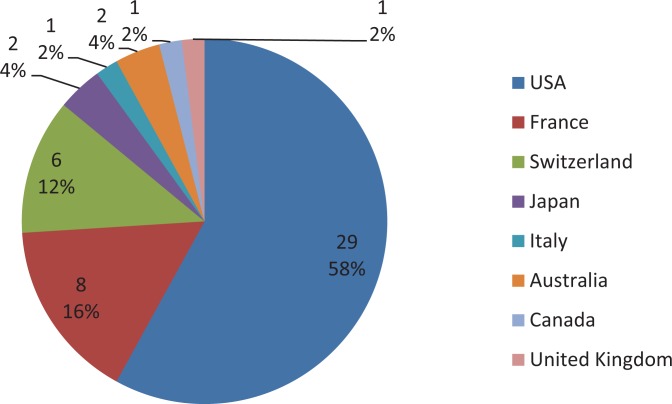
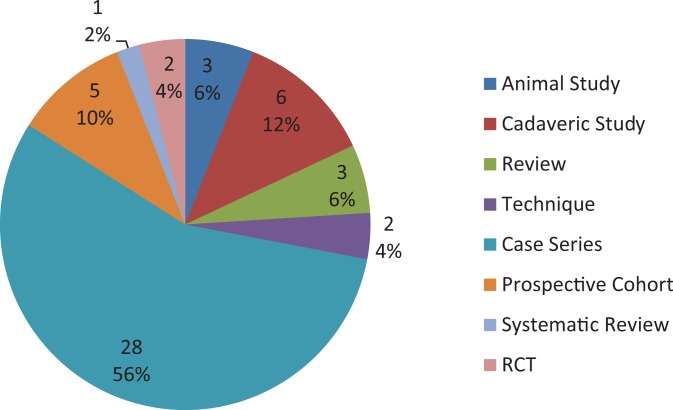
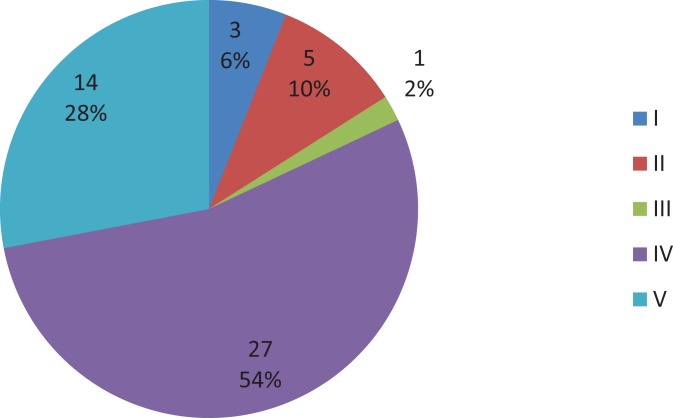
Results: The mean number of citations for each article in each of the 2 databases was 319 ± 187 (range, 177.5-1033.5). Twenty-nine articles (58%) were from the United States. The most common level of evidence was level 4 (54%), with 3 (6%) articles being level 1. There was no significant correlation between the mean number of citations and level of evidence (rs = -0.28), the MCMS (rs = -0.29), and the MINORS score (rs = -0.25). There was a weak negative correlation between the mean number of citations and the Jadad score (rs = -0.36).
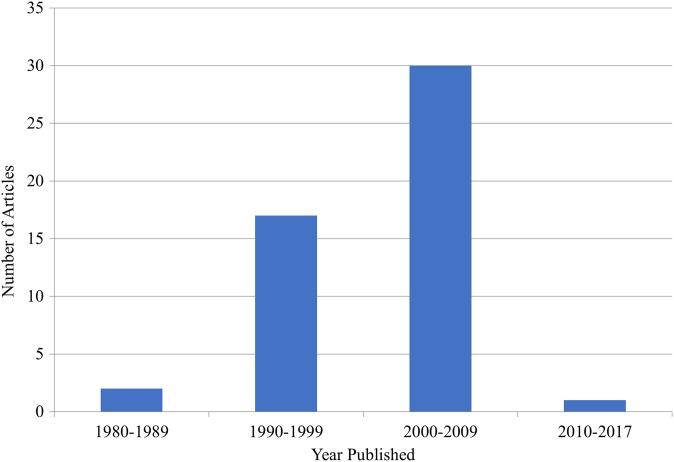
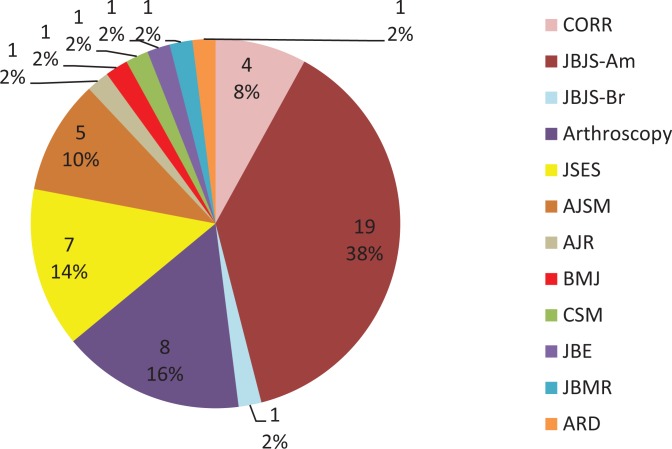
Conclusion: The top 50 cited articles in rotator cuff repair surgery comprise a variety of years, journals, countries of origin, and study types. Despite being the 50 most cited articles, the most common type of article was the level 4 case series with a poor mean quality assessment score. There was no significant correlation between the mean number of citations and level of evidence or methodological quality using a variety of scores.
Keywords: quality of evidence; rotator cuff; shoulder; top articles.
Conflict of interest statement
One or more of the authors has declared the following potential conflict of interest or source of funding: J.D.H. receives research support from DePuy and Smith & Nephew, is a paid consultant for NIA Magellan and Smith & Nephew, receives publishing royalties from SLACK, is a paid presenter/speaker for Smith & Nephew and Ossur, and receives educational support from Arthrex and MedInc.
Figures
References
-
- Adams AB, Simonson D. Publication, citations, and impact factors of leading investigators in critical care medicine. Respir Care. 2004;49(3):276–281. - PubMed
-
- Baldwin KD, Kovatch K, Namdari S, Sankar W, Flynn JM, Dormans JP. The 50 most cited articles in pediatric orthopedic surgery. J Pediatr Orthop B. 2012;21(5):463–468. - PubMed
-
- Baltussen A, Kindler CH. Citation classics in anesthetic journals. Anesth Analg. 2004;98(2):443–451. - PubMed
-
- Bayley M, Brooks F, Tong A, Hariharan K. The 100 most cited papers in foot and ankle surgery. Foot (Edinb). 2014;24(1):11–16. - PubMed
LinkOut - more resources
Full Text Sources
Other Literature Sources
