Use of over-the-scope-clip (OTSC) improves outcomes of high-risk adverse outcome (HR-AO) non-variceal upper gastrointestinal bleeding (NVUGIB)
- PMID: 29977995
- PMCID: PMC6031436
- DOI: 10.1055/a-0614-2390
Use of over-the-scope-clip (OTSC) improves outcomes of high-risk adverse outcome (HR-AO) non-variceal upper gastrointestinal bleeding (NVUGIB)
Abstract
Background and study aims: Endoscopic treatment of non-variceal upper gastrointestinal bleeding (NVUGIB) with high-risk adverse outcome (HR-AO) features has a high risk of failure. We studied the safety and efficacy of over-the-scope clips (OTSC) to treat these lesions.
Patients and methods: We included patients who were treated using OTSC for NVUGIB from January 2015 to October 2017. We studied rebleeding and mortality rates and used the Rockall data and our institution's prior data for comparison. We used descriptive and chi-square statistics.
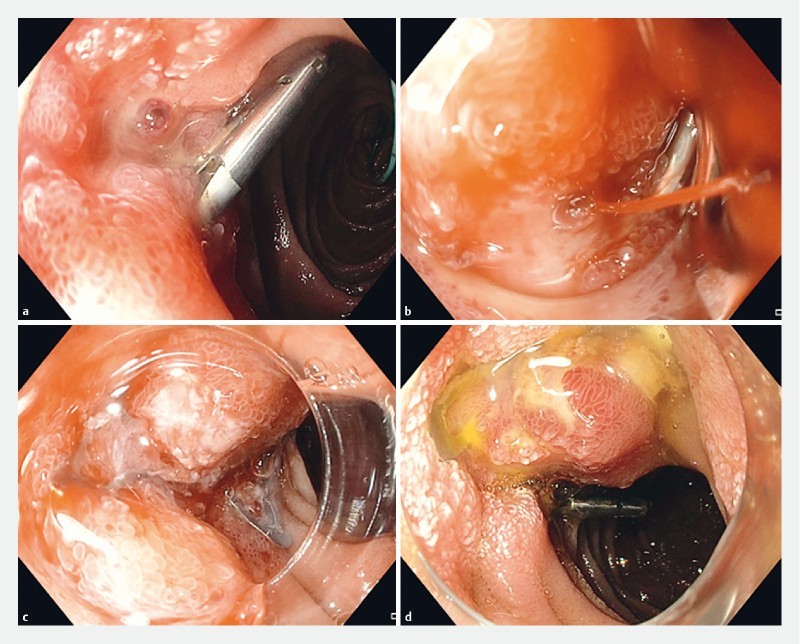
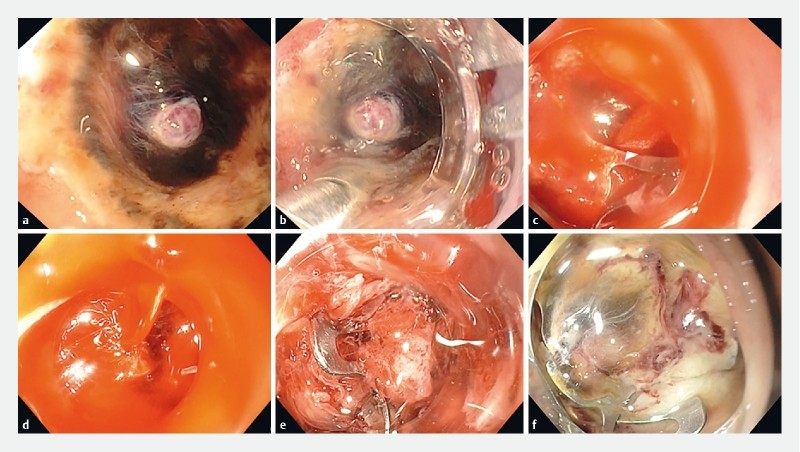
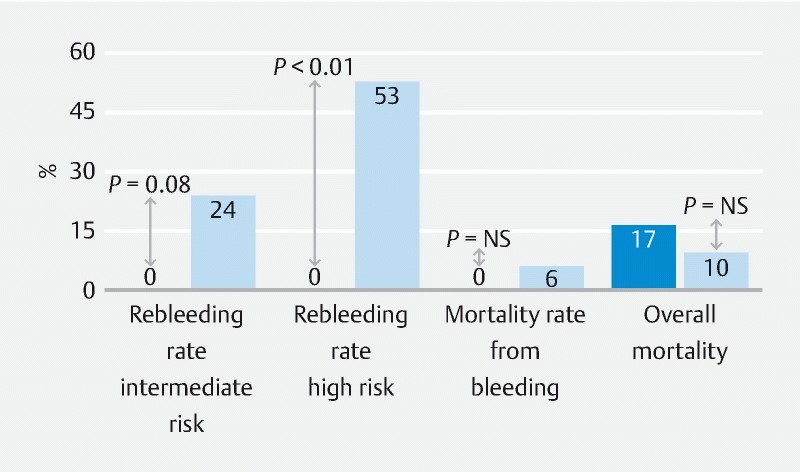
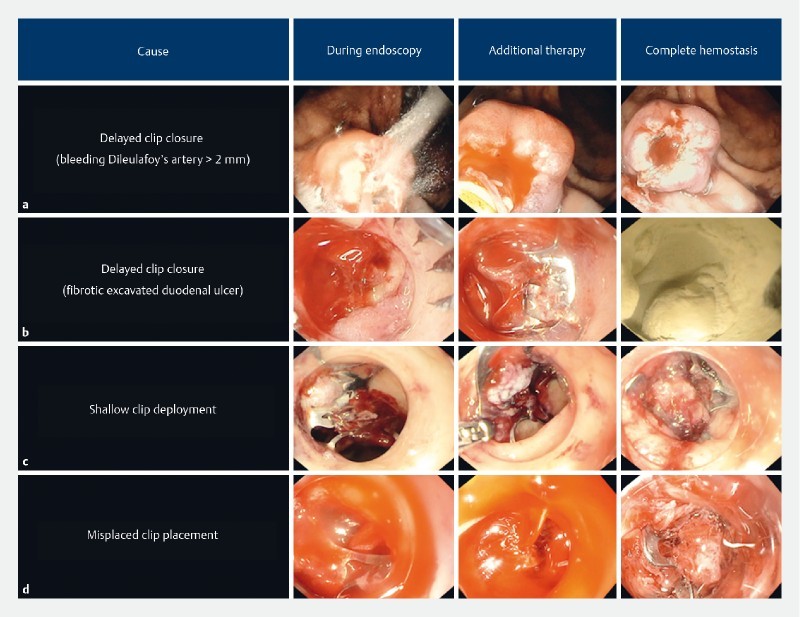
Results: We studied 18 patients with 19 bleeding lesions: 9 (47 %) duodenal ulcers, 4 (21 %) Dieulafoy's lesion, 3 (16 %) gastric ulcer, and 3 (16 %) bleeding after gastric biopsy, gastric polypectomy and endoscopic ultrasound-guided fine-needle aspiration of peri-gastric mass. We applied OTSC as the first-line treatment in 10 (53 %) and as the second-line treatment in 9 (47 %) bleeding lesions. Continued bleeding after OTSC occurred in six patients, but we treated it successfully and achieved complete hemostasis in all patients. We found OTSC use significantly decreased (0 % vs. 53 %, P < 0.01) and reduced (0 % vs. 24 %, P = 0.08) the rebleeding rate in our high-risk (RS ≥ 8) and intermediate-risk (RS = 4 - 7) Rockall score patients as compared to the rates reported by the Rockall study, respectively. When compared to our institution's prior study, we found a decrease in the rebleeding rate with OTSC (0 % vs. 21 %, P = 0.06) in our intermediate-to-high risk Rockall score patients (RS ≥ 4). There was no difference in mortality rates as compared to both control studies.
Conclusion: Use of OTSC is safe, efficacious and appears superior to standard treatment for HR-AO NVUGIB. OTSC should be considered as first-line treatment for HR-AO bleeding.
Conflict of interest statement
Figures
References
-
- Barkun A N, Bardou M, Kuipers E J et al.International consensus recommendations on the management of patients with nonvariceal upper gastrointestinal bleeding. Ann Intern Med. 2010;152:101–113. - PubMed
-
- Gralnek I M, Dumonceau J M, Kuipers E J et al.Diagnosis and management of nonvariceal upper gastrointestinal hemorrhage: European Society of Gastrointestinal Endoscopy (ESGE) Guideline. Endoscopy. 2015;47:a1–46. - PubMed
-
- Laine L, Jensen D M. Management of patients with ulcer bleeding. Am J Gastroenterol. 2012;107:345–360. - PubMed
-
- Barkun A N, Martel M, Toubouti Y et al.Endoscopic hemostasis in peptic ulcer bleeding for patients with high-risk lesions: a series of meta-analyses. Gastrointest Endosc. 2009;69:786–799. - PubMed
-
- Kato M, Jung Y, Gromski M A et al.Prospective, randomized comparison of 3 different hemoclips for the treatment of acute upper GI hemorrhage in an established experimental setting. Gastrointest Endosc. 2012;75:3–10. - PubMed
LinkOut - more resources
Full Text Sources
Other Literature Sources