Theories of Working Memory: Differences in Definition, Degree of Modularity, Role of Attention, and Purpose
- PMID: 29978205
- PMCID: PMC6105130
- DOI: 10.1044/2018_LSHSS-17-0114
Theories of Working Memory: Differences in Definition, Degree of Modularity, Role of Attention, and Purpose
Abstract
Purpose: The purpose of this article is to review and discuss theories of working memory with special attention to their relevance to language processing.
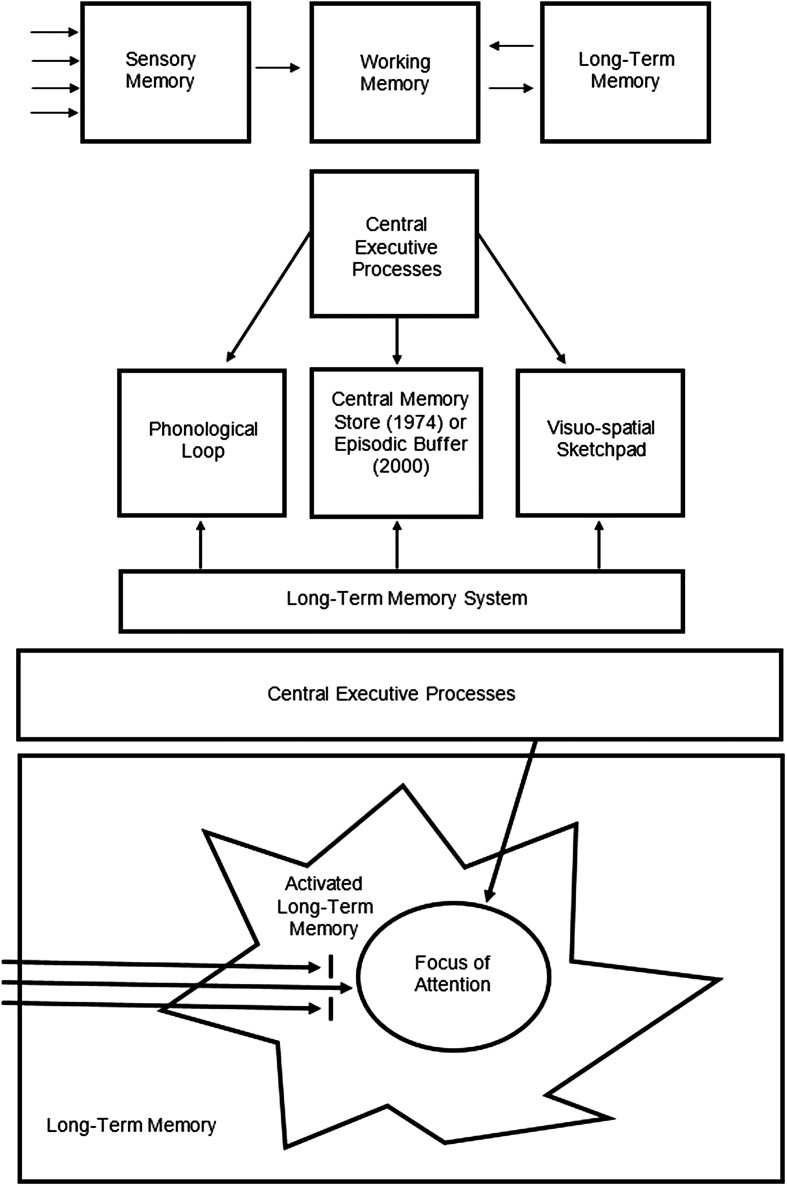
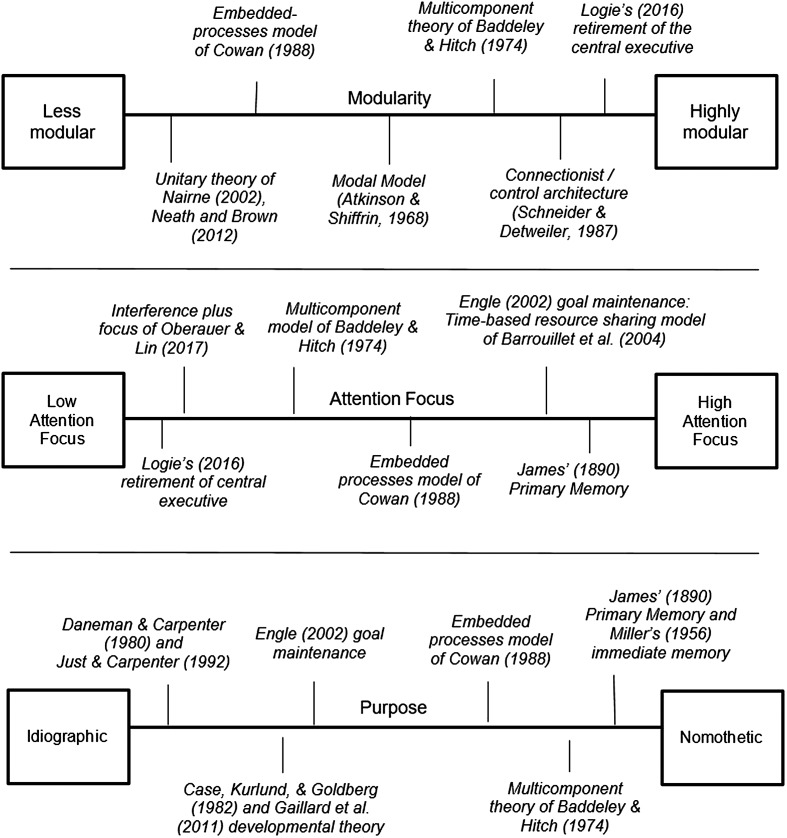
Method: We begin with an overview of the concept of working memory itself and review some of the major theories. Then, we show how theories of working memory can be organized according to their stances on 3 major issues that distinguish them: modularity (on a continuum from domain-general to very modular), attention (on a continuum from automatic to completely attention demanding), and purpose (on a continuum from idiographic, or concerned with individual differences, to nomothetic, or concerned with group norms). We examine recent research that has a bearing on these distinctions.
Results: Our review shows important differences between working memory theories that can be described according to positions on the 3 continua just noted.
Conclusion: Once properly understood, working memory theories, methods, and data can serve as quite useful tools for language research.
Figures
References
-
- Atkinson R. C., & Shiffrin R. M. (1968). Human memory: A proposed system and its control processes. In Spence K. W. & Spence J. T. (Eds.), The psychology of learning and motivation: Advances in research and theory, 2 (pp. 89–195). New York, NY: Academic Press.
-
- Awh E., Barton B., & Vogel E. K. (2007). Visual working memory represents a fixed number of items regardless of complexity. Psychological Science, 18, 622–628. - PubMed
-
- Baddeley A. (2000). The episodic buffer: A new component of working memory? Trends in Cognitive Sciences, 4, 417–423. - PubMed
Publication types
MeSH terms
Grants and funding
LinkOut - more resources
Full Text Sources
Other Literature Sources