


Reference database design for the automated analysis of microplastic samples based on Fourier transform infrared (FTIR) spectroscopy
- PMID: 29978249
- PMCID: PMC6113679
- DOI: 10.1007/s00216-018-1156-x
Reference database design for the automated analysis of microplastic samples based on Fourier transform infrared (FTIR) spectroscopy
Abstract
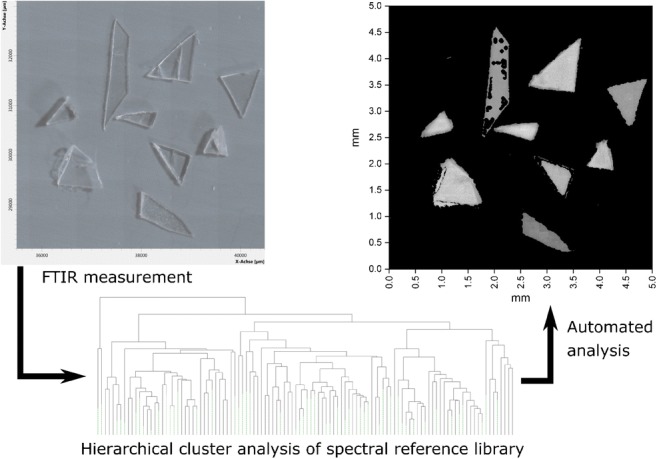
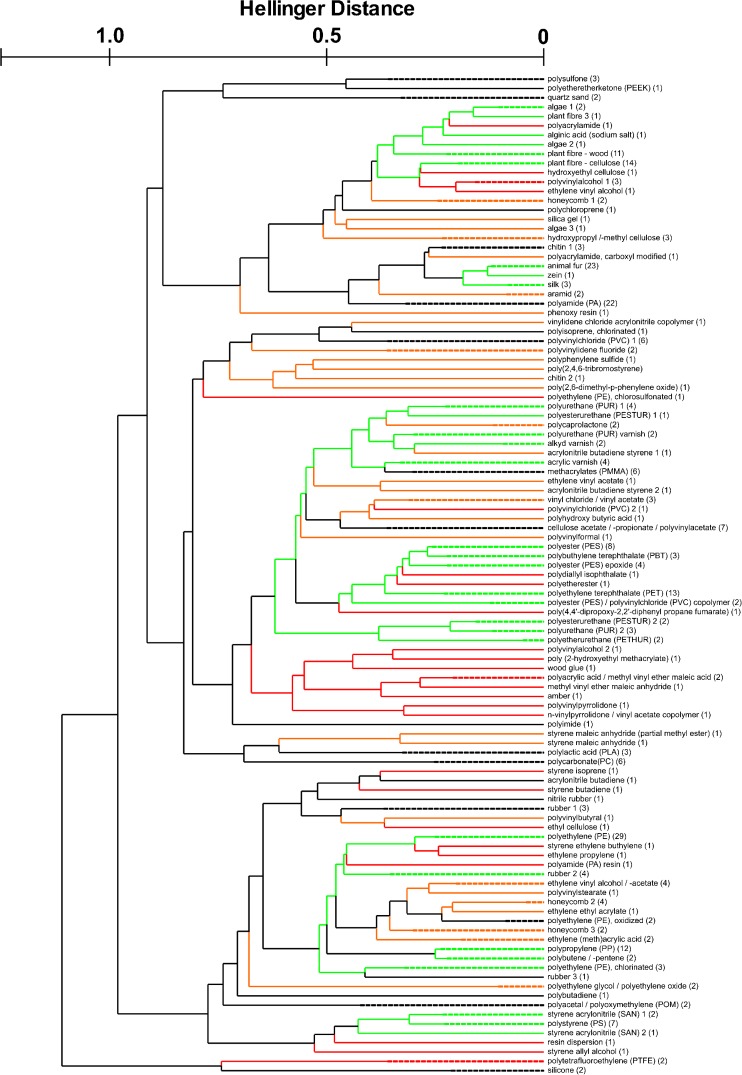
The identification of microplastics becomes increasingly challenging with decreasing particle size and increasing sample heterogeneity. The analysis of microplastic samples by Fourier transform infrared (FTIR) spectroscopy is a versatile, bias-free tool to succeed at this task. In this study, we provide an adaptable reference database, which can be applied to single-particle identification as well as methods like chemical imaging based on FTIR microscopy. The large datasets generated by chemical imaging can be further investigated by automated analysis, which does, however, require a carefully designed database. The novel database design is based on the hierarchical cluster analysis of reference spectra in the spectral range from 3600 to 1250 cm-1. The hereby generated database entries were optimized for the automated analysis software with defined reference datasets. The design was further tested for its customizability with additional entries. The final reference database was extensively tested on reference datasets and environmental samples. Data quality by means of correct particle identification and depiction significantly increased compared to that of previous databases, proving the applicability of the concept and highlighting the importance of this work. Our novel database provides a reference point for data comparison with future and previous microplastic studies that are based on different databases. Graphical abstract ᅟ.
Keywords: Database; FTIR; Imaging; Infrared; Microplastics; Spectroscopy.
Conflict of interest statement
The authors declare that they have no conflict of interest.
Figures
References
-
- GESAMP. Sources, fate and effects of microplastics in the marine environment: a global assessment. Rep Stud GESAMP. 2015;90:1–98.
Grants and funding
LinkOut - more resources
Full Text Sources
Other Literature Sources
