Incidence of Cerebral Palsy in Korea and the Effect of Socioeconomic Status: A Population-Based Nationwide Study
- PMID: 29978615
- PMCID: PMC6037601
- DOI: 10.3349/ymj.2018.59.6.781
Incidence of Cerebral Palsy in Korea and the Effect of Socioeconomic Status: A Population-Based Nationwide Study
Abstract
Purpose: Cerebral palsy (CP) is a neurodevelopmental disorder that causes serious disability. Prematurity and low birth weight (LBW) are known to be the strongest risk factors of CP. While socioeconomic status (SES) has been found to influence the occurrence of CP, prematurity, and LBW, no studies have investigated this effect in Korea. The aim of this study was to evaluate the incidence of CP, prematurity, and LBW in Korea, as well as the effect of SES thereon.
Materials and methods: Data were obtained from the National Health Information Database from 2007 to 2013; persons with a history of CP, prematurity, and LBW were investigated by year. SES was defined in accordance with income quintiles, birth regions, and coverage classification.
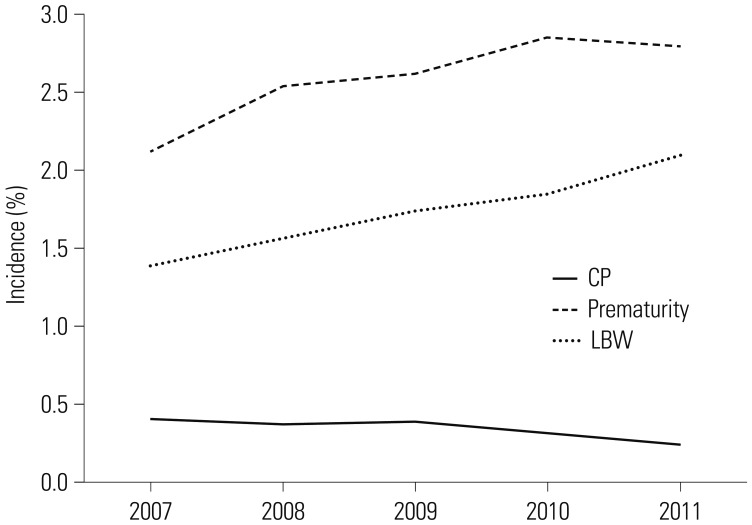
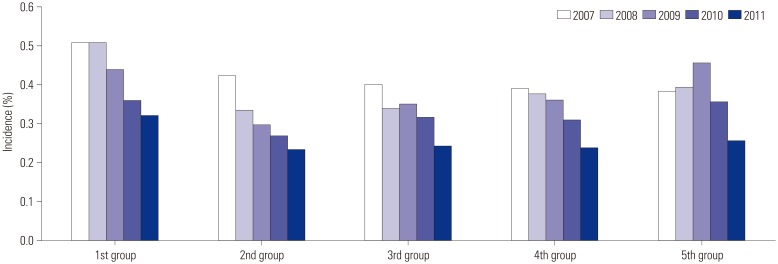
Results: The incidence of CP decreased over the last five years, despite increased rates of prematurity and LBW. CP incidence was significantly lower in affluent groups than in the most deprived group, although this difference disappeared after controlling for confounders. The incidence of CP was significantly higher in medical aid beneficiaries, even after controlling for confounders.
Conclusion: CP incidence in Korea has decreased over the last five years, despite an increase in high-risk deliveries. Income level had no effect in CP incidence. These results may aid CP management and prevention policies.
Keywords: Cerebral palsy; incidence; low birth weight; premature birth; socioeconomic factors.
© Copyright: Yonsei University College of Medicine 2018.
Conflict of interest statement
The authors have no financial conflicts of interest.
Figures
References
-
- Dolk H, Pattenden S, Bonellie S, Colver A, King A, Kurinczuk JJ, et al. Socio-economic inequalities in cerebral palsy prevalence in the United Kingdom: a register-based study. Paediatr Perinat Epidemiol. 2010;24:149–155. - PubMed
MeSH terms
LinkOut - more resources
Full Text Sources
Other Literature Sources
Medical
Miscellaneous