


Reaching Those At Risk for Psychiatric Disorders and Suicidal Ideation: Facebook Advertisements to Recruit Military Veterans
- PMID: 29980498
- PMCID: PMC6053612
- DOI: 10.2196/10078
Reaching Those At Risk for Psychiatric Disorders and Suicidal Ideation: Facebook Advertisements to Recruit Military Veterans
Erratum in
-
Correction: Reaching Those At Risk for Psychiatric Disorders and Suicidal Ideation: Facebook Advertisements to Recruit Military Veterans.JMIR Ment Health. 2019 Jan 9;6(1):e13035. doi: 10.2196/13035. JMIR Ment Health. 2019. PMID: 30626563 Free PMC article.
Abstract
Background: Younger military veterans are at high risk for psychiatric disorders and suicide. Reaching and engaging veterans in mental health care and research is challenging. Social media platforms may be an effective channel to connect with veterans.
Objective: This study tested the effectiveness of Facebook advertisements in reaching and recruiting Iraq and Afghanistan-era military veterans in a research study focused on mental health.
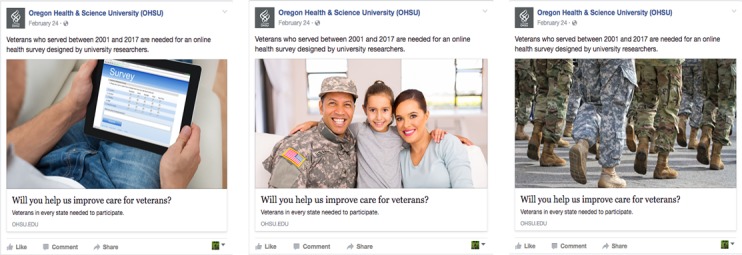
Methods: Facebook ads requesting participation in an online health survey ran for six weeks in 2017. Ads varied imagery and headlines. Validated instruments were used to screen for psychiatric disorders and suicidality. Outcomes included impressions, click-through rate, survey completion, and cost per survey completed.
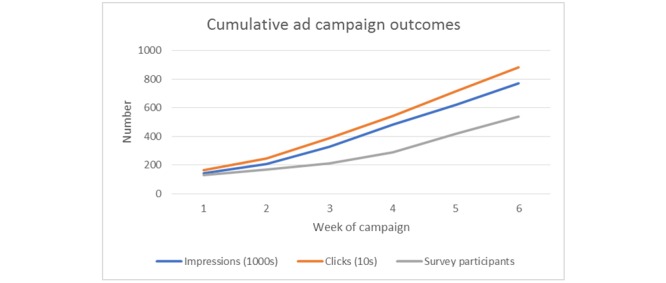
Results: Advertisements produced 827,918 impressions, 9,527 clicks, and 587 survey completions. Lack of enrollment in Veterans Affairs health care (193/587, 33%) and positive screens for current mental health problems were common, including posttraumatic stress disorder (266/585, 45%), problematic drinking (243/584, 42%), major depression (164/586, 28%), and suicidality (132/585, 23%). Approximately half of the survey participants (285/587, 49%) were recruited with just 2 of the 15 ads, which showed soldiers marching tied to an "incentive" or "sharing" headline. These 2 ads were also the most cost-effective, at US $4.88 and US $5.90 per participant, respectively. Among veterans with current suicidal ideation, the survey-taking image resulted in higher survey completion than the soldiers marching image (P=.007).
Conclusions: Facebook advertisements are effective in rapidly and inexpensively reaching military veterans, including those at risk for mental health problems and suicidality, and those not receiving Veterans Affairs health care. Advertisement image and headlines may help optimize the effectiveness of advertisements for specific subgroups.
Keywords: Facebook; Veterans Affairs; methodology; social media; veterans.
©Alan R Teo, Samuel BL Liebow, Benjamin Chan, Steven K Dobscha, Amanda L Graham. Originally published in JMIR Mental Health (http://mental.jmir.org), 05.07.2018.
Conflict of interest statement
Conflicts of Interest: None declared.
Figures
References
-
- Seal KH, Bertenthal D, Miner CR, Sen S, Marmar C. Bringing the war back home: mental health disorders among 103,788 US veterans returning from Iraq and Afghanistan seen at Department of Veterans Affairs facilities. Arch Intern Med. 2007 Mar 12;167(5):476–82. doi: 10.1001/archinte.167.5.476.167/5/476 - DOI - PubMed
-
- Reger MA, Smolenski DJ, Skopp NA, Metzger-Abamukang MJ, Kang HK, Bullman TA, Perdue S, Gahm GA. Risk of Suicide Among US Military Service Members Following Operation Enduring Freedom or Operation Iraqi Freedom Deployment and Separation From the US Military. JAMA Psychiatry. 2015 Jun;72(6):561–9. doi: 10.1001/jamapsychiatry.2014.3195.2211891 - DOI - PubMed
-
- Analysis of VA Health Care Utilization among Operation Enduring Freedom (OEF), Operation Iraqi Freedom (OIF), and Operation New Dawn (OND) Veterans. 2017. [2018-02-08]. (Epidemiology Program, Post-Deployment Health Group, Office of Patient Care Services, Veterans Health Administration, US Department of Veterans Affairs 2017 https://www.publichealth.va.gov/docs/epidemiology/healthcare-utilization... .
LinkOut - more resources
Full Text Sources
Other Literature Sources
Miscellaneous
