Review
. 2018 Jul 6;131(13):jcs216499.
doi: 10.1242/jcs.216499.

The enigmatic endosome - sorting the ins and outs of endocytic trafficking

Affiliations
Review

The enigmatic endosome - sorting the ins and outs of endocytic trafficking

Naava Naslavsky et al. J Cell Sci. .

Abstract

The early endosome (EE), also known as the sorting endosome (SE) is a crucial station for the sorting of cargoes, such as receptors and lipids, through the endocytic pathways. The term endosome relates to the receptacle-like nature of this organelle, to which endocytosed cargoes are funneled upon internalization from the plasma membrane. Having been delivered by the fusion of internalized vesicles with the EE or SE, cargo molecules are then sorted to a variety of endocytic pathways, including the endo-lysosomal pathway for degradation, direct or rapid recycling to the plasma membrane, and to a slower recycling pathway that involves a specialized form of endosome known as a recycling endosome (RE), often localized to the perinuclear endocytic recycling compartment (ERC). It is striking that 'the endosome', which plays such essential cellular roles, has managed to avoid a precise description, and its characteristics remain ambiguous and heterogeneous. Moreover, despite the rapid advances in scientific methodologies, including breakthroughs in light microscopy, overall, the endosome remains poorly defined. This Review will attempt to collate key characteristics of the different types of endosomes and provide a platform for discussion of this unique and fascinating collection of organelles. Moreover, under-developed, poorly understood and important open questions will be discussed.

Keywords: Budding; Early endosome; Fission; Late endosome; Recycling endosome; Sorting endosome.


Conflict of interest statement

Competing interestsThe authors declare no competing or financial interests.

Figures
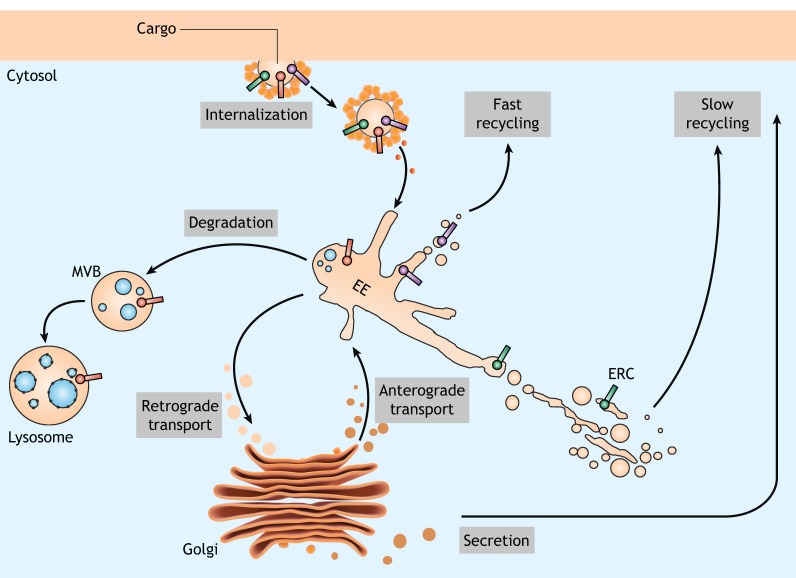
Fig. 1.
Fig. 1.
Overview of endocytic pathways. Once internalized from the plasma membrane, membrane-bound vesicles that carry receptors from the cell surface fuse with the EEs. The EE serves as a sorting station from which either tubulo-vesicular carriers deliver cargo to the endo-lysosomal system for degradation, or cargoes are recycled directly or indirectly to the plasma membrane via the endocytic recycling compartment.
Fig. 2.
Fig. 2.
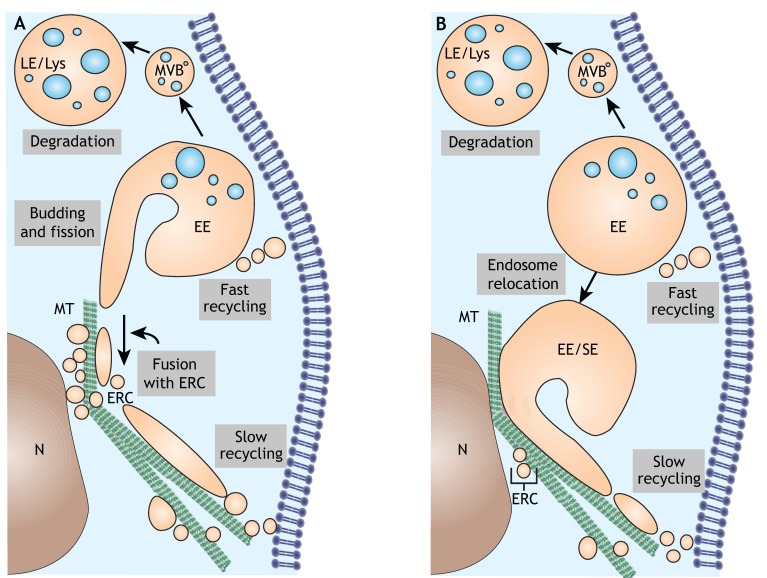
Possible models for the slow recycling pathway. EEs sort cargo toward degradation in the endo-lysosomal pathway, or to the recycling pathways, either directly from EEs or through a transitory ERC. (A) Budding and fission model. Here, vesicles and tubules bud and undergo fission at the EE and carry cargo in transport carriers to the perinuclear region of the cell, where they likely undergo fusion with recycling endosomes. REs at the ERC are dynamic, fuse with one another, and eventually vesicles pinch off in a budding process leading to fission and the generation of transport carriers that transport recycling receptors along microtubules to the plasma membrane. (B) Endosome relocation model. In this model, recycling occurs from largely intact EEs that do not have any intralumenal vesicles and that are repositioned and transported along microtubules to the ERC region. Eventually, tubules and vesicles undergo budding and fission from the EEs that have relocalized to the ERC to recycle cargo receptors along microtubules to the plasma membrane. MT, microtubules; N, nucleus.
Fig. 3.
Fig. 3.
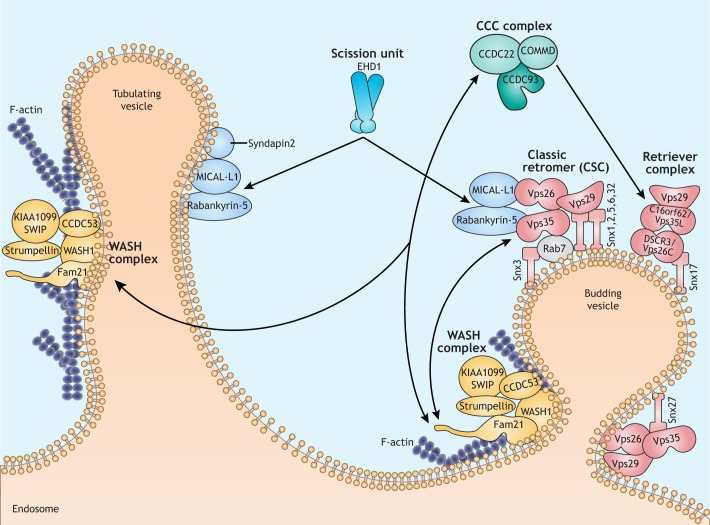
Endocytic regulatory complexes at the EE. EEs recruit multiple endocytic complexes for the sorting of cargo and the subsequent budding and fission of transport carriers. The classic retromer (CSC), comprising Vps35, Vps26 and Vps29, is recruited to EE through interactions with Snx3, Rab7 and/or SNX BAR proteins (Snx1, Snx2, Snx5, Snx6 and Snx32), or Snx27. Additional interactions occur between the retromer and WASH complex that are mediated by the WASH subunit Fam21 and the retromer component Vps35. The WASH complex binds to phospholipids through its Fam21 subunit, and nucleates actin at the EE, potentially providing a force for constriction of budding vesicles. The WASH complex also interacts with the CCC complex through the binding of Fam21 to the CCDC93 subunit of the CCC complex, and regulates endosome to plasma membrane recycling through an as-yet-uncharacterized mechanism. The CCC complex is also responsible for recruitment of the retriever complex to the EE, where it interacts with Snx17 at the EE membrane and selects cargo such as β1 integrins to budding vesicles for recycling. Tubular carriers are generated by complexes that include MICAL-L1 and syndapin 2, a BAR-domain protein that inserts itself into bilayers and bends membranes (Dharmalingam et al., 2009; Giridharan et al., 2013). EHD1 interacts with syndapin 2, MICAL-L1, rabankyrin-5 and the retromer, leading to speculation that EHD1 could serve as a general fission factor not only for MICAL-L1-containing tubular carriers, but also for tubulovesicular structures that contain the retromer and affiliated cargo.
Fig. 4.
Fig. 4.
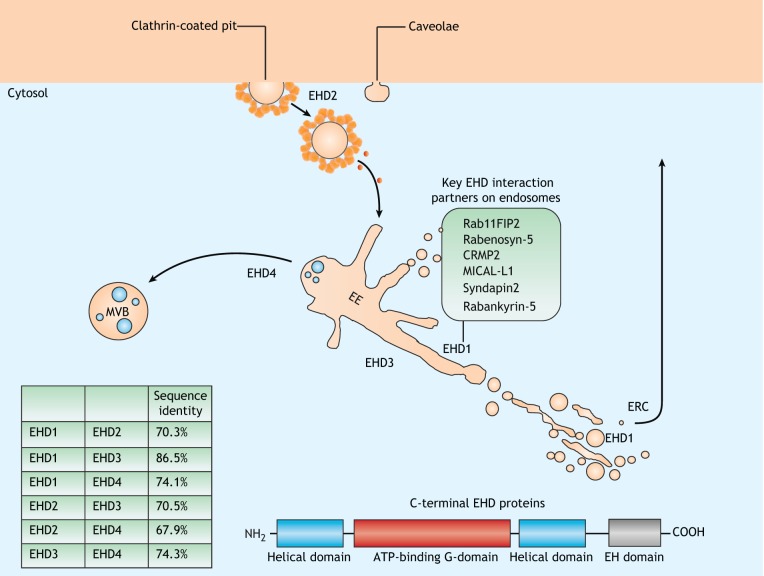
Role of EHD proteins in membrane trafficking. The four EHD proteins display considerable sequence identity, from ∼68–87%, and have been implicated in membrane remodeling (table inset). EHD1, EHD3 and EHD4 have been characterized in the regulation of endosomal transport, primarily at the EE, with EHD1 additionally involved in the regulation of recycling from the ERC. EHD2, the most divergent of the EHD proteins, controls caveolar mobility and may influence internalization at the plasma membrane. For further details on the EHD protein family see Naslavsky and Caplan (2011).

References

    1. Allaire P. D., Seyed Sadr M., Chaineau M., Seyed Sadr E., Konefal S., Fotouhi M., Maret D., Ritter B., Del Maestro R. F. and McPherson P. S. (2013). Interplay between Rab35 and Arf6 controls cargo recycling to coordinate cell adhesion and migration. J. Cell Sci. 126, 722-731. 10.1242/jcs.112375 - DOI - PubMed
    1. Arighi C. N., Hartnell L. M., Aguilar R. C., Haft C. R. and Bonifacino J. S. (2004). Role of the mammalian retromer in sorting of the cation-independent mannose 6-phosphate receptor. J. Cell Biol. 165, 123-133. 10.1083/jcb.200312055 - DOI - PMC - PubMed
    1. Babbey C. M., Ahktar N., Wang E., Chen C. C.-H., Grant B. D. and Dunn K. W. (2006). Rab10 regulates membrane transport through early endosomes of polarized Madin-Darby canine kidney cells. Mol. Biol. Cell 17, 3156-3175. 10.1091/mbc.e05-08-0799 - DOI - PMC - PubMed
    1. Babst M., Sato T. K., Banta L. M. and Emr S. D. (1997). Endosomal transport function in yeast requires a novel AAA-type ATPase, Vps4p. EMBO J. 16, 1820-1831. 10.1093/emboj/16.8.1820 - DOI - PMC - PubMed
    1. Babst M., Katzmann D. J., Snyder W. B., Wendland B. and Emr S. D. (2002). Endosome-associated complex, ESCRT-II, recruits transport machinery for protein sorting at the multivesicular body. Dev. Cell 3, 283-289. 10.1016/S1534-5807(02)00219-8 - DOI - PubMed

Publication types

LinkOut - more resources