. 2018 Jul 6;9(1):2638.
doi: 10.1038/s41467-018-05051-5.

A mosaic monoploid reference sequence for the highly complex genome of sugarcane

Affiliations

A mosaic monoploid reference sequence for the highly complex genome of sugarcane

Olivier Garsmeur et al. Nat Commun. .

Abstract

Sugarcane (Saccharum spp.) is a major crop for sugar and bioenergy production. Its highly polyploid, aneuploid, heterozygous, and interspecific genome poses major challenges for producing a reference sequence. We exploited colinearity with sorghum to produce a BAC-based monoploid genome sequence of sugarcane. A minimum tiling path of 4660 sugarcane BAC that best covers the gene-rich part of the sorghum genome was selected based on whole-genome profiling, sequenced, and assembled in a 382-Mb single tiling path of a high-quality sequence. A total of 25,316 protein-coding gene models are predicted, 17% of which display no colinearity with their sorghum orthologs. We show that the two species, S. officinarum and S. spontaneum, involved in modern cultivars differ by their transposable elements and by a few large chromosomal rearrangements, explaining their distinct genome size and distinct basic chromosome numbers while also suggesting that polyploidization arose in both lineages after their divergence.


Conflict of interest statement

The authors declare no competing interests.

Figures
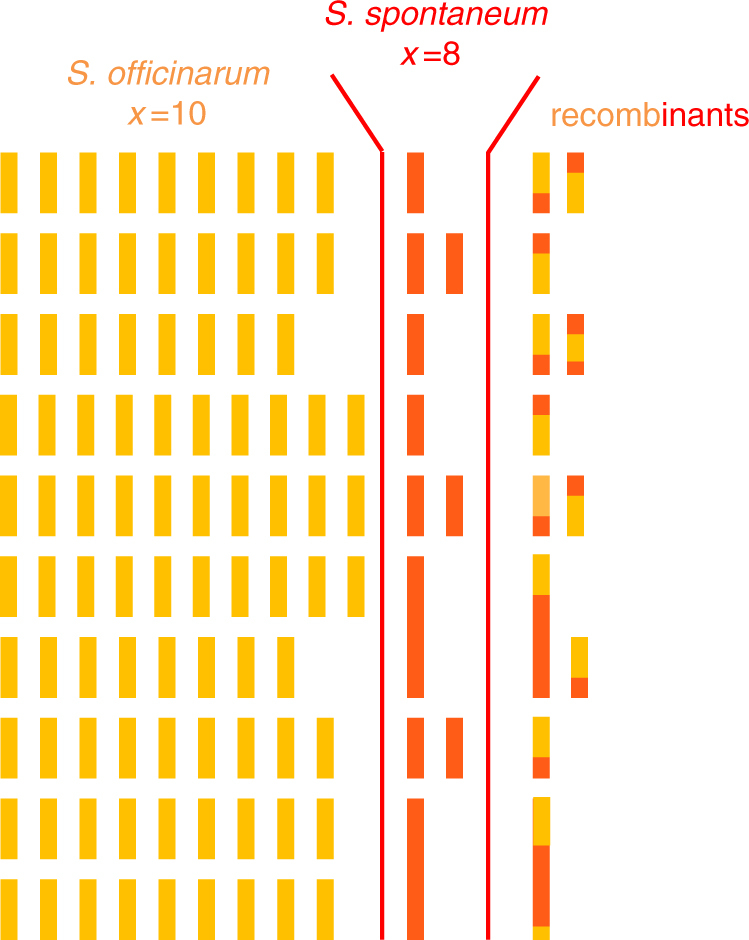
Fig. 1
Fig. 1
Schematic representation of the genome of a typical modern sugarcane cultivar. Each bar represents a chromosome, in orange or red when originating from S. officinarum or S. spontaneum, respectively. Chromosomes aligned on the same row are hom(oe)ologous chromosomes (HG). The key characteristics of this genome are the high polyploidy, aneuploidy, bispecific origin of the chromosomes, the existence of structural differences between chromosomes of the two origins, and the presence of interspecific chromosome recombinants
Fig. 2
Fig. 2
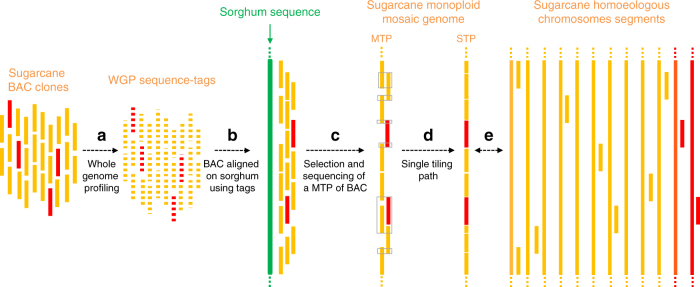
Sequencing strategy targeting the sugarcane monoploid genome based on the overall synteny and colinearity conservation within sugarcane hom(oe)ologs and with sorghum. a WGP sequence tags were produced from R570 sugarcane BACs. b WGP sequence tags were aligned onto the sorghum sequence, thus allowing the location of sugarcane BACs on sorghum. c A minimum tiling path of a BAC (MTP) corresponding to a monoploid sugarcane genome was defined and sequenced. d Overlapping BAC sequences were trimmed to construct the single tiling path (STP). e The STP sequence contains BAC contigs that belong to distinct hom(oe)ologous chromosomes. S. officinarum and S. spontaneum chromosome segments are represented in orange and red, respectively
Fig. 3
Fig. 3
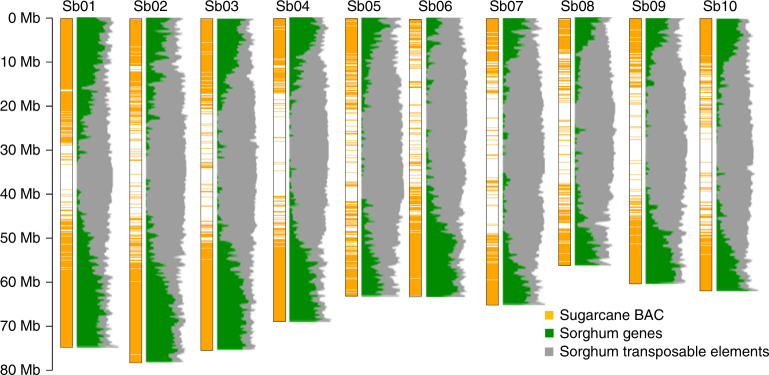
Distribution of the 11,732 sugarcane BACs aligned onto the sorghum genome through WGP. Sugarcane BAC clones are represented by orange bars. Sorghum gene and transposable element densities are represented in green and gray, respectively
Fig. 4
Fig. 4
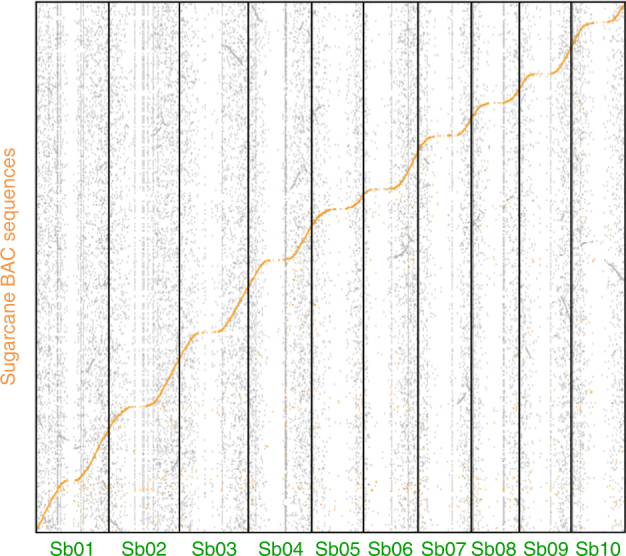
Coverage of the sorghum genome by the sequenced sugarcane BAC MTP. Dot plot with alignment of BAC sequences from the sugarcane MTP (y-axis) on the sorghum genomic sequence (x-axis). The sorghum genome covered by the sugarcane MTP sequence is highlighted in orange. Gray segments correspond to duplicated regions resulting from ancestral whole-genome duplications in Poales
Fig. 5
Fig. 5
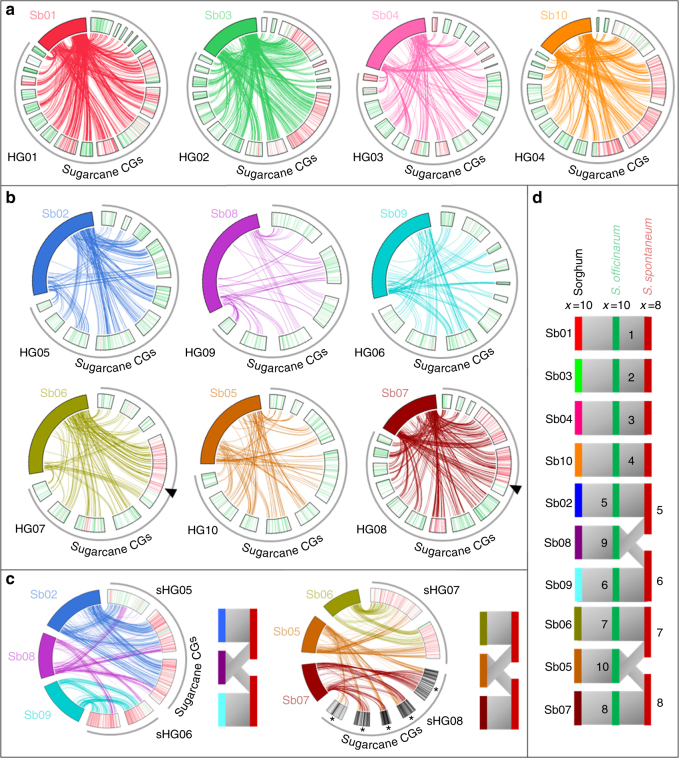
SNP-based sugarcane genetic map with putative origin of cosegregation groups and comparison with sorghum chromosomes. The 132 CGs of cultivar R570 are represented with SNP markers assigned to S. officinarum or S. spontaneum indicated by green and red bars, respectively. Circos represents orthologous relationships between sugarcane CGs and sorghum chromosomes (Sb1–Sb10) based on the alignment, for each CG, of a majority of the markers on one (a, b) or two (c) sorghum chromosomes (color links) (see Supplementary Fig. 2 for representation of all links). Based on these orthologous relationships, CGs were assembled in hom(oe)ology groups (HGs): a Four HGs (HG1–HG4) including CGs from S. officinarum, S. spontaneum, and interspecific recombinants orthologous to one sorghum chromosome. b Six HGs (HG6–HG10) including S. officinarum CGs, and a few S. spontaneum and interspecific recombinant CGs orthologous to one sorghum chromosome. Arrows point to two interspecific recombinations (see text). c Two pairs of HGs (sHG5 and sHG6, and sHG7 and sHG8), each including S. spontaneum or interspecific recombinant CGs orthologous to two sorghum chromosomes. d Schematic comparison of the deduced basic genome organization in S. spontaneum (x = 8), S. officinarum (x = 10), and sorghum (x = 10). Asterisk represents CGs from the MQ76-53 SNP map (see text and Supplementary Fig. 3)

References

    1. European Commission of Agriculture and rural development. Sugar. http://ec.europa.eu/agriculture/sugar/index_en.htm.
    1. Gouy, M., Nibouche, S., Hoarau, J. H., & Costet, L. in Translational Genomics for Crop Breeding: Abiotic Stress, Yield and Quality, Vol. 2, (eds. Varshney, R. & Tuberosa, R.) Ch. 13, 211–237 (John Wiley & Sons, Ames, Chichester and Oxford, 2013).
    1. D’Hont A, Ison D, Alix K, Roux C, Glaszmann JC. Determination of basic chromosome numbers in the genus Saccharum by physical mapping of ribosomal RNA genes. Genome. 1998;41:221–225. doi: 10.1139/g98-023. - DOI
    1. Screenivasan, T. V., Ahloowalia, B. S. & Heinz, D. J. Sugarcane improvement through breeding. Cytogenetics5, 211–253 (1987).
    1. Brandes E. Origin, dispersal and use in breeding of the Melanesian garden sugarcane and their derivatives, Saccharum officinarum L. Proc. Int. Soc. Sugarcane Technol. 1956;9:709–750.

Publication types

Substances