Review
. 2019 Jan 1;144(1):8-25.
doi: 10.1002/ijc.31718. Epub 2018 Oct 31.

Aneuploidy: Cancer strength or vulnerability?

Affiliations
Review

Aneuploidy: Cancer strength or vulnerability?

Giorgia Simonetti et al. Int J Cancer. .

Abstract

Aneuploidy is a very rare and tissue-specific event in normal conditions, occurring in a low number of brain and liver cells. Its frequency increases in age-related disorders and is one of the hallmarks of cancer. Aneuploidy has been associated with defects in the spindle assembly checkpoint (SAC). However, the relationship between chromosome number alterations, SAC genes and tumor susceptibility remains unclear. Here, we provide a comprehensive review of SAC gene alterations at genomic and transcriptional level across human cancers and discuss the oncogenic and tumor suppressor functions of aneuploidy. SAC genes are rarely mutated but frequently overexpressed, with a negative prognostic impact on different tumor types. Both increased and decreased SAC gene expression show oncogenic potential in mice. SAC gene upregulation may drive aneuploidization and tumorigenesis through mitotic delay, coupled with additional oncogenic functions outside mitosis. The genomic background and environmental conditions influence the fate of aneuploid cells. Aneuploidy reduces cellular fitness. It induces growth and contact inhibition, mitotic and proteotoxic stress, cell senescence and production of reactive oxygen species. However, aneuploidy confers an evolutionary flexibility by favoring genome and chromosome instability (CIN), cellular adaptation, stem cell-like properties and immune escape. These properties represent the driving force of aneuploid cancers, especially under conditions of stress and pharmacological pressure, and are currently under investigation as potential therapeutic targets. Indeed, promising results have been obtained from synthetic lethal combinations exploiting CIN, mitotic defects, and aneuploidy-tolerating mechanisms as cancer vulnerability.

Keywords: aneuploidy; cancer therapy; carcinogenesis; spindle assembly checkpoint.


Figures

Figure 1
Figure 1
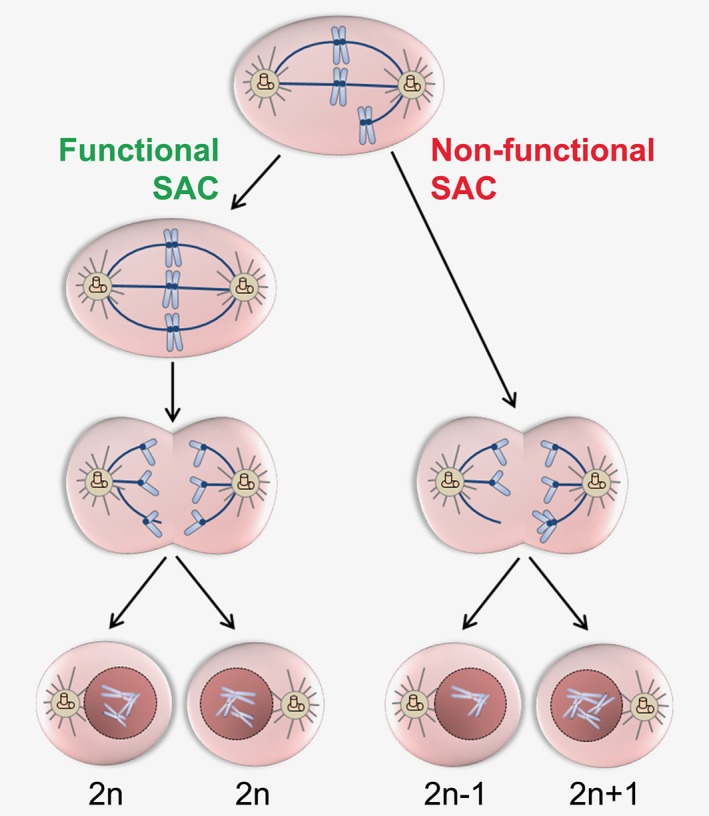
Generation of aneuploidy by non‐functional SAC. The SAC is activated by the presence of unattached or misaligned kinetochores and prevents chromosome segregation errors. A non‐functional SAC allows cells with unattached or misaligned kinetochores to proceed from metaphase to anaphase, resulting in daughter cells with an abnormal chromosome number.
Figure 2
Figure 2
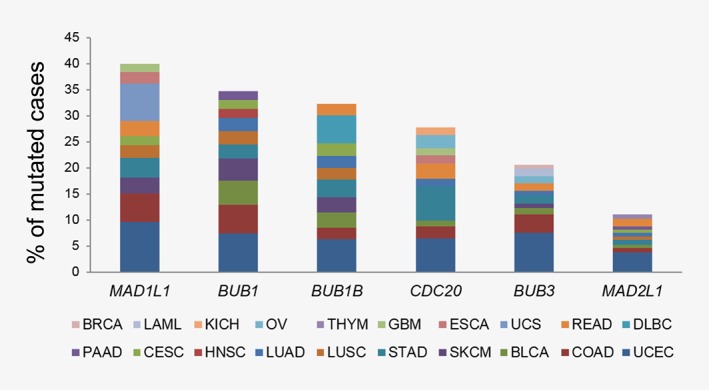
Distribution of SAC gene mutations across cancers. Frequency of patients with mutations in SAC genes from TCGA cohorts (LAML, Acute Myeloid Leukemia; BLCA, Bladder Urothelial Carcinoma; BRCA, Breast Invasive Carcinoma; CESC, Cervical Squamous Cell Carcinoma and Endocervical Adenocarcinoma; COAD, Colon Adenocarcinoma; ESCA, Esophageal Carcinoma; GBM, Glioblastoma Multiforme; HNSC, Head and Neck Squamous Cell Carcinoma; KICH, Kidney Chromophobe; LUAD, Lung Adenocarcinoma; LUSC, Lung Squamous Cell Carcinoma; DLBC, Diffuse Large B‐cell Lymphoma; OV, Ovarian Serous Cystadenocarcinoma; PAAD, Pancreatic Adenocarcinoma; READ, Rectum Adenocarcinoma; SKCM, Skin Cutaneous Melanoma; STAD, Stomach Adenocarcinoma; THYM, Thymoma; UCS, Uterine Carcinosarcoma; UCEC, Uterine Corpus Endometrial Carcinoma).
Figure 3
Figure 3
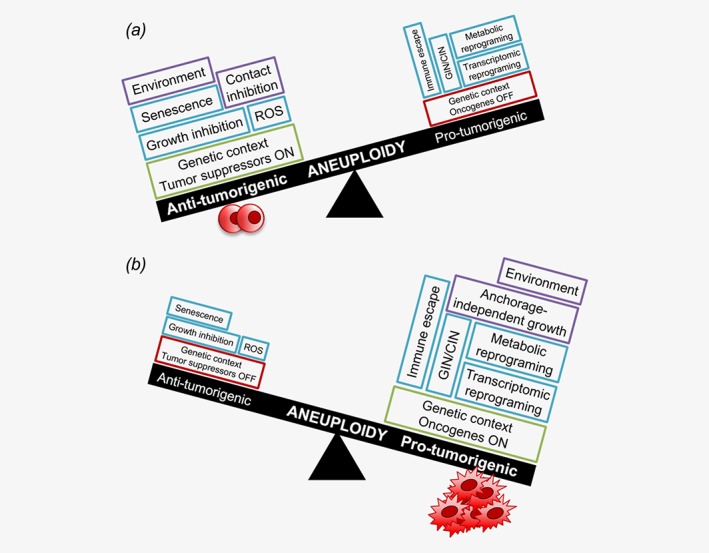
The complex relationship between aneuploidy and cancer. (a) Aneuploidy‐related growth and contact inhibition, ROS production, cell senescence can cooperate with environmental conditions and tumor suppressor activity to inhibit malignant transformation (round shaped cells represent nontransformed cells). (b) When prosurvival and protumorigenic events induced by aneuploidy (anchorage‐independent growth, transcriptional and metabolic reprogramming, GIN, CIN, immune escape) synergize with activation of oncogenes and favorable environmental conditions, cells carrying an aberrant chromosome number undergo malignant transformation (irregular shaped cells represent malignant cells; ROS, reactive oxygen species; CIN, chromosomal instability; GIN, genomic instability).

References

    1. Gupta S. Hepatic polyploidy and liver growth control. Semin Cancer Biol 2000;10:161–71. - PubMed
    1. Faggioli F, Vezzoni P, Montagna C. Single‐cell analysis of ploidy and centrosomes underscores the peculiarity of normal hepatocytes. PloS One 2011;6:e26080. - PMC - PubMed
    1. Duncan AW, Taylor MH, Hickey RD, et al. The ploidy conveyor of mature hepatocytes as a source of genetic variation. Nature 2010;467:707–10. - PMC - PubMed
    1. Duncan AW, Hanlon Newell AE, Smith L, et al. Frequent aneuploidy among normal human hepatocytes. Gastroenterology 2012;142:25–8. - PMC - PubMed
    1. Duncan AW, Hanlon Newell AE, Bi W, et al. Aneuploidy as a mechanism for stress‐induced liver adaptation. J Clin Invest 2012;122:3307–15. - PMC - PubMed

Publication types

LinkOut - more resources