


No Association Between Screening for Hepatocellular Carcinoma and Reduced Cancer-Related Mortality in Patients With Cirrhosis
- PMID: 29981779
- PMCID: PMC6180323
- DOI: 10.1053/j.gastro.2018.06.079
No Association Between Screening for Hepatocellular Carcinoma and Reduced Cancer-Related Mortality in Patients With Cirrhosis
Abstract
Background & aims: Screening patients with cirrhosis for hepatocellular carcinoma (HCC) has been recommended. We conducted a matched case-control study within the US Veterans Affairs (VA) health care system to determine whether screening by abdominal ultrasonography (USS) and/or by measuring serum level of α-fetoprotein (AFP) was associated with decreased cancer-related mortality in patients with cirrhosis.
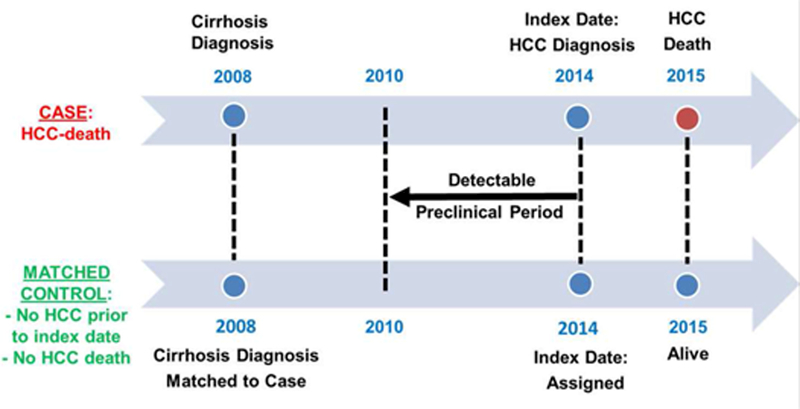
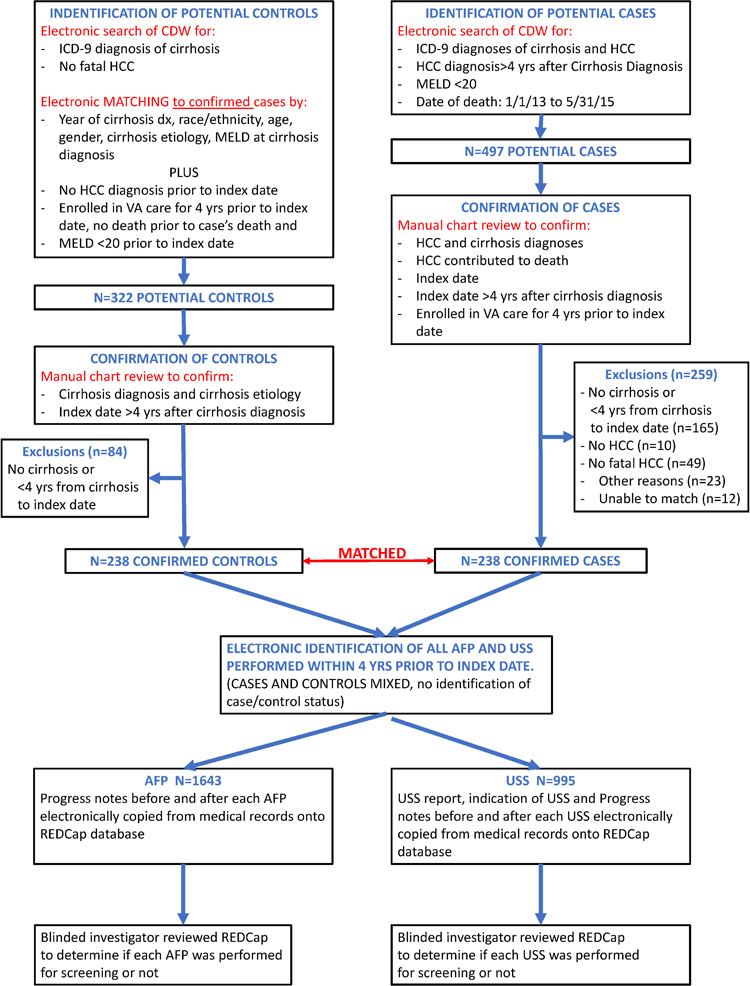
Methods: We defined cases (n = 238) as patients with cirrhosis who died of HCC from January 1, 2013 through August 31, 2015 and had been in VA care with a diagnosis of cirrhosis for at least 4 years before the diagnosis of HCC. We matched each case to 1 control (n = 238), defined as a patient with cirrhosis who did not die of HCC and had been in VA care for at least 4 years before the date of the matched case's HCC diagnosis. Controls were matched to cases by year of cirrhosis diagnosis, race and ethnicity, age, sex, etiology of cirrhosis, Model for End-Stage Liver Disease score, and VA medical center. We identified all USS and serum AFP tests performed within 4 years before the date of HCC diagnosis in cases or the equivalent index date in controls and determined by chart extraction (blinded to case or control status) whether these tests were performed for screening.
Results: There were no significant differences between cases and controls in the proportions of patients who underwent screening USS (52.9% vs 54.2%), screening measurement of serum AFP (74.8% vs 73.5%), screening USS or measurement of serum AFP (81.1% vs 79.4%), or screening USS and measurement of serum AFP (46.6% vs 48.3%) within 4 years before the index date, with or without adjusting for potential confounders. There also was no difference in receipt of these screening tests within 1, 2, or 3 years before the index date.
Conclusions: In a matched case-control study of the VA health care system, we found that screening patients with cirrhosis for HCC by USS, measurement of serum AFP, either test, or both tests was not associated with decreased HCC-related mortality. We encourage additional case-control studies to evaluate the efficacy of screening for HCC in other health care systems, in which available records are sufficiently detailed to enable identification of the indication for USS and AFP tests.
Keywords: Liver Cancer; Liver Transplantation; Surveillance; Survival.
Copyright © 2018. Published by Elsevier Inc.
Figures
Comment in
-
Should We Abandon Current Hepatocellular Carcinoma Screening Practices?Gastroenterology. 2018 Oct;155(4):972-974. doi: 10.1053/j.gastro.2018.09.001. Epub 2018 Sep 8. Gastroenterology. 2018. PMID: 30201363 No abstract available.
-
Screening for Hepatocellular Carcinoma in Cirrhosis: Challenges and Unresolved Issues.Gastroenterology. 2019 Mar;156(4):1217-1218. doi: 10.1053/j.gastro.2018.11.068. Epub 2018 Dec 10. Gastroenterology. 2019. PMID: 30543794 No abstract available.
-
Screening for Hepatocellular Carcinoma to Improve Cancer-Related Mortality: Looking Behind When We Should Be Looking Ahead.Gastroenterology. 2019 Mar;156(4):1215-1217. doi: 10.1053/j.gastro.2018.09.061. Epub 2018 Dec 10. Gastroenterology. 2019. PMID: 30543796 No abstract available.
-
RE: No Association Between Screening for Hepatocellular Carcinoma and Reduced Cancer-Related Mortality in Patients With Cirrhosis.Gastroenterology. 2019 Mar;156(4):1217. doi: 10.1053/j.gastro.2018.09.060. Epub 2018 Dec 10. Gastroenterology. 2019. PMID: 30543798 No abstract available.
-
Hepatocellular Carcinoma Surveillance: An Effective But Complex Process.Gastroenterology. 2019 Mar;156(4):1215. doi: 10.1053/j.gastro.2018.08.066. Epub 2018 Dec 10. Gastroenterology. 2019. PMID: 30543799 No abstract available.
-
Reply.Gastroenterology. 2019 Mar;156(4):1218-1220. doi: 10.1053/j.gastro.2019.02.024. Epub 2019 Feb 19. Gastroenterology. 2019. PMID: 30794764 No abstract available.
-
Is there a real survival benefit of surveillance for hepatocellular carcinoma in cirrhotic patients?Hepatobiliary Surg Nutr. 2019 Apr;8(2):148-150. doi: 10.21037/hbsn.2018.11.15. Hepatobiliary Surg Nutr. 2019. PMID: 31098364 Free PMC article. No abstract available.
-
Hepatocellular carcinoma surveillance: an open question.Hepatobiliary Surg Nutr. 2019 Aug;8(4):431-432. doi: 10.21037/hbsn.2019.02.10. Hepatobiliary Surg Nutr. 2019. PMID: 31489324 Free PMC article. No abstract available.
References
-
- El-Serag HB. Hepatocellular carcinoma. N Engl J Med 2011;365:1118–27. - PubMed
-
- Heimbach J, Kulik LM, Finn R, et al. Aasld guidelines for the treatment of hepatocellular carcinoma. Hepatology 2017. - PubMed
-
- European Association For The Study Of The Liver and European Organisation For Research Treatment Of Cancer (EASL-EORTC) clinical practice guidelines: management of hepatocellular carcinoma. J Hepatol 2012;56:908–43. - PubMed
-
- American Cancer Society. Can Liver Cancer Be Found Early? In: American Cancer Society, ed. Volume 2018 Atlanta, GA: American Cancer Society,, 2016.
Publication types
MeSH terms
Substances
Grants and funding
LinkOut - more resources
Full Text Sources
Other Literature Sources
Medical
