Review
. 2019 Mar:133:254-261.
doi: 10.1016/j.freeradbiomed.2018.07.001. Epub 2018 Jul 5.

Placental iron transport: The mechanism and regulatory circuits

Affiliations
Review

Placental iron transport: The mechanism and regulatory circuits

Veena Sangkhae et al. Free Radic Biol Med. 2019 Mar.

Abstract

As the interface between the fetal and maternal circulation, the placenta facilitates both nutrient and waste exchange for the developing fetus. Iron is essential for healthy pregnancy, and transport of iron across the placenta is required for fetal growth and development. Perturbation of this transfer can lead to adverse pregnancy outcomes. Despite its importance, our understanding of how a large amount of iron is transported across placental membranes, how this process is regulated, and which iron transporter proteins function in different placental cells remains rudimentary. Mechanistic studies in mouse models, including placenta-specific deletion or overexpression of iron-related proteins will be essential to make progress. This review summarizes our current understanding about iron transport across the syncytiotrophoblast under physiological conditions and identifies areas for further investigation.

Keywords: Iron; Placenta; Pregnancy.


Conflict of interest statement

Disclosures

VS has no conflict of interest. EN is a consultant and stockholder of Intrinsic LifeSciences (a company developing hepcidin diagnostics) and Silarus Therapeutics (a company developing erythroferrone-targeted therapeutics).

Figures
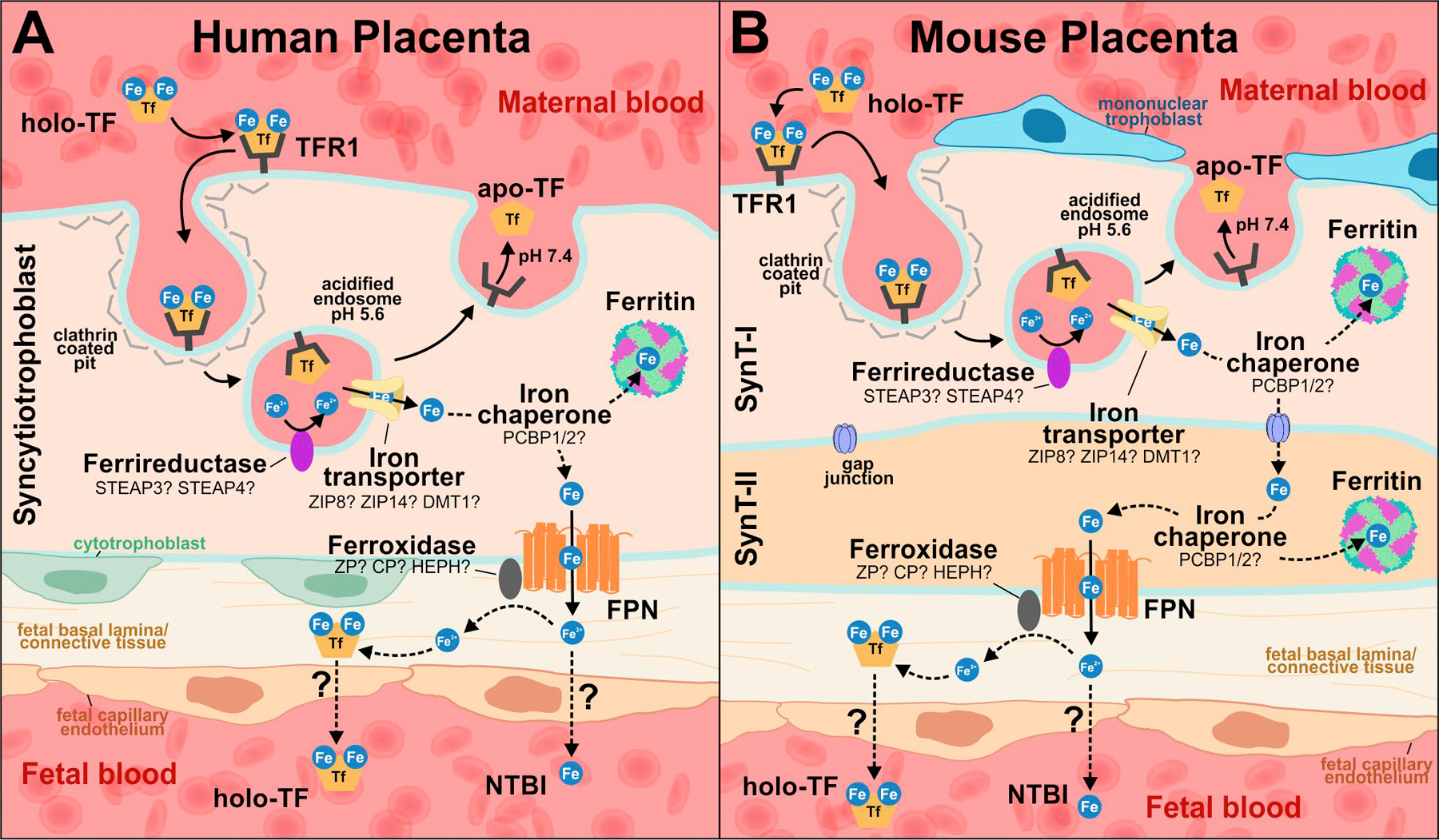
Fig. 1.
Fig. 1.. Iron trafficking across the syncytiotrophoblast.
(A) Human placenta, with a single layer of syncytiotrophoblast. (B) Mouse placenta, with two syncytiotrophoblast layers (SynT-I and SynT-II). In both humans and mice, transferrin-bound iron (holo-TF) from the maternal circulation binds to transferrin receptor, TFR1, expressed on the apical membrane of placental syncytiotrophoblast (SynT-I in mice). The iron-transferrin-receptor complex is internalized via clathrin-mediated endocytosis, and ferric iron (Fe3+) is released from transferrin in acidified endosomes. The apo-TF/TFR1 complex is recycled back to the cell surface. Fe3+ in the endosome is thought to be reduced to ferrous iron (Fe2+) by a ferrireductase and exported into the cytoplasm through an endosomal iron transporter. Cytoplasmic Fe may be chaperoned, possibly by PCBP1 or 2, either to ferritin for storage or to FPN on the basal membrane (SynT-II in mice) for export toward the fetal circulation. In the mouse placenta (B), it is unknown how Fe is transported from SynT-I to SynT-II, but it likely occurs through gap junctions. The fate of iron following export through FPN is unclear; it may enter the fetal circulation as NTBI or oxidized to Fe3+ by ferroxidases and loaded onto transferrin prior to reaching the fetal circulation.

References

    1. Duck KA, Connor JR, Iron uptake and transport across physiological barriers, Biometals: Int. J. Role Metal. Ions Biol. Biochem. Med 29 (2016) 573–591. - PMC - PubMed
    1. Wardman P, Candeias LP, Fenton chemistry: an introduction, Radiat. Res 145 (1996) 523–531. - PubMed
    1. Fisher AL, Nemeth E, Iron homeostasis during pregnancy, Am. J. Clin. Nutr 106 (2017) 1567S–1574S. - PMC - PubMed
    1. Widdowson EM, Spray CM, Chemical development in utero, Arch. Dis. Child 26 (1951) 205–214. - PMC - PubMed
    1. Bothwell TH, Iron requirements in pregnancy and strategies to meet them, Am. J. Clin. Nutr 72 (2000) 257S–264S. - PubMed

Publication types
