


Using wearable technology to predict health outcomes: a literature review
- PMID: 29982520
- PMCID: PMC7263786
- DOI: 10.1093/jamia/ocy082
Using wearable technology to predict health outcomes: a literature review
Abstract
Objective: To review and analyze the literature to determine whether wearable technologies can predict health outcomes.
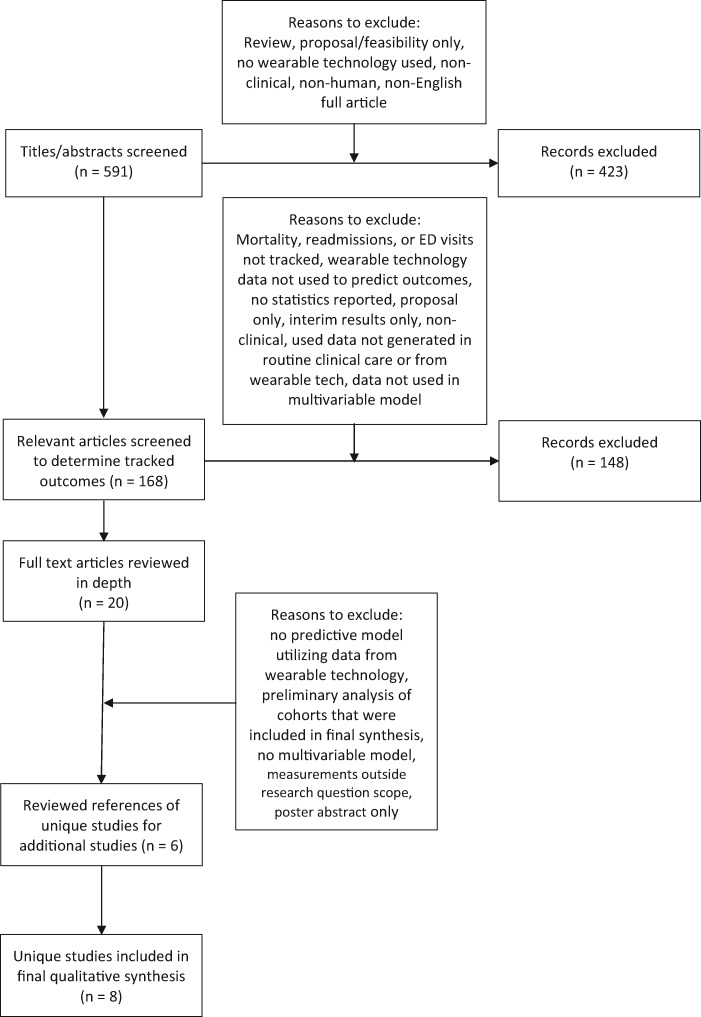
Materials and methods: We queried Ovid Medline 1946 -, Embase 1947 -, Scopus 1823 -, the Cochrane Library, clinicaltrials.gov 1997 - April 17, 2018, and IEEE Xplore Digital Library and Engineering Village through April 18, 2018, for studies utilizing wearable technology in clinical outcome prediction. Studies were deemed relevant to the research question if they involved human subjects, used wearable technology that tracked a health-related parameter, and incorporated data from wearable technology into a predictive model of mortality, readmission, and/or emergency department (ED) visits.
Results: Eight unique studies were directly related to the research question, and all were of at least moderate quality. Six studies developed models for readmission and two for mortality. In each of the eight studies, data obtained from wearable technology were predictive of or significantly associated with the tracked outcome.
Discussion: Only eight unique studies incorporated wearable technology data into predictive models. The eight studies were of moderate quality or higher and thereby provide proof of concept for the use of wearable technology in developing models that predict clinical outcomes.
Conclusion: Wearable technology has significant potential to assist in predicting clinical outcomes, but needs further study. Well-designed clinical trials that incorporate data from wearable technology into clinical outcome prediction models are required to realize the opportunities of this advancing technology.
Figures
References
-
- Hodgson CL,Udy AA,Bailey M, et al. The impact of disability in survivors of critical illness.Intensive Care Med 2017;437:992–1001. - PubMed
-
- Courtney M,Edwards H,Chang A, et al. Fewer emergency readmissions and better quality of life for older adults at risk of hospital readmission: A randomized controlled trial to determine the effectiveness of a 24-week exercise and telephone follow-up program.J Am Geriatr Soc 2009;573:395–402. - PubMed
-
- Violi F,Cangemi R,Falcone M, et al. Cardiovascular complications and short-term mortality risk in community-acquired pneumonia.Clin Infect Dis 2017;6411:1486–93. - PubMed
Publication types
MeSH terms
Grants and funding
LinkOut - more resources
Full Text Sources
Other Literature Sources
Miscellaneous
