. 2018 Jul 1;10(7):1687-1704.
doi: 10.1093/gbe/evy126.

Genome Evolution of Bartonellaceae Symbionts of Ants at the Opposite Ends of the Trophic Scale

Affiliations

Genome Evolution of Bartonellaceae Symbionts of Ants at the Opposite Ends of the Trophic Scale

Gaelle Bisch et al. Genome Biol Evol. .

Abstract

Many insects rely on bacterial symbionts to supply essential amino acids and vitamins that are deficient in their diets, but metabolic comparisons of closely related gut bacteria in insects with different dietary preferences have not been performed. Here, we demonstrate that herbivorous ants of the genus Dolichoderus from the Peruvian Amazon host bacteria of the family Bartonellaceae, known for establishing chronic or pathogenic infections in mammals. We detected these bacteria in all studied Dolichoderus species, and found that they reside in the midgut wall, that is, the same location as many previously described nutritional endosymbionts of insects. The genomic analysis of four divergent strains infecting different Dolichoderus species revealed genes encoding pathways for nitrogen recycling and biosynthesis of several vitamins and all essential amino acids. In contrast, several biosynthetic pathways have been lost, whereas genes for the import and conversion of histidine and arginine to glutamine have been retained in the genome of a closely related gut bacterium of the carnivorous ant Harpegnathos saltator. The broad biosynthetic repertoire in Bartonellaceae of herbivorous ants resembled that of gut bacteria of honeybees that likewise feed on carbohydrate-rich diets. Taken together, the broad distribution of Bartonellaceae across Dolichoderus ants, their small genome sizes, the specific location within hosts, and the broad biosynthetic capability suggest that these bacteria are nutritional symbionts in herbivorous ants. The results highlight the important role of the host nutritional biology for the genomic evolution of the gut microbiota-and conversely, the importance of the microbiota for the nutrition of hosts.


Figures

Fig. 1.
Fig. 1.
—Localization of bacteria within the digestive tract of Dolichoderus sp. JSC2372. (A) Cross-section of lower midgut and pylorus. (B) Close-up of the midgut wall. (C) Close-up of the midgut wall—hematoxylin and eosin staining. (D) Transition between midgut and pylorus. (E) Isolated cells of a midgut wall colonizer of JSC188, stained with SYBR Green. The field microscope was not calibrated, but the approximate bacterial cell length was 30 µm. In panels a, b, d (resin section FISH), red indicates the signal of eubacterial probes, yellow, Rhizobiales-specific probe; blue, DAPI; green, tissue autofluorescence. hc, hemocoel; mg, midgut; py, pylorus; bcl, basal cell layer; hgec, hypertrophied gut epithelial cells; ba, bacterial cells.
Fig. 2.
Fig. 2.
—Relationships among Bartonellaceae from ants and other hosts. Phylogenetic trees were inferred based on (A) a concatenated alignment of partial 16S, rpoB and pyrG nucleotide sequences and (B) a data set of 293 concatenated protein sequences. Only bootstrap values >80% are shown. Ant symbionts are shown in red color; Bartonella species in blue, and outgroups in gray. Tokpelaia strains with sequenced genomes are indicated in bold.
Fig. 3.
Fig. 3.
—Comparative genomics of the ant-associated Tokpelaia species. (A) Diagram showing the number of unique genes in each species as well as the overlaps between the Dolichoderus spp. symbionts as well as the overlap with Ca. T. hoelldobblerii. The relative fraction of genes sorted into the functional categories is shown for protein families (B) that represent the Tokpelaia core genome, are unique to Ca. T. hoelldobblerri and the Dolichoderus spp. symbionts, respectively, and (C) that have been lost in the Dolichoderus spp. symbionts and Ca. T. hoelldobblerii, respectively.
Fig. 4.
Fig. 4.
—Biosynthesis and degradation of histidine and arginine in the ant-associated Tokpelaia species. Schematic illustration of the transporters and enzymes involved in the import, synthesis and degradation of histidine and arginine. Red arrows indicate presence in the Dolichoderus spp. symbionts; blue arrows indicate presence in Ca. T. hoelldobblerii. Red and blue dots indicate the number of metabolic pathways that result in a given product for, respectively, the Dolichoderus spp. symbionts and Ca. T. hoelldobblerii.
Fig. 5.
Fig. 5.
—Phylogeny of proteins involved in the histidine pathways. Phylogenetic trees were inferred based on (A) the HisD protein involved in the synthesis of histidine and (B) the HutU protein involved in the degradation of histidine. Ant symbionts are shown in red color; Bartonella species in blue, and outgroups in gray.
Fig. 6.
Fig. 6.
—Vitamin biosynthetic pathways in the ant-associated Tokpelaia species. Schematic illustration of genes for the synthesis of vitamins (A) thiamine (B1), (B) pyridoxal (B6), and (C) nicotinamide (B3). (D) Phylogenetic tree inferred from a concatenated alignment of the NadABC genes using the maximum likelihood method. Only bootstrap values above 80% are shown. Red arrows indicate presence in the Dolichoderus spp. symbionts; blue arrows indicate presence in Ca. T. hoelldobbleri; dashed black arrows and gene names in grey indicate absence. Green dots show the active forms of the vitamins.
Fig. 7.
Fig. 7.
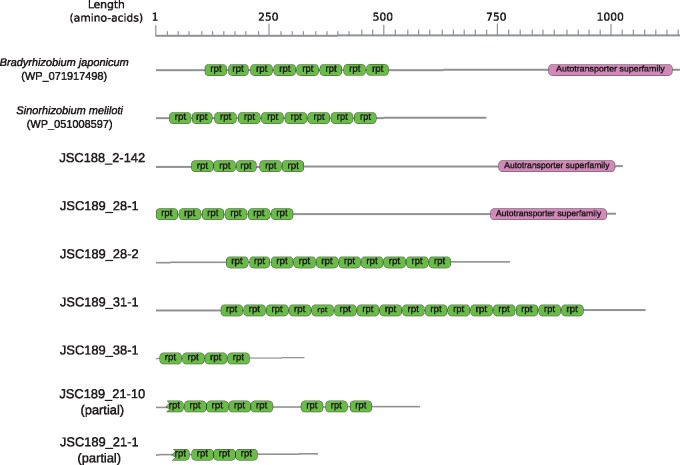
—Autotransporters in the ant-associated Tokpelaia species. Domain organization of the inferred autotransporters in the Dolichoderus spp. symbionts compared with two reference proteins from the Rhizobiales. Green boxes indicate repeated protein domains.

References

    1. Alsmark CM, et al. . 2004. The louse-borne human pathogen Bartonella quintana is a genomic derivative of the zoonotic agent Bartonella henselae. Proc Natl Acad Sci USA. 101:9716–9721. - PMC - PubMed
    1. Altschul SF, Gish W, Miller W, Myers EW, Lipman DJ.. 1990. Basic local alignment search tool. J Mol Biol. 215(3):403–410. - PubMed
    1. Anderson KE, et al. . 2012. Highly similar microbial communities are shared among related and trophically similar ant species. Mol Ecol. 21(9):2282–2296. - PubMed
    1. Baker GC, Smith JJ, Cowan DA.. 2003. Review and re-analysis of domain-specific 16S primers. J Microbiol Methods 55(3):541–555. - PubMed
    1. Bankevich A, et al. . 2012. SPAdes: a new genome assembly algorithm and its applications to single-cell sequencing. J Comput Biol J Comput Mol Cell Biol. 19(5):455–477. - PMC - PubMed

Publication types

LinkOut - more resources