Review
. 2018 Aug 20;44(5):958-965.
doi: 10.1093/schbul/sby096.

CACNA1C: Association With Psychiatric Disorders, Behavior, and Neurogenesis

Affiliations
Review

CACNA1C: Association With Psychiatric Disorders, Behavior, and Neurogenesis

Anna L Moon et al. Schizophr Bull. .

Abstract

Large-scale genome-wide association studies have consistently shown that genetic variation in CACNA1C, a gene that encodes calcium voltage-gated channel subunit alpha1C, increases risk for psychiatric disorders. CACNA1C encodes the Cav1.2 subunit of voltage-gated calcium channels, which themselves have been functionally implicated in a broad spectrum of neuropsychiatric syndromes. Research has concentrated on uncovering the underlying biological mechanisms that could be responsible for this increased risk. This review presents an overview of recent findings regarding Cacna1c variation in animal models, particularly focusing on behavioral phenotypes associated with neurodevelopmental disorders such as cognition, anxiety and depressive phenotypes, and fear conditioning. The impact of reduced gene dosage of Cacna1c on adult hippocampal neurogenesis is also assessed, including new data from a novel Cacna1c+/- rat model.


Figures
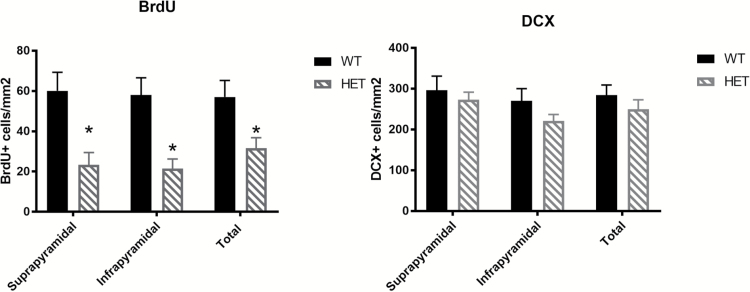
Fig. 1.
Fig. 1.
Cacna1c +/ rats show decreased BrdU, a marker of cell proliferation, in both suprapyramidal and infrapyramidal blades of the dentate gyrus (F = 11.9133, P = .0043, one-way ANOVA). There are no differences in doublecortin positive cells between Cacna1c+/− rats and wild-type littermates. Bars represent normalized mean per mm2 ±SEM, n = 8/genotype, all males.
Fig. 2.
Fig. 2.
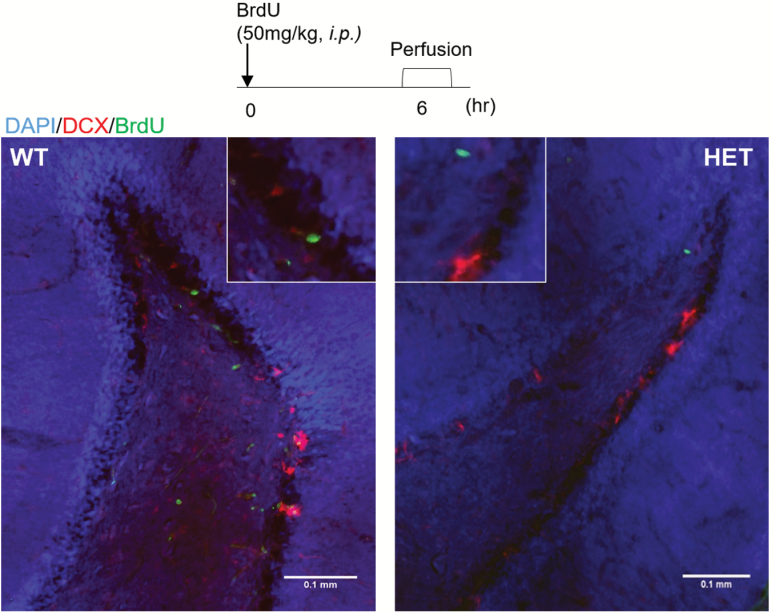
Representative immunofluorescent image of BrdU+ cells (green) and DCX+ cells (red) in the dentate gyrus of the hippocampus. For color, please see the figure online.

References

    1. Sklar P, Smoller JW, Fan J, et al. Whole-genome association study of bipolar disorder. Mol Psychiatry. 2008;13:558–569. - PMC - PubMed
    1. Ferreira MA, O’Donovan MC, Meng YA, et al. ; Wellcome Trust Case Control Consortium. Collaborative genome-wide association analysis supports a role for ANK3 and CACNA1C in bipolar disorder. Nat Genet. 2008;40:1056–1058. - PMC - PubMed
    1. Green EK, Hamshere M, Forty L, et al. ; WTCCC. Replication of bipolar disorder susceptibility alleles and identification of two novel genome-wide significant associations in a new bipolar disorder case–control sample. Mol Psychiatry. 2013;18:1302–1307. - PMC - PubMed
    1. Gonzalez S, Xu C, Ramirez M, et al. Suggestive evidence for association between L-type voltage-gated calcium channel (CACNA1C) gene haplotypes and bipolar disorder in Latinos: a family-based association study. Bipolar Disord. 2013;15:206–214. - PMC - PubMed
    1. Liu Y, Blackwood DH, Caesar S, et al. ; Wellcome Trust Case Control Consortium. Meta-analysis of genome-wide association data of bipolar disorder and major depressive disorder. Mol Psychiatry. 2011;16:2–4. - PMC - PubMed

Publication types

MeSH terms

Substances