. 2011 Apr;14(4):372-387.
doi: 10.1016/j.crci.2010.06.013. Epub 2010 Aug 7.

Synthetic Biology, Tinkering Biology, and Artificial Biology. What are We Learning?

Affiliations

Synthetic Biology, Tinkering Biology, and Artificial Biology. What are We Learning?

Steven A Benner et al. C R Chim. 2011 Apr.

Abstract

While chemical theory cannot yet support an engineering vision that allows molecules, DNA sequences, and proteins to be interchangeable parts in artificial constructs without "tinkering", progress can be made in synthetic biology by pursuing challenges at the limits of existing theory. These force scientists across uncharted terrain where they must address unscripted problems where, if theory is inadequate, failure results. Thus, synthesis drives discovery and paradigm change in ways that analysis cannot. Further, if failures are analyzed, new theories emerge. Here, we illustrate this by synthesizing an artificial genetic system capable of Darwinian evolution, a feature theorized to be universal to life.

Keywords: Mars exploration; Nucleic acids; biobricks; paleogenetics; philosophy of science; synthetic biology; tinkering.


Conflict of interest statement

Statement of conflicts of interest Various authors are inventors on patents covering certain of these technologies.

Figures
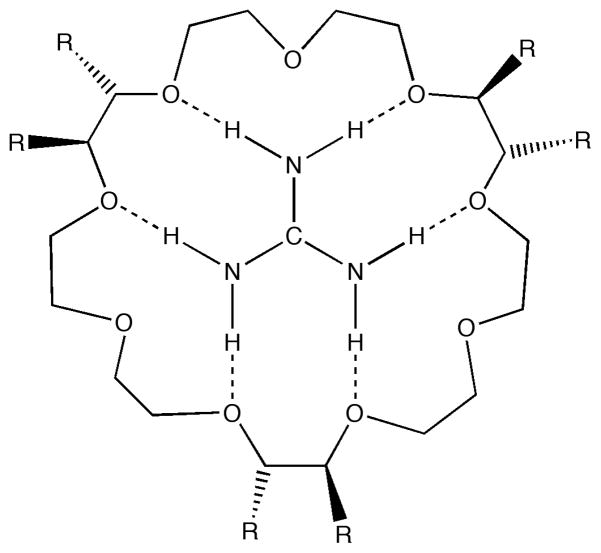
Figure 1
Figure 1
Synthesis in biology was first used to help understand the connection between biomolecular structure and behavior by making unnatural molecules that bind to small molecules. This synthetic receptor was created by Jean Marie Lehn and his colleagues to mimic the ability of natural receptors to bind to small cationic ligands, and was cited in his Nobel Prize lecture.
Figure 2
Figure 2
Four approaches to understand life as a universal.
Figure 3
Figure 3
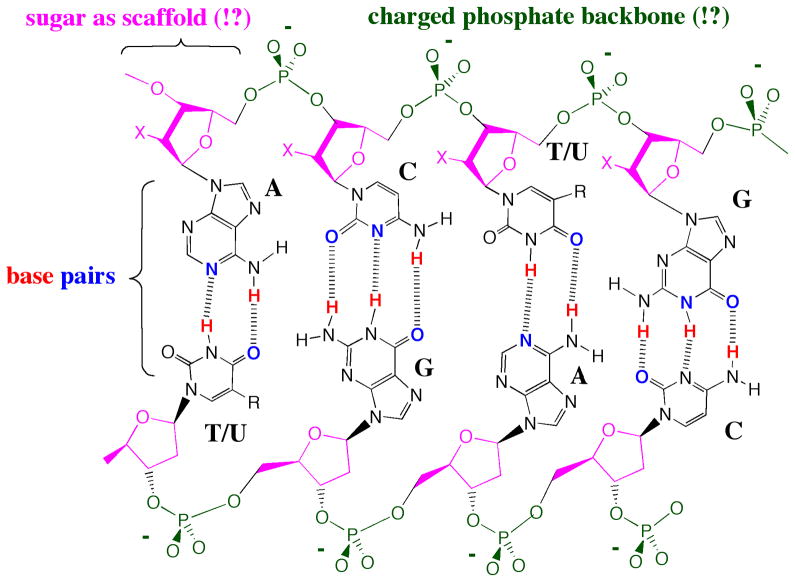
The rules governing the molecular recognition and self-assembly of DNA duplexes are so simple that many are tempted to believe that molecular recognition in chemistry is, in general, similarly simple. Hence, various individuals seek “codes” for protein folding or drug binding.
Figure 4
Figure 4
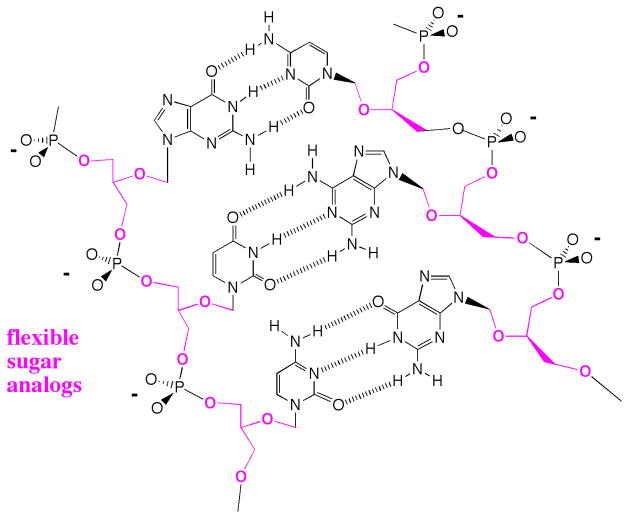
The failure of these flexible glycerol DNA molecules led us to re-evaluate our view of the role of sugars in double helix formation.
Figure 5
Figure 5
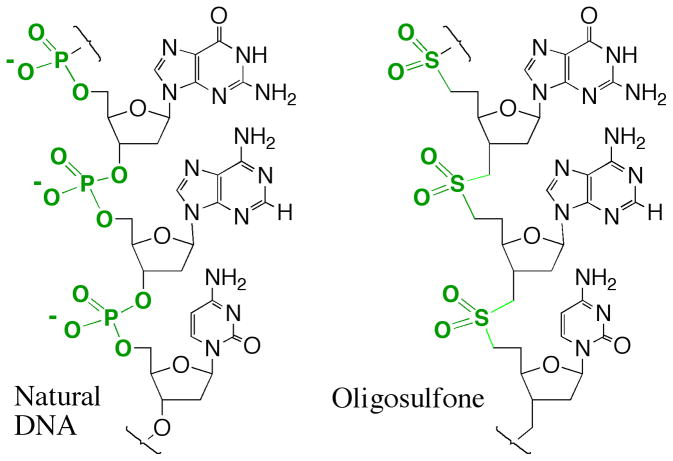
Replacing phosphates (–PO2- units, each having a negative charge, left) in DNA by dimethylenesulfone linkers (the –SO2- units, right, each lacking a negative charge) gave an uncharged analog of DNA. The uncharged analog of RNA was also synthesized.
Figure 6
Figure 6
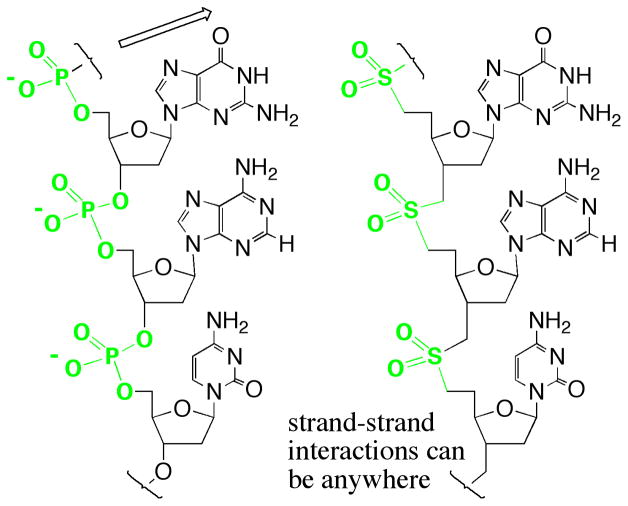
The repeating backbone anion drives the interaction between two strands as far from the backbone as possible. This guides strand-strand interactions, and forms the basis for Watson-Crick pairing rules.
Figure 7
Figure 7
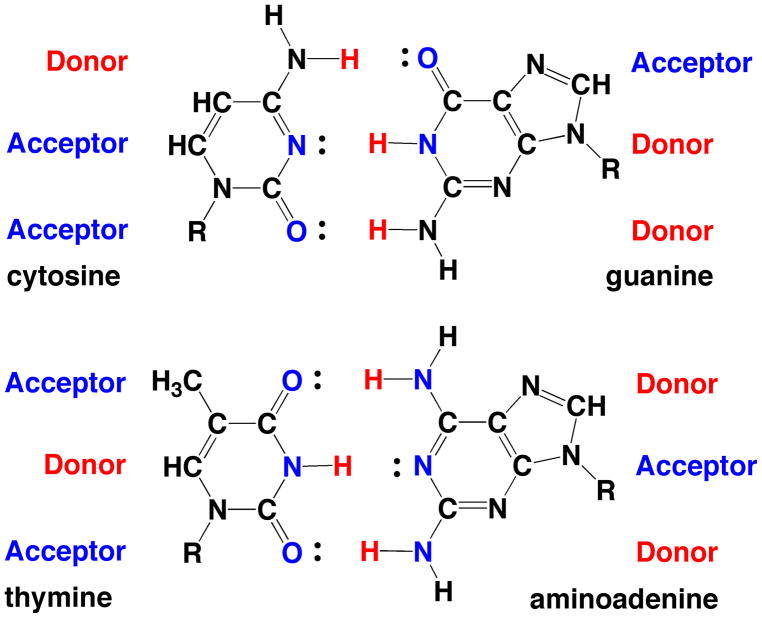
The two standard Watson-Crick pairs, idealized by replacing natural adenine (which lacks the bottom NH2 group) with amino adenine. The
Figure 8
Figure 8
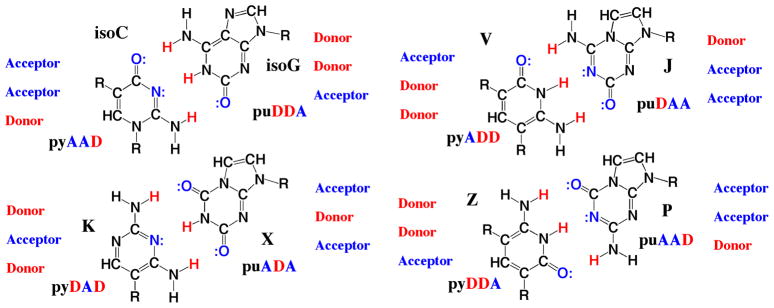
Shuffling hydrogen bond donor and acceptor groups in the standard nucleobase pairs generated eight additional heterocycles that, according to simple theory, should form four new, mutually independent, base pairs. This is called an “artificially expanded genetic information system” (AEGIS). Could molecular behavior at the center of genetics and Darwinian Evolution be so simple? Synthesis was used to decide.
Figure 9
Figure 9
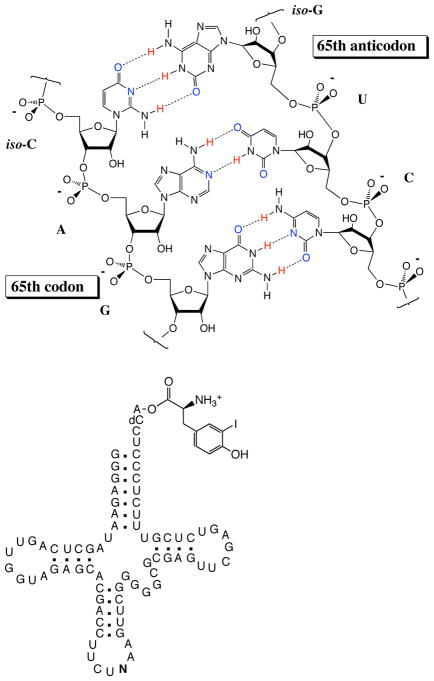
Putting a synthetic base into a messenger RNA, and providing a transfer RNA having the complementary non-standard base in the anticodon loop (the “N”) allowed the incorporation of a 21st amino acid (here, iodotyrosine) into a protein.
Figure 10
Figure 10
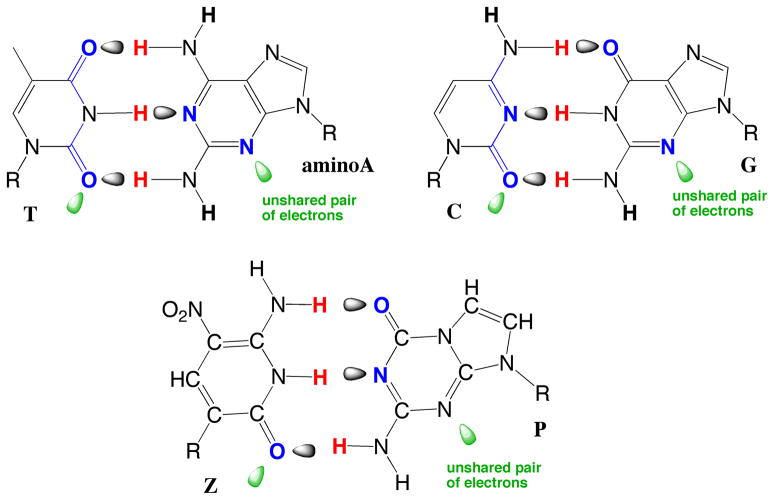
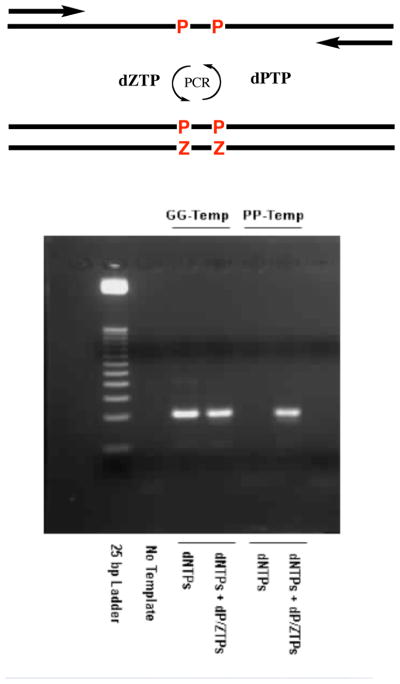
The Z and P pairs that have been incorporated into six letter PCR, with mechanistic studies that show that this six letter synthetic genetic system can support Darwinian evolution. Key to meeting this challenge was to make a small accommodation to the desire of natural DNA polymerases to have nucleobases that present electron density (the green lobes) to the minor groove (down, in this structure) of the double helix. This is the case for T, A (shown here with an extra NH2 unit), C, and G (top). It is also the case with the Z and P synthetic nucleobases (bottom).
Figure 11
Figure 11
The polymerase chain reaction with a six-letter genetic alphabet, incorporating P and Z in addition to A, T, G, and C.
Figure 12
Figure 12
A Venn diagram illustrating the hazards of synthetic biology. The green circle contains systems able to evolve. Those outside the circle cannot, and present no more hazard than a toxic chemical. The blue circle contains systems that are self-sustaining. Those inside the circle “live” without continuing human intervention; those outside require continuous feeding, and are no more hazardous than a pathogen that dies when released from a laboratory. Systems within the red circle use standard terran molecular biology; those outside do not. The greatest chance for hazard comes from a system that is self-sustaining, uses standard biochemistry, and is capable of evolving, the intersection between the three circles.

References

    1. Hawking S. The Universe in a Nutshell. Bantam Spectra; New York: 2009.
    1. Szybalski W. In: Control of Gene Expression. Kohn A, Shatkay A, editors. 23–24. Plenum Press; New York: 1974. pp. 404–405.pp. 411–412.pp. 415–417.
    1. Adleman LM. Science. 1994;266:1021–1024. - PubMed
    1. Regis E. What is Life? Investigating the Nature of Life in the Age of Synthetic Biology. Oxford University Press; Oxford, UK: 2009.
    1. Anonymous. The Economist. 2010 May 20; http://www.economist.com/displaystory.cfm?story_id=16163006.

LinkOut - more resources