. 2018 Jun 26:11:179.
doi: 10.1186/s13068-018-1169-x. eCollection 2018.

Molecular characterization of a novel chitinase Cm Chi1 from Chitinolyticbacter meiyuanensis SYBC-H1 and its use in N-acetyl-d-glucosamine production

Affiliations

Molecular characterization of a novel chitinase Cm Chi1 from Chitinolyticbacter meiyuanensis SYBC-H1 and its use in N-acetyl-d-glucosamine production

Alei Zhang et al. Biotechnol Biofuels. .

Abstract

Background: N-acetyl-d-glucosamine (GlcNAc) possesses many bioactivities that have been used widely in many fields. The enzymatic production of GlcNAc is eco-friendly, with high yields and a mild production process compared with the traditional chemical process. Therefore, it is crucial to discover a better chitinase for GlcNAc production from chitin.

Results: A novel chitinase gene (Cmchi1) cloned from Chitinolyticbacter meiyuanensis SYBC-H1 and expressed in Escherichia coli BL21(DE3) cells. The recombinant enzyme (CmChi1) contains a glycosyl hydrolase family 18 catalytic module that shows low identity (12-27%) with the corresponding domain of the well-characterized chitinases. CmChi1 was purified with a recovery yield of 89% by colloidal chitin affinity chromatography, whereupon it had a specific activity of up to 15.3 U/mg. CmChi1 had an approximate molecular mass of 70 kDa after the sodium dodecyl sulfate-polyacrylamide gel electrophoresis, and its optimum activity for colloidal chitin (CC) hydrolysis occurred at pH 5.2 and 50 °C. Furthermore, CmChi1 exhibited kcat/Km values of 7.8 ± 0.11 mL/s/mg and 239.1 ± 2.6 mL/s/μmol toward CC and 4-nitrophenol N,N'-diacetyl-β-d-chitobioside [p-NP-(GlcNAc)2], respectively. Analysis of the hydrolysis products revealed that CmChi1 exhibits exo-acting, endo-acting and N-acetyl-β-d-glucosaminidase activities toward N-acetyl chitooligosaccharides (N-acetyl CHOS) and CC substrates, behavior that makes it different from typical reported chitinases. As a result, GlcNAc could be produced by hydrolyzing CC using recombinant CmChi1 alone with a yield of nearly 100% and separated simply from the hydrolysate with a high purity of 98%.

Conclusion: The hydrolytic properties and good environmental adaptions indicate that CmChi1 has excellent potential in commercial GlcNAc production. This is the first report on exo-acting, endo-acting and N-acetyl-β-d-glucosaminidase activities from Chitinolyticbacter species.

Keywords: Chitinase; Chitinolyticbacter meiyuanensis SYBC-H1; Colloidal chitin; Multi-functional; N-acetyl-d-glucosamine.


Figures
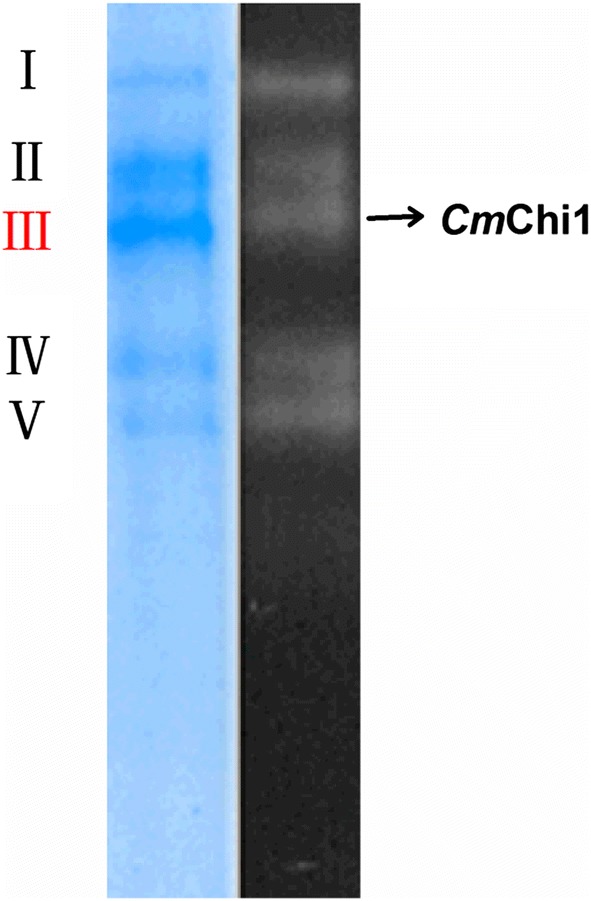
Fig. 1
Fig. 1
The native PAGE and zymogram analysis of all chitinases purified from C. meiyuanensis SYBC-H1 cells using chitinase–glycogen complex precipitation method. The amount of protein applied to the gel is 10 μg. The gel slice on the left is the coomassie stained one and that on the right is the zymogram. Five proteins [I, II, III (CmChi1), IV and V] with chitinase activity were purified using chitinase–glycogen complex precipitation followed by autodigestion of the complex
Fig. 2
Fig. 2
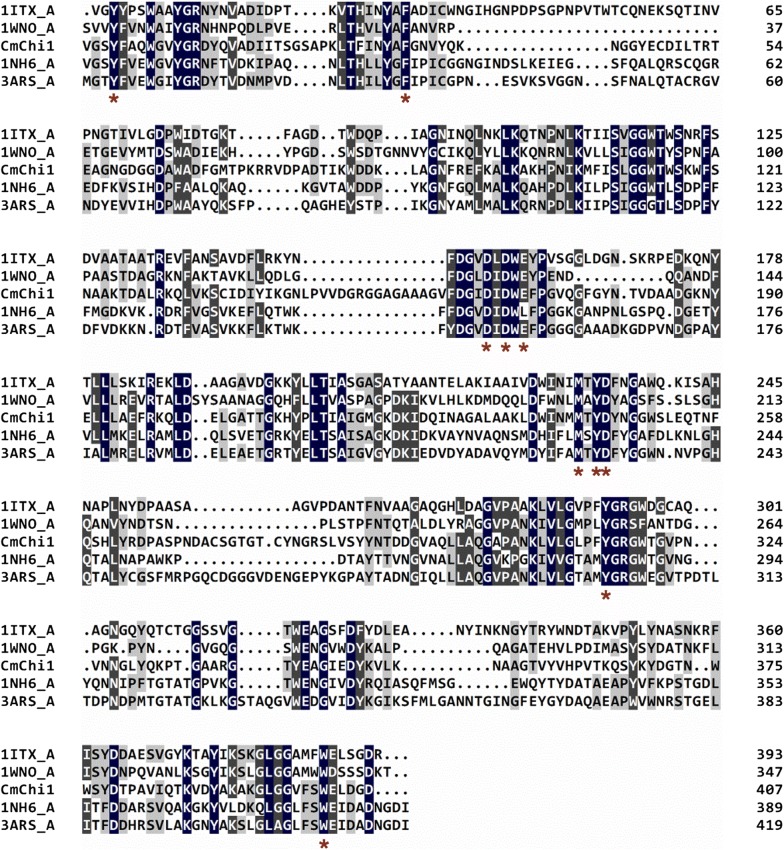
Multiple alignments of the amino acid sequences of GH18 catalytic domain in CmChi1 and related GH18 family chitinases. The other listed sequences included the chitinases from Bacillus circulans Wl-12 (PDB No. 1ITX), Serratia marcescens ATCC990 (PDB No.1NH6), Vibrio harveyi (PDB No. 3ARS) and Aspergillus fumigatus Yj-407 (PDB No. 1WNO). Gray represents conserved residues between sequences. The red asterisks represent the conserved catalytic active sites. The numbers on the right are the positions of the first amino acid residue in the whole sequence
Fig. 3
Fig. 3
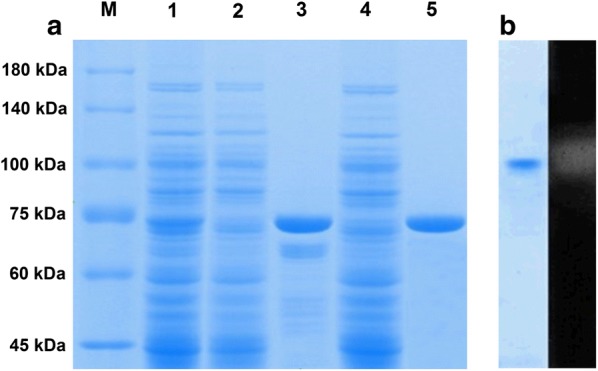
Polyacrylamide gel electrophoresis (PAGE) analysis of chitinases from C. meiyuanensis SYBC-H1 and recombinant E. coli BL21(DE3). a SDS-PAGE analysis of the expression and purification of recombinant CmChi1. The amount of protein applied to the gel is 10 μg Lane M, protein molecular mass markers; lane 1, total protein of recombinant Escherichia coli BL21(DE3); lane 2, extract of a 50-mM imidazole eluted sample from a Ni–NTA column; lane 3, extract of a 200-mM imidazole eluted sample from a Ni–NTA column; lane 4, eluted sample using 1 M NaCl from the complex containing CC and CmChi1; lane 5, digestion extract without reducing sugar from the complex containing CC and CmChi1. b Zymogram analysis of purified recombinant CmChi1 by a native PAGE. The left gel slice is the coomassie stained one and that on the right is the zymogram. The zymogram assay was conducted in 50 mM sodium citrate buffer (pH 5.2) containing 0.5 mM 4-methylumbelliferyl N,N′-diacetyl-β-d-chitobioside (4-MU-[GlcNAc]2) at 37 °C for 30 min, then placed at 340 nm for showing fluorescence
Fig. 4
Fig. 4
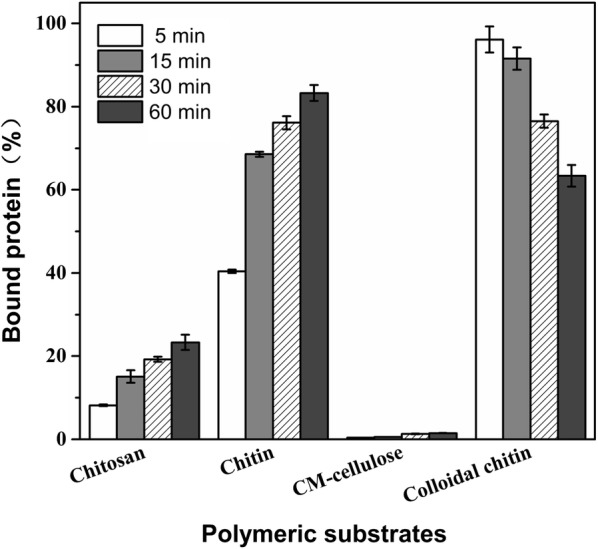
Affinity of the purified CmChi1 for polysaccharides. The reaction mixture of 2-mL contained 150 μg of CmChi1 and 1 g/L of one of the polymeric substrates in 50 mM sodium citrate buffer couple with 0.5 M NaCl (pH 5.2). The affinity mixture was incubated at 4 °C with rotary shaking at 1000 rpm. Samples from different time intervals were immediately centrifuged, and the unabsorbed protein in the supernatant was measured. The adsorbed protein was calculated as the amount of protein in the control minus that in the supernatant. All experiments were performed in triplicate
Fig. 5
Fig. 5
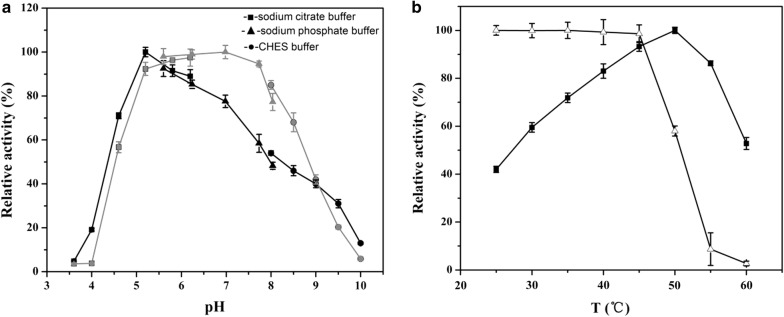
Effect of pH and temperature on the activity and stability of CmChi1. a Optimal pH and pH stability of the recombinant CmChi1. The optimal pH was determined in 50 mM solutions of various buffers within the pH range 3.5–10.0 (black line). To determine pH stability, the enzyme was incubated at 45 °C for 2 h with various pH buffers (gray line), and the residual activities were measured. b Optimal temperature and thermal stability of the recombinant CmChi1. The temperature optimum was determined at different temperatures (25–60 °C) in 50 mM sodium citrate (pH 5.2) (solid squares). To determine the thermostability, the residual activity was measured in 50 mM sodium citrate (pH 5.2) after the enzyme was treated for 2 h at different temperatures (open triangles)
Fig. 6
Fig. 6
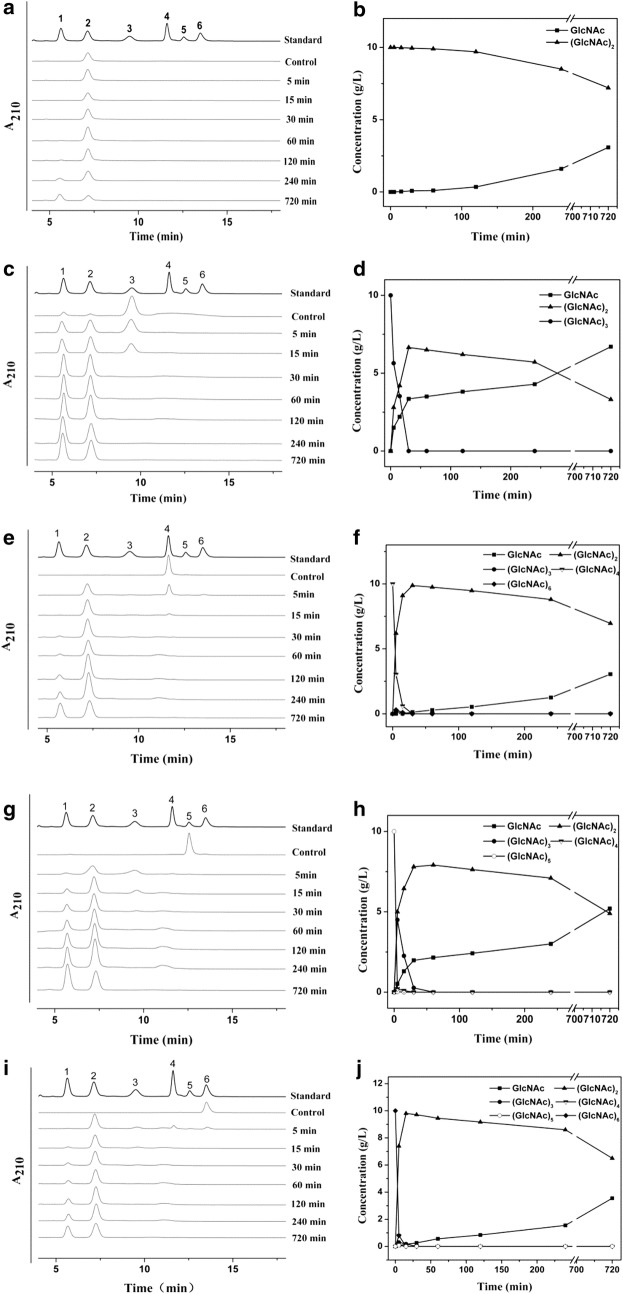
Cleavage pattern of (GlcNAc)2–6 by CmChi1. Numbers 1–6 represent GlcNAc to (GlcNAc)6. a, c, e, g, i show the hydrolysis products from (GlcNAc)2–6 using HPLC, respectively. b, d, f, h, j show the concentrations of CHOS products generated during the reaction time course from (GlcNAc)2–6, respectively
Fig. 7
Fig. 7
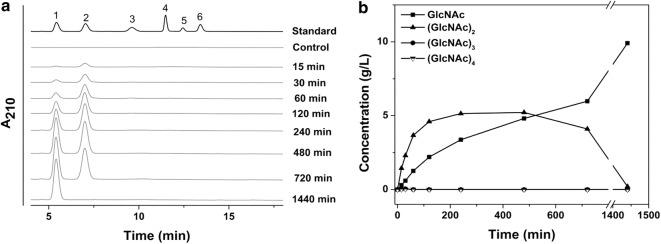
Hydrolysis of CC by CmChi1. The reactions contained 50 μg CmChi1 and 1% (w/v) CC, and were performed in sodium citrate buffer (pH 5.2) at 50 °C, and aliquots were withdrawn at different time intervals and analyzed by HPLC. Numbers 1–6 represent GlcNAc to (GlcNAc)6. a HPLC profiles of reaction products from CC. b The time courses of products generated from CC. Products were quantified from the respective areas using standard curves of (GlcNAc)1–6

References

    1. Kaur S, Dhillon GS. Recent trends in biological extraction of chitin from marine shell wastes: a review. Crit Rev Biotechnol. 2015;35(1):44–61. doi: 10.3109/07388551.2013.798256. - DOI - PubMed
    1. Yan N, Chen X. Don’t waste seafood waste. Nature. 2015;524(7564):155–157. doi: 10.1038/524155a. - DOI - PubMed
    1. Chen J-K, Shen C-R, Liu C-L. N-acetylglucosamine: production and applications. Mar Drug. 2010;8(9):2493–2516. doi: 10.3390/md8092493. - DOI - PMC - PubMed
    1. Husson E, Hadad C, Huet G, Laclef S, Lesur D, Lambertyn V, Jamali A, Gottis S, Sarazin C, Van Nhien AN. The effect of room temperature ionic liquids on the selective biocatalytic hydrolysis of chitin via sequential or simultaneous strategies. Green Chem. 2017;19(17):4122–4131. doi: 10.1039/C7GC01471F. - DOI
    1. Bobbink FD, Zhang J, Pierson Y, Chen X, Yan N. Conversion of chitin derived N-acetyl-d-glucosamine (NAG) into polyols over transition metal catalysts and hydrogen in water. Green Chem. 2015;17(2):1024–1031. doi: 10.1039/C4GC01631A. - DOI