


Presentation of the Molecular Subtypes of Breast Cancer Detected By Immunohistochemistry in Surgically Treated Patients
- PMID: 29983785
- PMCID: PMC6026408
- DOI: 10.3889/oamjms.2018.231
Presentation of the Molecular Subtypes of Breast Cancer Detected By Immunohistochemistry in Surgically Treated Patients
Abstract
Introduction: The detection of estrogen, progesterone and HER-2 neu receptors on the surface of the tumour cell is a significant prognostic factor, alone or in combination. The presence or absence of receptors on the surface of the tumour cell is associated with the conditional gene expression in the tumour cell itself. Based on these genetically determined expressions of the tumour cell, five molecular subtypes of breast cancer have been classified on the St. Gallen International Expert Consensus in 2011 that can be immunohistochemically detected, with each subtype manifesting certain prognosis and aggression.
Aim: Analyzing the presentation of molecular subtypes of breast cancer that are immunohistochemically detected in surgically treated patients at the Clinic for Thoracic and Vascular Surgery.
Material and methods: We used the international classification on molecular subtypes of breast cancer which divides them into: Luminal A (ER+ and/or PR+, HER-2 negative, Ki-67 < 14%), Luminal B with HER-2 negative (ER+ and/or PR+, HER-2 negative, Ki-67 ≥ 14%), Luminal B with HER-2 positive (ER+ and/or PR+, HER-2+, any Ki-67), HER-2 enriched (ER-, PR-, HER-2+), and basal-like (triple negative) (ER-, PR-, HER-2 negative, CK5/6+ and/or EGFR+). A total of 290 patients, surgically treated for breast cancer, were analysed during 2014.
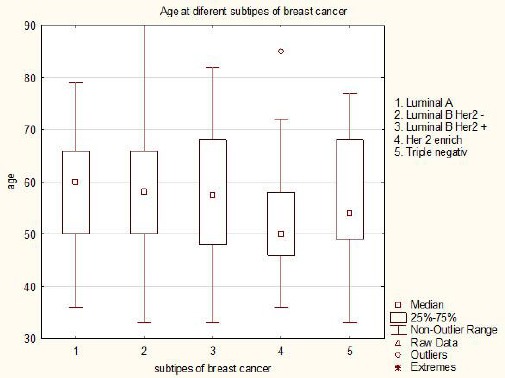
Results: In our analysis, we found that Luminal A was present in 77 (26.55%) patients, Luminal B HER-2 negative was present in 91 (31.38%) patients, Luminal B HER-2 positive was present in 70 (24.14%) patients, HER-2 enriched was present in 25 (8.62%) patients and basal-like (or triple negative) was present in 27 (9.31%) patients.
Conclusion: Detecting the subtype of breast cancer is important for evaluating the prognosis of the disease, but also for determining and providing an adequate therapy. Therefore, determining the subtype of breast cancer is necessary for the routine histopathological assay.
Keywords: HER-2 enriched; Luminal A; Luminal B HER-2 negative; Luminal B HER-2 positive; Subtypes of breast cancer; Triple-negative.
Figures
References
-
- Justo N, Wilking N, Jönsson B, Luciani S, Cazap E. A Review of Breast Cancer Care and Outcomes in Latin America. Oncologist. 2013;18(3):248–256. https://doi.org/10.1634/theoncologist.2012-0373 PMid:23442305 PMCid: PMC3607519. - PMC - PubMed
-
- Bhikoo R, Srinivasa S, Tzu-Chieh Yu, Moss D, Hill G A. Systematic Review of Breast Cancer Biology in Developing Countries (Part 1): Africa, the Middle East, Eastern Europe, Mexico, the Caribbean and South America. Cancers (Basel) 2011;3(2):2358–2381. https://doi.org/10.3390/cancers3022358 PMid:24212814 PMCid: PMC3757422. - PMC - PubMed
-
- Ghoncheh M, Pournamdar Z, Salehiniya H. Incidence and Mortality and Epidemiology of Breast Cancer in the World. Asian Pac J Cancer Prev. 2016;17(Spec No):43–6. - PubMed
-
- Global cancer observatory. www.gco.iarc.fr.
-
- Prat A, Pineda E, Adamo B, Galván P, Fernández A, Gaba L, Díez M, Viladot M, Arance A, Mu-oz M. Clinical implications of the intrinsic molecular subtypes of breast cancer. Breast. 2015;24(Suppl 2):S26–35. https://doi.org/10.1016/j.breast.2015.07.008 PMid:26253814. - PubMed
LinkOut - more resources
Full Text Sources
Other Literature Sources
Research Materials
Miscellaneous