Review
. 2018 Jul 1;7(7):209-231.
doi: 10.1089/wound.2017.0761.

Immune Regulation of Skin Wound Healing: Mechanisms and Novel Therapeutic Targets

Affiliations
Review

Immune Regulation of Skin Wound Healing: Mechanisms and Novel Therapeutic Targets

Jacqueline Larouche et al. Adv Wound Care (New Rochelle). .

Abstract

Significance: The immune system plays a central role in orchestrating the tissue healing process. Hence, controlling the immune system to promote tissue repair and regeneration is an attractive approach when designing regenerative strategies. This review discusses the pathophysiology of both acute and chronic wounds and possible strategies to control the immune system to accelerate chronic wound closure and promote skin regeneration (scar-less healing) of acute wounds. Recent Advances: Recent studies have revealed the key roles of various immune cells and immune mediators in skin repair. Thus, immune components have been targeted to promote chronic wound repair or skin regeneration and several growth factors, cytokines, and biomaterials have shown promising results in animal models. However, these novel strategies are often struggling to meet efficacy standards in clinical trials, partly due to inadequate drug delivery systems and safety concerns. Critical Issues: Excess inflammation is a major culprit in the dysregulation of normal wound healing, and further limiting inflammation effectively reduces scarring. However, current knowledge is insufficient to efficiently control inflammation and specific immune cells. This is further complicated by inadequate drug delivery methods. Future Directions: Improving our understanding of the molecular pathways through which the immune system controls the wound healing process could facilitate the design of novel regenerative therapies. Additionally, better delivery systems may make current and future therapies more effective. To promote the entry of current regenerative strategies into clinical trials, more evidence on their safety, efficacy, and cost-effectiveness is also needed.

Keywords: biomaterials; chronic wounds; immune system; immunomodulation; scarring; therapeutics.


Figures

None
Mikaël M. Martino, PhD
<b>Figure 1.</b>
Figure 1.
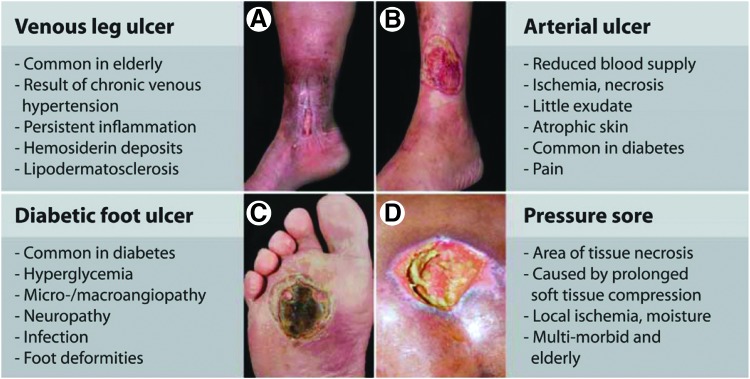
Clinical presentations of various chronic wound pathologies. Impaired wound healing cascade will lead to the development of nonhealing wound pathologies such as: (A) venous leg ulcer (B) arterial ulcer (C) diabetic foot ulcer (D) pressure sore. Reprinted with adaptation with permission from Ref. ©AAAS Publishing Group.
<b>Figure 2.</b>
Figure 2.
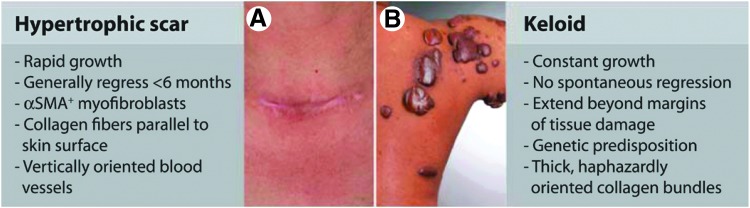
Clinical examples of scarring pathologies. (A) Hypertrophic scar (B) Keloid. Reprinted with adaptation with permission from Ref. ©AAAS Publishing Group.
<b>Figure 3.</b>
Figure 3.
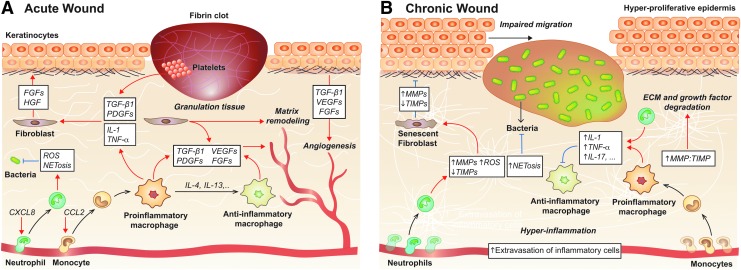
Overview of the immune mechanisms in acute and chronic wound healing. (A) Acute wound healing results from a well-coordinated series of events divided into four overlapping phases: hemostasis, inflammation, proliferation/matrix deposition, and tissue remodeling. Neutrophils and macrophages are particularly important in mediating this process, though T cells and platelets also play key roles. (B) High numbers of inflammatory cells and the formation of a biofilm preclude the restoration of tissue homeostasis in chronic wounds. Excess secretion of inflammatory mediators leads to growth factor and ECM degradation and prevents macrophage phenotype conversion, which creates a feed-forward loop preventing resolution. Black arrows indicate differentiation, blue arrows indicate inhibition and red arrows indicate induction. CXCL, C-X-C chemokine ligand; ECM, extracellular matrix; FGF, fibroblast growth factor; IL, interleukin; MMP, matrix metalloproteinase; NET, neutrophil extracellular trap; ROS, reactive oxygen species; TGF, transforming growth factor; TIMP, tissue inhibitor of matrix metalloproteinase; TNF, tumor necrosis factor.
<b>Figure 4.</b>
Figure 4.
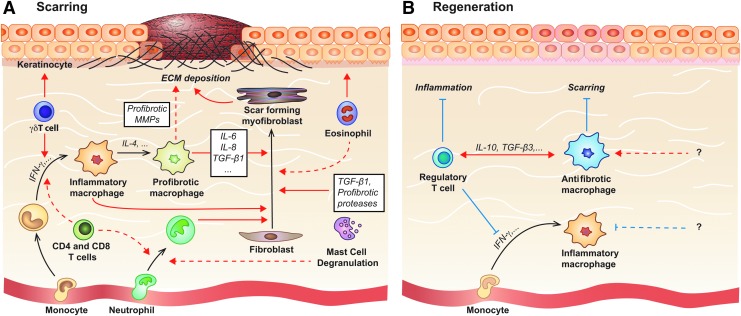
Molecular and cellular mechanisms involved in scar formation and dermal regeneration. (A) Immune cells act along numerous, redundant pathways to promote excess ECM deposition and hyperproliferation of keratinocytes, leading to scar formation. Key immune cell types involved in pathologic scar formation include macrophages, mast cells, neutrophils, eosinophils, and T cells. (B) Dermal regeneration is improved by generally decreasing innate and adaptive immune cell recruitment and activation, and encouraging antifibrotic macrophage polarization (e.g. via IL-10). Pathways that induce antifibrotic macrophage polarization in vivo are still very elusive, though research on other tissues suggests that Tregs may help promote antifibrotic macrophage polarization and suppress proinflammatory immune responses. Black arrows indicate differentiation, blue arrows indicate inhibition and red arrows indicate induction. IFN, interferon Treg, regulatory T cells.
<b>Figure 5.</b>
Figure 5.
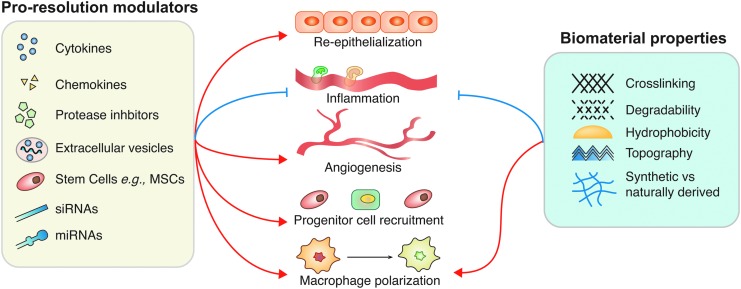
Biomaterial and molecular-based strategies to resolve chronic wounds principally focus on promoting reepithelialization, angiogenesis, progenitor cell recruitment, directing macrophage polarization, and inhibiting the migration of excess inflammatory cells. Current strategies are very diverse, either directly delivering cytokines and growth factors to the wound, or by using siRNAs, miRNAs, stem cells, and EVs to alter cytokine expression and production by cells in the wound bed. Material-based strategies are also being explored, particularly for their potential to direct macrophage polarization. Blue arrows indicate inhibition and red arrows indicate induction. EV, extracellular vesicle; siRNA, small interfering RNA.
<b>Figure 6.</b>
Figure 6.
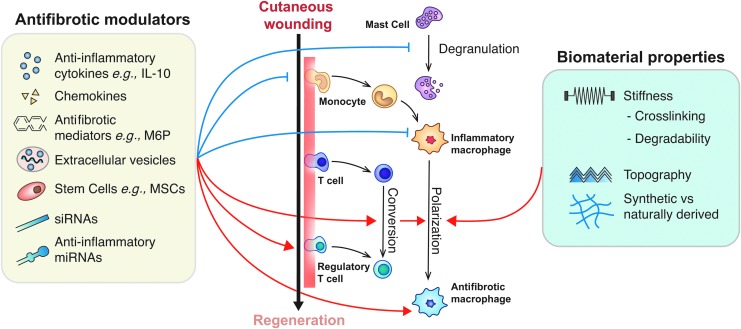
Therapeutic strategies for cutaneous wound regeneration that are targeting the immune system. Therapeutics for scar prevention should, in general, promote antifibrotic macrophage polarization, and prevent mast cell degranulation and inflammatory macrophage polarization/recruitment. Pending future studies confirming the role of Tregs in skin regeneration, therapeutics should also promote their recruitment. This is currently being done via delivery of cytokines, chemokines, other antifibrotic mediators, and stem cells, though delivering siRNA, miRNA, and EVs may also be promising. Biomaterials present a promising means of delivering antifibrotic modulators, and their properties can also encourage macrophage polarization. Black arrows indicate differentiation, blue arrows indicate inhibition, and red arrows indicate induction. M6P, mannose-6-phosphate.

References

    1. Sen CK, Gordillo GM, Roy S, et al. . Human skin wounds: a major and snowballing threat to public health and the economy. Wound Repair Regen 2010;17:763–771 - PMC - PubMed
    1. Weiser TG, Regenbogen SE, Thompson KD, et al. . An estimation of the global volume of surgery: a modelling strategy based on available data. Lancet 2008;372:139–144 - PubMed
    1. Julier Z, Park AJ, Briquez PS, Martino MM. Promoting tissue regeneration by modulating the immune system. Acta Biomater 2017;53:13–28 - PubMed
    1. Eming SA, Martin P, Tomic-Canic M. Wound repair and regeneration: mechanisms, signalling, and translation. Wound Healing 2014;6:265sr6 - PMC - PubMed
    1. Ramos-Torrecillas J, Garcia-Martinez O, De Luna-Bertos E, Ocana-Peinado FM, Ruiz C. Effectiveness of platelet-rich plasma and hyaluronic acid for the treatment and care of pressure ulcers. Biol Res Nurs 2015;17:152–158 - PubMed